
Jonathan Cohen's photos with the keyword: Great Russell Street
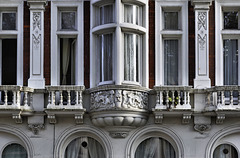
Great Russell Mansions – Great Russell Street, Blo…

A Pediment to Learning – The British Museum, Great…
| 30 Oct 2016 |
|
Pediments were a common feature in ancient Greek architecture. They were usually triangle-shaped and sat on the top of buildings such as temples. They would be decorated with sculptures and reliefs, which reflected the purpose of the building. The pediment above the Museum’s South entrance was built in the 1850s. It is decorated with sculptures, which illustrate what 19th -century visitors would have found inside the Museum. The original pediment had a Wedgewood blue background and the statues were all painted white.
The core Museum building was designed by Robert Smirke in 1823 in Greek Revival style. This emulated the architecture of ancient Greece, and so the building has Greek features including the pediment and columns at the South entrance. The sculptures in the pediment were designed by Sir Richard Westmacott. They follow the grand theme of the Progress of Civilization (as envisioned, of course, by our Victorian ancestors in decidedly masculine terms).
As you look at the pediment, the left hand side shows the creation of man as he emerges from a rock as an ignorant being. He meets the next character, the Angel of Enlightenment who is holding the Lamp of Knowledge. From this man learns basic skills, such as cultivating land and taming animals. The next step in the progress of civilization is for man to expand his knowledge and understanding. The next eight figures represent the subjects he must learn to do this. From left to right they are architecture and sculpture; painting and science; geometry and drama; music and poetry. (I must add that my recollection of high school does not equip me to see the relationship of geometry to drama). These subjects were all covered in the Museum’s early collection and it was this knowledge which could help to educate man. The final human figure, on the right hand side, represents educated man. Having expanded his knowledge, man can now dominate the world around him.
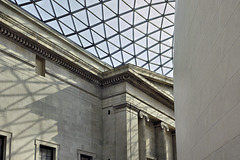
The Great Court – British Museum, Bloomsbury, Lond…
| 23 Oct 2016 |
|
Designed by Foster and Partners, the Queen Elizabeth II Great Court transformed the Museum’s inner courtyard into the largest covered public square in Europe. It is a two-acre space enclosed by a spectacular glass roof with the world-famous Reading Room at its centre. In the original Robert Smirke design the courtyard was meant to be a garden. However, in 1852–7 the Reading Room and a number of bookstacks were built in the courtyard to house the library department of the Museum and the space was lost.
In 1997, the Museum’s library department was relocated to the new British Library building in St Pancras and there was an opportunity to re-open the space to public. The Great Court was opened on 6 December 2000 by Her Majesty the Queen.
The design of the Great Court was loosely based on Foster’s concept for the roof of the Reichstag in Berlin, Germany. A key aspect of the design was that with every step in the Great Court the vista changed and allowed the visitor a new view on their surroundings. Work on the Great Court's magnificent glass and steel roof began in September 1999. It was constructed out of 3,312 panes of glass, no two of which are the same. At two acres, the Great Court increased public space in the Museum by forty per cent, allowing visitors to move freely around the main floor for the first time in 150 years.
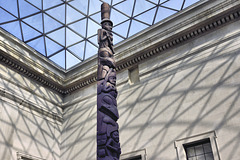
Kayung Totem Pole – British Museum, Bloomsbury, Lo…
| 23 Oct 2016 |
|
The Kayung totem pole is a 12-metre (39 ft) totem pole made by the Haida people. Carved and originally located in the village of Kayung on Graham Island in British Columbia, it dates from around 1850. Before being sold to collectors, the pole was located in a village called Kayung on Graham Island in British Columbia’s Haida Gwaii archipelago. Kayung had been an important village for the Haida before European contact. After the population was decimated by successive smallpox epidemics in the late 1800s, Henry Wiah, the town chief, encouraged the remaining population to move to nearby Masset.
A Peek at the Reading Room – British Museum, Bloom…
| 23 Oct 2016 |
|
|
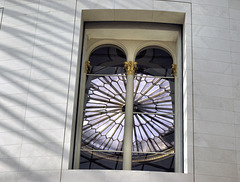
The Reading Room stands at the heart of the Museum, in the centre of the Great Court. Completed in 1857, it was hailed as one of the great sights of London and became a world famous centre of learning.
By the early 1850s the British Museum Library badly needed a larger reading room. Antonio Panizzi, the Keeper of Printed Books (1837–56), had the idea of constructing a round room in the empty central courtyard of the Museum building. With a design by Sydney Smirke (1798–1877), work on the Reading Room began in 1854. Three years later it was completed. Using cast iron, concrete, glass and the latest heating and ventilation systems, it was a masterpiece of mid-nineteenth century technology. The room had a diameter of 140 feet (approximately 42.6m) and was inspired by the domed Pantheon in Rome. However, it is not a free standing dome in the technical sense. It has been constructed in segments on a cast iron framework. The ceiling is suspended on cast iron struts hanging down from the frame and is made out of papier mache. A number of bookstacks were built surrounding the new Reading Room. They were made of iron to take the weight of the books and protect them against fire. In all they contained three miles (4.8 kilometres) of bookcases and twenty-five miles (forty kilometres) of shelves.
The Reading Room opened on 2 May 1857. Between 8–16 May, the library was opened up for a special one-off public viewing. Over 62,000 visitors came to marvel at the new building. Those wanting to use it had to apply in writing and were issued a reader’s ticket by the Principal Librarian. Among those granted tickets were: Karl Marx, Lenin (who signed in under the name Jacob Richter) and novelists such as Bram Stoker and Sir Arthur Conan Doyle.
The Reading Room is currently closed.
Jump to top
RSS feed- Jonathan Cohen's latest photos with "Great Russell Street" - Photos
- ipernity © 2007-2026
- Help & Contact
|
Club news
|
About ipernity
|
History |
ipernity Club & Prices |
Guide of good conduct
Donate | Group guidelines | Privacy policy | Terms of use | Statutes | In memoria -
Facebook
X
