

Jonathan Cohen's photos with the keyword: Beacon Hill
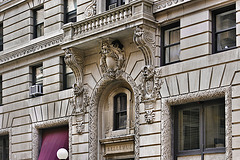
Former Hotel Bellevue #1 – 21 Beacon Street, Bosto…
| 12 Nov 2011 |
|
Built in 1899 as the Hotel Bellevue and is now an elegant residential condo building.
The Bellevue Hotel and the adjacent apartment building at 122 Bowdoin Street served as John Kennedy’s residences when he moved to Boston to run for the U.S. Congress in 1946 under the slogan of "The New Generation Offers a Leader." The future president initially lived at the Bellevue, where his grandfather John F. Fitzgerald, former Boston Mayor and U.S. Congressman, was spending his retirement years.
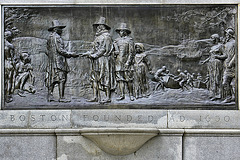
300th Anniversary Monument – Boston Common, Boston…
| 16 Nov 2011 |
|
In Boston, on the edge of Boston Common and along Beacon Street, is a large stone monument at an entrance to the Common. This monument celebrates the 300th Anniversary of the founding of the City of Boston.
Inscribed on the Beacon Street side of the monument are three texts, one of which is the famous declaration of John Winthrop, the governor of the Massachusetts Bay Colony, spoken on board the Arbella just before the city was founded:
"For wee must consider that wee shall be as a citty on a hill the lies of all people are uppon us so that if wee shall deale falsely with our God in this worke we have undertaken … wee shall be made a story and a by-word through the world."
On the Common side, there is one phrase, "Boston Founded AD 1630" as well as a basin in the stone that indicate that it probably was a fountain at one time. Immediately above the basin is a bronze relief sculpture done by John Francis Palermino. It depicts two men about to shake hands, with other settlers nearby. The man on the left represents William Blackstone and behind him are Native Americans. These represent those who had lived on the Shawmut Peninsula – the core piece of land that would become the city of Boston – before the newcomers arrived, represented by the man and the line of people to the right. Boston Harbour and the buildings of Charlestown (founded two years earlier) are in the background, along with a ship floating in the harbour. There are hills in the far background.
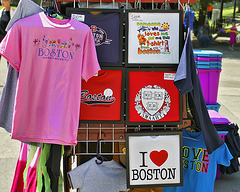
Un-Commons T-Shirts – Tremont Street, Boston, Mass…
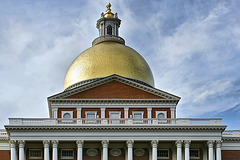
The State House Dome – Beacon Street, Boston, Mass…
King's Chapel – Boston, Massachusetts
The Massachusetts State House – Viewed from Bowdoi…
Former Hotel Bellevue #2 – 21 Beacon Street, Bosto…
| 12 Nov 2011 |
|
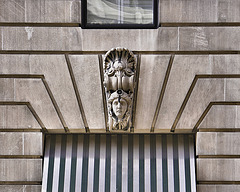
Built in 1899 as the Hotel Bellevue and is now an elegant residential condo building.
The Bellevue Hotel and the adjacent apartment building at 122 Bowdoin Street served as John Kennedy’s residences when he moved to Boston to run for the U.S. Congress in 1946 under the slogan of "The New Generation Offers a Leader." The future president initially lived at the Bellevue, where his grandfather John F. Fitzgerald, former Boston Mayor and U.S. Congressman, was spending his retirement years.
Former Hotel Bellevue #3 – 21 Beacon Street, Bosto…
| 12 Nov 2011 |
|
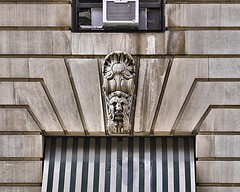
Built in 1899 as the Hotel Bellevue and is now an elegant residential condo building.
The Bellevue Hotel and the adjacent apartment building at 122 Bowdoin Street served as John Kennedy’s residences when he moved to Boston to run for the U.S. Congress in 1946 under the slogan of "The New Generation Offers a Leader." The future president initially lived at the Bellevue, where his grandfather John F. Fitzgerald, former Boston Mayor and U.S. Congressman, was spending his retirement years.
The Sunflower Castle – Mount Vernon and River Stre…
| 30 Nov 2011 |
|
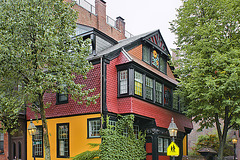
The home at 130 Mount Vernon Street, often referred to by locals as the Sunflower House or Sunflower Castle, is stylistically unique amongst its more conservative red brick, brownstone and clapboard neighbours. The Sunflower Castle is an 1840 home which was transformed into its present form in 1878 by then owner Charles Luce, who no doubt was seeking some attention.
To describe the residence: the first floor of stucco is painted in a bright blazing yellow that will pale in comparison only to the sun. The second floor, in contrast, is covered in a series of red English patterned tile (supposedly made in Akron, Ohio). Situated just above the front door on Mount Vernon Street is a black iron griffon. And lastly, located just over the iron griffon is what appears to be a wooden carving of a sunflower for which this home received its nickname.
Memorial to Robert Gould Shaw and the 54th Regimen…
| 13 Nov 2011 |
|
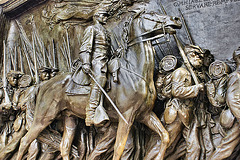
The 54th Regiment Massachusetts Volunteer Infantry was an infantry regiment that saw extensive service in the Union Army during the American Civil War. The regiment was one of the first official black units in the United States during the Civil War. Commanded by Colonel Robert Gould Shaw, it sprang to life after the passage of the Emancipation Proclamation. Secretary of War Edwin M. Stanton decided white officers would be in charge of all "colored" units.
The Memorial to Robert Gould Shaw and the Massachusetts Fifty-Fourth Regiment is a bronze relief sculpture, by Augustus Saint-Gaudens, located at 24 Beacon Street, adjacent to the Boston Common. The sculpture depicts the 54th Regiment marching down Beacon Street on May 28, 1863
By most accounts, the 54th left Boston with very high morale. This was despite the fact that Jefferson Davis’ proclamation of December 23, 1862 effectively put both African-American enlisted men and white officers under a death sentence. The proclamation was affirmed by the Confederate Congress in January 1863 and turned both enlisted soldiers and their white officers over to the states from which the enlisted soldiers had been slaves. As most Southern states had enacted draconian measures for "servile insurrection" after Nat Turner’s Rebellion the likely sentence was a capital one.
Robert Gould Shaw was born in Boston to a prominent abolitionist family. The 54th Regiment was sent to Charleston, South Carolina, to take part in the operations against the Confederates stationed there. On July 18, 1863, along with two brigades of white troops, the 54th assaulted Confederate Battery Wagner. As the unit hesitated in the face of fierce Confederate fire, Shaw led his men into battle by shouting, "Forward, Fifty-Fourth Forward!" He mounted a parapet and urged his men forward, but was shot through the heart and he died almost instantly. According to the color sergeant of the 54th Mass, he was shot and killed trying to lead the unit forward and fell on the outside of the fort.
The victorious Confederates buried him in a mass grave with many of his men, an act they intended as an insult. Shaw's father publicly proclaimed that he was proud to know that his son was interred with his troops, befitting his role as a soldier and a fighter for social justice.
The story of Shaw and the 54th Massachusetts was dramatized in the 1989 film "Glory," with Shaw portrayed by Matthew Broderick. The film also starred Denzel Washington and Morgan Freeman,
William H. Prescott's House – 55 Beacon Street, Bo…
| 18 Nov 2011 |
|
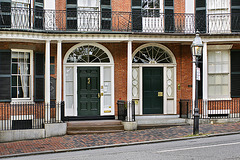
The American historian, William Hickling Prescott, lived at number 55 Beacon Street from 1845-1859. (He was a grandson of the William Prescott who commanded the American soldiers at the Battle of Bunker Hill, and who issued the famous command "Do not fire until you see the whites of their eyes!")
Prescott was one of the first English-speaking historians to write about the Spanish Empire. His books included histories of the Spanish monarchs and of the conquests of Mexico and Peru. Some have been translated into several languages and remain in print today. He built a rear addition, which included his extensive library on the second floor, and a third floor study, now faithfully restored, where he wrote his History of the Conquest of Peru.
During his lifetime, he was upheld as one of the greatest living American intellectuals, and knew personally many of the leading political figures of the day, in both the United States and Britain. Indeed, William Makepeace Thackery, the author of the novel "Vanity Fair," was a house guest during a visit to America in 1852.
The Prescott house and the adjoining home at 54 Beacon Street, were built in 1808 by the esteemed American architect Asher Benjamin and are highlighted by two bow-fronts. These Federal period twin houses overlook Boston Common. The land was once owned by John Singleton Copley, America’s most accomplished colonial portrait painter.
The Twa Corbies – Public Garden, Boston, Massachus…
| 18 Nov 2011 |
|
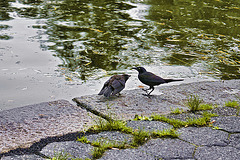
As I was walking all alone,
I heard two crows making a moan;
One said to the other,
"Where shall we go and dine today?"
- Old Scottish Ballad
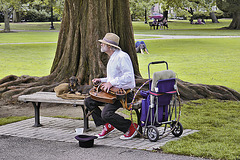
Donald Heller, the Hurdy-Gurdy Man – Public Garden…
| 20 Nov 2011 |
|
When the truth gets buried deep
Beneath the thousand years of sleep
Time demands a turn-around
And once again the truth is found
Awakening the Hurdy Gurdy Man
Who comes singing songs of love.
- Donovan
Cheers Pub – Beacon Street, Boston, Massachusetts
| 29 Nov 2011 |
|
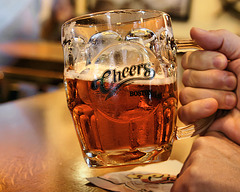
Cheers Beacon Hill, formerly the Bull & Finch Pub, is a bar and restaurant located on Beacon Street in the Beacon Hill neighborhood of Boston, Massachusetts, across from the Boston Public Garden. Founded in 1969 as the Bull & Finch Pub, the bar is known internationally as the exterior of the bar seen in the NBC television sitcom Cheers which ran from 1982 to 1993. The show used the Bull & Finch exterior for the series’ establishing shots of the namesake bar Cheers. No interior shots were used, and the interior does not resemble that of the Cheers bar. In 2002, the Bull & Finch Pub was officially renamed "Cheers Beacon Hill".
On March 10, 2009, the Boston Globe reported that longtime Cheers bartender Eddie Doyle, with a 35-year tenure that predated the sitcom Cheers, had been laid off. Owner Tom Kershaw cited the recession as the reason for the decision. The block on which Cheers resides has been renamed Eddie Doyle square in his honor.
The Ether Monument Revisited – Public Garden, Bost…
| 25 Nov 2011 |
|
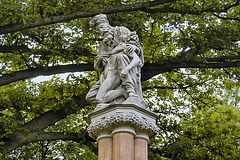
The Ether Monument, also known as The Good Samaritan, is a statue and fountain near the northwest corner of Boston’s Public Garden, near the intersection of Arlington Street and Beacon Street. It commemorates the first public demonstration of ether anesthesia, which occurred on October 16, 1846. Massachusetts General Hospital, where this procedure took place, is located about a 15-minute walk from the site of the monument
The statue depicts a medical doctor in medieval Moorish-Spanish robe and turban – representing a Good Samaritan – who holds the drooping body of an almost naked man on his left knee. The doctor holds in his left hand a cloth, suggesting the use of ether that would be developed in centuries to come. The anachronistic use of a Moorish doctor was probably intentional and served to avoid choosing sides in a debate that was raging at the time over who should receive credit for the first use of ether as an anesthetic. Erected in 1867, the monument is 40 feet (12 m) tall and is the oldest monument in the Public Garden.
At the base of the statue are inscriptions explaining the significance of the discovery of the use of ether as an anesthetic. There are four inscriptions, which include biblical quotations:
"To commemorate that the inhaling of ether causes insensibility to pain. First proved to the world at the Mass. General Hospital in Boston, October A.D. MDCCCXLVI"
"This also cometh forth from the Lord of Hosts which is wonderful and excellent in working." Isaiah 28:29
"In gratitude for the relief of human suffering by the inhaling of ether a citizen of Boston has erected this monument A.D. MDCCCLXVII."
"Neither shall there be any more pain." Revelation 21:4
"Cast Your Bread Upon the Water" – Public Garden,…
| 28 Nov 2011 |
|
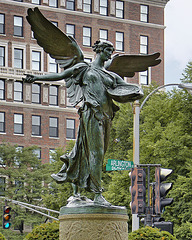
Daniel Chester French was commissioned to sculpt two memorials to the noted Boston philanthropist George Robert White (1847-1922). One of these monuments (completed and dedicated in 1924) stands in Boston’s Public Garden, at the northwest corner near the intersection of Beacon and Arlington Streets.
The monument, titled "Casting Bread Upon the Waters," shows a smiling, moving angel holding a basket in her left hand and scattering seed with her right, as if to show how White gave his money to many causes which then took root and bore fruit. The base of the statue gives the verse from Ecclesiastes 11:1 from which the statue takes its name:
Cast your bread on the waters;
for you shall find it after many days.
Ether Monument, Side Panel – Public Garden, Boston…
| 27 Nov 2011 |
|
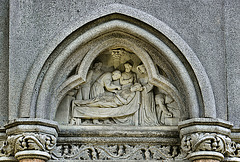
Today a monument to ether may seem strange, but for those living in the nineteenth century the drug was nothing short of a miracle. "The greatest invention for humanity since the printing press," one contemporary wrote. Imagine having a tooth pulled without Novocain, a tumor removed without general anesthesia, or a leg amputated with only a bullet to bite. Then you can understand why private citizen Thomas Lee paid handsomely ($6,300 for the statuary alone) to publicly commemorate the first etherized operation, which took place in Boston in 1846. On October 16 of that year, dentist Thomas G. Morton electrified an audience of surgeons and medical students in the operating theater of Massachusetts General Hospital when he put a printer, Gilbert Abbot, to sleep. The attending surgeon then removed a tumor from the sleeping patient's neck: no thrashing, no screams, no restraint by assistants. The theater broke into cheers.
When you visit the monument, be sure to look for the four reliefs by John Quincy Adams Ward, hidden under the monument's Gothic arches. The south relief shows an operation under anesthesia; the doctors wear a mix of nineteenth century and classical costume.
Techumseh Statue – Cheers Pub, Beacon Street, Bost…
| 30 Nov 2011 |
|
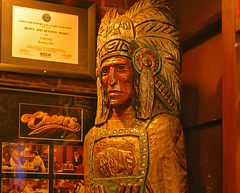
The Native American warrior statue in "Cheers" was a statue of Tecumseh. It was featured prominently in episode 189 of season 8 in 1990, Bar Wars III: The Return of Tecumseh. In it, Rebecca would like nothing better than to end the long-standing feud between the Cheers gang and their arch-rivals at Gary's Olde Towne Tap. But this proves impossible when it seems that someone at Gary's has stolen Cheers' beloved statue. The war escalates throughout the episode, with a surprising twist at the finale.
Jump to top
RSS feed- Jonathan Cohen's latest photos with "Beacon Hill" - Photos
- ipernity © 2007-2026
- Help & Contact
|
Club news
|
About ipernity
|
History |
ipernity Club & Prices |
Guide of good conduct
Donate | Group guidelines | Privacy policy | Terms of use | Statutes | In memoria -
Facebook
X
