

Jonathan Cohen's photos with the keyword: Los Chiles

Welcome to Nicaragua – Caño Negro National Wildlif…
| 01 Aug 2016 |
|
The Río Frío serves as a riverine highway linking Los Chiles, Costa Rica and the Nicaraguan town of San Carlos. These days, the border is peaceful and boats ferry people across the line – mainly Nicaraguans who come to Costa Rica to work and to shop. Indeed, the only sign that there is a border at all is a welcome sign, a stone marker, an empty shack with a fading Nicaraguan flag.
It was not always so. In the more troubled days of the Contras’ war against the Sandanista government, armed guards with orders to shoot at sight patrolled the river crossings. It was not uncommon for escaping Nicaraguans to attempt to swim across the border through caiman infested waters.

The "Jesus Christ" Lizard – Caño Negro National Wi…
| 01 Aug 2016 |
|
Abundant in the tropical rain forests of Central America, from southern Mexico to Panama, the green basilisk lizard is also called a plumed or double-crested basilisk. Part of the iguana family, green basilisks grow to about 2 feet (61 centimeters) in length, including their long, whip-like tail. Green basilisks are omnivores, surviving on a diet of plant material, insects, fruit, and small vertebrates. They are common throughout their range and have no special status, but abundant natural predators like snakes and birds keep these amazing lizards on their toes.
Males have distinctive, high crests on their heads and backs, which they use to impress females. Pregnant females prepare a shallow trench where they lay up to 20 eggs. The mother then leaves the eggs to hatch on their own. Hatchlings are born with the ability to run (on land and water), climb, and swim.
Indeed, the green basilisk lizard’s amazing ability to run on water gives this species its most recognizable moniker: the Jesus Christ lizard. Green basilisks spend much of their time in the trees and are never far from a body of water. When threatened, they can drop from a tree into the water and sprint, upright, about 5 feet (1.5 meters) per second across the surface. To accomplish this, they have long toes on their rear feet with fringes of skin that unfurl in the water, increasing surface area. As they rapidly churn their legs, they slap their splayed feet hard against the water, creating a tiny air pocket that keeps them from sinking, provided they maintain their speed. They can move along the surface like this for 15 feet (4.5 meters) or more. When gravity eventually does take over, the basilisk resorts to its excellent swimming skills to continue its flight. They are excellent swimmers and are capable of remaining underwater for up to 30 minutes

Capuchin Monkey – Caño Negro National Wildlife Ref…
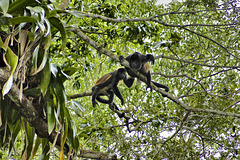
Howler Monkeys – Caño Negro National Wildlife Refu…
| 31 Jul 2016 |
|
According to Wikipedia, howler monkeys are among the largest of the New World monkeys and one of only a few nest-building monkeys.
Most howler species live in groups of six to 15 animals, with one to three adult males and multiple females. Mantled howler monkeys are an exception, commonly living in groups of 15 to 20 individuals with more than three adult males. The number of males in a given group is negatively correlated with the size of their hyoid, and is positively correlated with testes size.
Physical fighting among group members is infrequent and generally of short duration. However, serious injuries can result. Both males and females rarely fight with each other, but physical aggression is even more rare between sexes. Group size varies by species and by location, with an approximate male to female ratio of one male to four females.
As their name suggests, vocal communication forms an important part of their social behavior. They each have an enlarged basihyal or hyoid bone which helps them make their loud vocalizations. Group males generally call at dawn and dusk, as well as interspersed times throughout the day. The main vocals consist of loud, deep guttural growls or "howls". Howler monkeys are widely considered to be the loudest land animal. According to Guinness Book of World Records, their vocalizations can be heard clearly for 3 miles (4.8 km). The function of howling is thought to relate to intergroup spacing and territory protection, as well as possibly to mate-guarding.
These large and slow-moving monkeys are the only folivores of the New World monkeys. Howlers eat mainly top canopy leaves, together with fruit, buds, flowers, and nuts. They need to be careful not to eat too many leaves of certain species in one sitting, as some contain toxins that can poison them. Howler monkeys are also known to occasionally raid birds’ nests and chicken coops and consume the eggs.
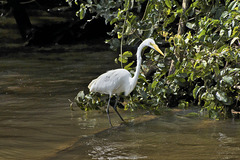
Great Egret – Caño Negro National Wildlife Refuge,…
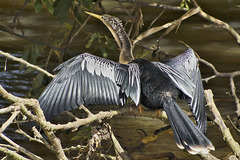
Anhinga – Caño Negro National Wildlife Refuge, Río…
| 31 Jul 2016 |
|
The anhinga, sometimes called snakebird, darter, American darter, or water turkey, is a water bird of the warmer parts of the Americas. The word anhinga comes from the Brazilian Tupi language and means devil bird or snake bird. When swimming the origin of the name snakebird is apparent: only the colored neck appears above water so the bird looks like a snake ready to strike. They do not have external nostrils and breathe solely through their epiglottis.
The anhinga is a large bird and measures approximately 89 cm (35 in) in length, with a 1.14 m (3.7 ft) wingspan. It dives and searches for underwater prey, including fish and amphibians. Unlike ducks, which coat their feathers with oil from their uropygial gland, the anhinga does not have waterproof feathers. Because the anhinga is thus barely buoyant, it can stay below the surface more easily and for longer periods of time. However, if it attempts to fly while its wings are still wet, the anhinga has difficulty, flapping vigorously while "running" on the water. As do cormorants when drying their feathers, the anhinga will stand with wings spread and feathers fanned open in a semicircular shape, resembling a male meleagrine, which led to the anhinga being referred to colloquially as the "water turkey." Anhingas will often search for food in small groups.

Washing Their Wheels in the Río Frío – Los Chiles,…
| 30 Jul 2016 |
|
Stretching across northwestern Costa Rica and into Nicaragua is the calm Río Frío. The mellow river is surrounded by wetlands that get flooded in the rainy season, forming a vast lake. The most scenic stretch of the river is the Cano Negro portion, a scene reminiscent of the Florida everglades. This area is also home to an abundance of underwater wildlife including fresh water sharks, caimans and hundreds of amphibians and reptiles.

A Canoe Named Pollera – Los Chiles, Alajuela Provi…
| 30 Jul 2016 |
|
A pollera is a Spanish term for a big one-piece skirt used mostly in traditional festivities and folklore throughout Spanish-speaking Latin America. Polleras are made from different materials, such as cotton or wool and tend to have colourful decorations. Most of the decorations are embroidered, flowers and regional animals are among the most common designs found in polleras.

Zona Portuaria – Los Chiles, Alajuela Province, Co…
| 30 Jul 2016 |
|
Los Chiles is the capital city of the canton of Los Chiles in the province of Alajuela in Costa Rica. The city lies at an elevation of 43 meters above sea level on the San Carlos Plain (Llanura de San Carlos) in northern Costa Rica. Los Chiles is a "border town," only four kilometers from Nicaragua. The vast majority of the population of the city was born in Nicaragua. The Río Frío, on the western edge of town, is a major thoroughfare used to access small villages and farms in the surrounding area.
During the 1980s, it was a strategic location on an important supply route for the Contras fighting to overthrow the Sandinista government in Nicaragua, and during that time military men from the United States were a common (albeit illegal) sight on the streets on the town.
Jump to top
RSS feed- Jonathan Cohen's latest photos with "Los Chiles" - Photos
- ipernity © 2007-2026
- Help & Contact
|
Club news
|
About ipernity
|
History |
ipernity Club & Prices |
Guide of good conduct
Donate | Group guidelines | Privacy policy | Terms of use | Statutes | In memoria -
Facebook
X
