

Jonathan Cohen's photos with the keyword: Chameleon
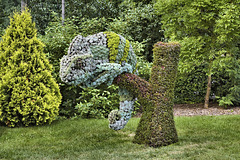
Disappearing into Nature – Mosaïcultures Internati…
| 04 Aug 2014 |
|
|
This sculpture – contributed by the Republic of Yemen – is entitled "Disappearing into Nature." Yemen lies south of Saudi Arabia. Known for its sweeping arid plains, the country nonetheless boasts a rich diversity of wildlife and vegetation, including some 1,800 indigenous plant species. A pioneer of coffee cultivation, Yemen was the only nation to export the commodity until the mid-1700s. Nonetheless, Yemenites’s favourite plant remains qat, a stimulant whose leaves when chewed yield a euphoric sensation.
Yemen is home to more than 360 bird species. Its shoreline teems with crab, crayfish, shrimps, jellyfish, sea cucumber. Unfortunately, only pockets of Yemen’s once lush forests still line the riverbanks. Fallen to hunters, wild mammals (the leopard, the antelope, the gazelle) have disappeared, leaving only beasts of burden and house pets: camels, dromadaires, oxen, donkeys, goats, cats and dogs. Among the 40 species of serpents present, 14 are poisonous. Other reptiles, such as monitor lizards and geckos, are more benign.
Another native of this region of the world is the veiled chameleon (Chamaeleo calyptratus) which is the subject of this sculpture. The chameleon’s eyes are able to pivot almost 180 degrees, independently of one another. The chameleon feeds on insects. When it spots its prey, the chameleon trains both eyes on it. The chameleon ambushes its victim and captures it with its highly agile and sticky tongue. When fully deployed in such a manner, the organ can reach one and a half times the chameleon’s body length.
Usually of a peaceful disposition, the chameleon is easily riled if another chameleon blocks its path. If it feels the slightest bit provoked, it alters its behaviour radically, puffing up its body, changing colours, often displaying very bright hues, opening its mouth wide and blowing until one of the two parties, acknowledging its domination by the other, leaves.
For a description of the art of Mosaiculture and of the Mosaïcultures Internationales de Montréal competition, please turn to the first photo in this series at:
www.ipernity.com/doc/jonathan.cohen/33872015
Jump to top
RSS feed- Jonathan Cohen's latest photos with "Chameleon" - Photos
- ipernity © 2007-2026
- Help & Contact
|
Club news
|
About ipernity
|
History |
ipernity Club & Prices |
Guide of good conduct
Donate | Group guidelines | Privacy policy | Terms of use | Statutes | In memoria -
Facebook
X
