

Jonathan Cohen's photos with the keyword: NoMad neighborhood
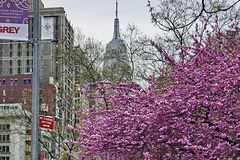
Cherry Blossoms – Madison Square Park, Broadway ne…
| 24 Jun 2015 |
|
|
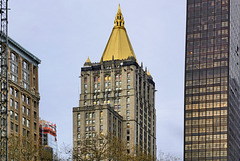
The New York Life Building – Viewed from Madison S…
| 22 Jun 2015 |
|
|
The New York Life Insurance Building, New York, located at 51 Madison Avenue, Manhattan, New York City, across from Madison Square Park, is the headquarters of the New York Life Insurance Company. Designed in 1926 by Cass Gilbert, who also designed the landmark Woolworth Building, the massive building, which was inspired by Salisbury Cathedral, rises forty stories to its pyramidal gilded roof and occupies the full block between 26th and 27th Streets, Madison Avenue and Park Avenue South. The building stands 615 feet (187 m) tall and contains 40 floors. It was the last significant Gilbert skyscraper in Manhattan.
The building was completed in 1928 after two years of construction at the cost of $21 million. It combines streamlined Gothic details and distinctly Moderne massing. The gold pyramid at the top consists of 25,000 gold-leaf tiles. From 1837–1889, the site was occupied by the Union Depot of the New York and Harlem and the New York and New Haven Railroads, a concert garden, and P.T. Barnums Hippodrome. Until 1925, the site housed the first two Madison Square Gardens, the second one designed by architect Stanford White.
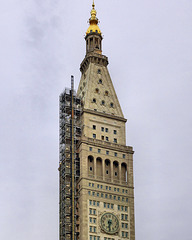
The Met Life Tower – Viewed from Madison Square Pa…
| 21 Jun 2015 |
|
|
The Metropolitan Life Insurance Company Tower, also known as the Metropolitan Life Tower or Met Life Tower, and currently being converted into the New York Edition Hotel, is a landmark skyscraper located on Madison Avenue near the intersection with East 23rd Street, across from Madison Square Park in Manhattan, New York City. Designed by the architectural firm of Napoleon LeBrun & Sons and built by the Hedden Construction Company, the tower is modeled after the Campanile in Venice, Italy. The original tower was sheathed in Tuckahoe marble, but during the 1964 renovation plain limestone was used to cover the tower and the East Wing, replacing the old Renaissance revival details with a streamlined, modern look. Much of the building’s original ornamentation was removed.
The building was constructed in 1909 and served as world headquarters of the Metropolitan Life Insurance Company until 2005. It was the world’s tallest building for three years, until 1913, when it was surpassed by the Woolworth Building. There are four clock faces, one on each side of the tower, located from the 25th to 27th floors. Each clock face is 26.5 feet (8 m) in diameter with each number being four feet (1.2 m) tall. The minute hands each weigh half a ton. The clock tower is mentioned in the opening of Murray Leinster’s 1919 story "The Runaway Skyscraper," the clock running backwards indicating that the skyscraper was traveling in time. In the animated TV series Futurama, the tower is seen in the future as wider and its face replaced with a digital clock.
The building was added to the National Register of Historic Places in 1972, designated a National Historic Landmark in 1978, and a New York City landmark in 1989.
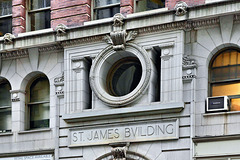
The Saint James Building – Broadway at 26th Street…
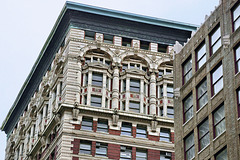
The St. James Building – Broadway at 26th Street,…
| 19 Jun 2015 |
|
|
In 1897, when the St. James Building was built on the site of one of the 19th Century’s most elegant hotels, it stood in the heart of New York’s wealthiest neighborhood just across from Delmonico’s. (Confederate saboteurs had tried to burn the hotel down on November 25, 1864.)
The St. James Building was designed by renowned architect Bruce Price, who designed many of the Canadian Pacific Railway‘s Château-type stations and hotels, including the Chateau Frontenac in Quebec City. The St. James Building is a striking combination of stone, brick, terra cotta, iron and copper in the Beaux Arts style with extensive detailing inside and out. One of its original treasures – a lobby mural painted by the famous French decorating firm of Arthur Brounet – is maintained in its original glory, one of the few remaining of the dozens of originals that adorned Manhattan theatres, hotels and residences.
The St. James Building provided offices for architects, including its designer, Bruce Price, and the Flatiron's Daniel Burnham. Oscar F. Spate had his office here when in 1901 he made an ill-fated attempt to turn seating in Madison and Central parks into a for-profit enterprise. Future Israeli prime minister Golda Meir worked here for the Pioneer Women's Organization for Palestine (1932-34). From 1965 to 1968, this was the base of the Mattachine Society, the leading pre-Stonewall gay rights group.
The St. James Building was extensively restored and technologically upgraded in the 1980s and 90s and was highly celebrated on its 100th birthday in 1996. The area around the St. James Building, now called NoMad, has been experiencing a huge surge in popularity and the St. James is once again surrounded by the some of the finest hotels, residences, restaurants in the city.
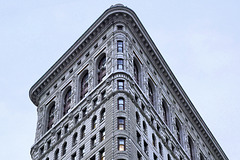
The Crown of the Flatiron – Broadway at 22nd Stree…
| 18 Jun 2015 |
|
|
Not well known among out-of-towners who are not into historic architecture, the Flatiron Building is a favorite of New Yorkers and admirers around the world. Perhaps because it symbolizes so much of how New Yorkers see themselves: defiant, bold, sophisticated, and interesting – with just enough embedded grime and soot to highlight its details.
The Flatiron Building was designed by Chicago’s Daniel Burnham as a vertical Renaissance palazzo with Beaux-Arts styling. Unlike New York’s early skyscrapers, which took the form of towers arising from a lower, blockier mass, such as the contemporary Singer Building (1902–1908), the Flatiron Building epitomizes the Chicago school conception: like a classical Greek column, its facade – limestone at the bottom changing to glazed terra-cotta from the Atlantic Terra Cotta Company in Tottenville, Staten Island as the floors rise – is divided into a base, shaft and capital.
The Flatiron’s most interesting feature is its shape – a slender hull plowing up the streets of commerce as the bow off a great ocean liner plows through the waves of its domain. The apex of the building is just six feet wide, and expands into a limestone wedge adorned with Gothic and Renaissance details of Greek faces and terra cotta flowers. The building has two claims to fame – one architectural, the other cultural. Some consider the Flatiron Building to be New York City’s first skyscraper. It certainly was one of the first buildings in the city to employ a steel frame to hold up its 285-foot tall facade, but not the first. Some felt its shape (like a flatiron) was less artistic and more dangerous. They thought it would fall over, and during construction the Flatiron Building was nicknamed "Burnham’s Folly."
The building’s cultural legacy is a little more interesting and has passed into the local social consciousness as a fable. It is said that the building created unusual eddies in the wind which would cause women’s skirts to fly around as they walked on 23rd street. This attracted throngs of young men who gathered to view the barelegged spectacle. Police would try to disperse these knots of heavy-breathers by calling to them, "23 Skidoo." This phrase has passed out of common usage, but its descendant, the word "scram" remains in a back corner of the American lexicon.
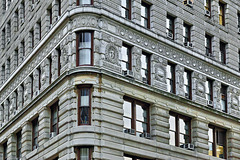
The Wedge of the Flatiron – Broadway at 22nd Stree…
| 18 Jun 2015 |
|
|
Not well known among out-of-towners who are not into historic architecture, the Flatiron Building is a favorite of New Yorkers and admirers around the world. Perhaps because it symbolizes so much of how New Yorkers see themselves: defiant, bold, sophisticated, and interesting – with just enough embedded grime and soot to highlight its details.
The Flatiron Building was designed by Chicago’s Daniel Burnham as a vertical Renaissance palazzo with Beaux-Arts styling. Unlike New York’s early skyscrapers, which took the form of towers arising from a lower, blockier mass, such as the contemporary Singer Building (1902–1908), the Flatiron Building epitomizes the Chicago school conception: like a classical Greek column, its facade – limestone at the bottom changing to glazed terra-cotta from the Atlantic Terra Cotta Company in Tottenville, Staten Island as the floors rise – is divided into a base, shaft and capital.
The Flatiron’s most interesting feature is its shape – a slender hull plowing up the streets of commerce as the bow off a great ocean liner plows through the waves of its domain. The apex of the building is just six feet wide, and expands into a limestone wedge adorned with Gothic and Renaissance details of Greek faces and terra cotta flowers. The building has two claims to fame – one architectural, the other cultural. Some consider the Flatiron Building to be New York City’s first skyscraper. It certainly was one of the first buildings in the city to employ a steel frame to hold up its 285-foot tall facade, but not the first. Some felt its shape (like a flatiron) was less artistic and more dangerous. They thought it would fall over, and during construction the Flatiron Building was nicknamed "Burnham’s Folly."
The building’s cultural legacy is a little more interesting and has passed into the local social consciousness as a fable. It is said that the building created unusual eddies in the wind which would cause women’s skirts to fly around as they walked on 23rd street. This attracted throngs of young men who gathered to view the barelegged spectacle. Police would try to disperse these knots of heavy-breathers by calling to them, "23 Skidoo." This phrase has passed out of common usage, but its descendant, the word "scram" remains in a back corner of the American lexicon.
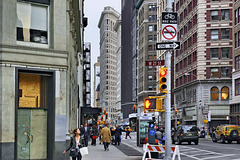
The Flatiron Building – Viewed from Broadway at 27…
| 18 Jun 2015 |
|
|
Not well known among out-of-towners who are not into historic architecture, the Flatiron Building is a favorite of New Yorkers and admirers around the world. Perhaps because it symbolizes so much of how New Yorkers see themselves: defiant, bold, sophisticated, and interesting – with just enough embedded grime and soot to highlight its details.
The Flatiron Building was designed by Chicago’s Daniel Burnham as a vertical Renaissance palazzo with Beaux-Arts styling. Unlike New York’s early skyscrapers, which took the form of towers arising from a lower, blockier mass, such as the contemporary Singer Building (1902–1908), the Flatiron Building epitomizes the Chicago school conception: like a classical Greek column, its facade – limestone at the bottom changing to glazed terra-cotta from the Atlantic Terra Cotta Company in Tottenville, Staten Island as the floors rise – is divided into a base, shaft and capital.
The Flatiron’s most interesting feature is its shape – a slender hull plowing up the streets of commerce as the bow off a great ocean liner plows through the waves of its domain. The apex of the building is just six feet wide, and expands into a limestone wedge adorned with Gothic and Renaissance details of Greek faces and terra cotta flowers. The building has two claims to fame – one architectural, the other cultural. Some consider the Flatiron Building to be New York City’s first skyscraper. It certainly was one of the first buildings in the city to employ a steel frame to hold up its 285-foot tall facade, but not the first. Some felt its shape (like a flatiron) was less artistic and more dangerous. They thought it would fall over, and during construction the Flatiron Building was nicknamed "Burnham’s Folly."
The building’s cultural legacy is a little more interesting and has passed into the local social consciousness as a fable. It is said that the building created unusual eddies in the wind which would cause women’s skirts to fly around as they walked on 23rd street. This attracted throngs of young men who gathered to view the barelegged spectacle. Police would try to disperse these knots of heavy-breathers by calling to them, "23 Skidoo." This phrase has passed out of common usage, but its descendant, the word "scram" remains in a back corner of the American lexicon.
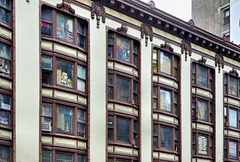
Taking Stock – Broadway at 28th Street, New York,…
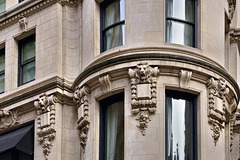
Lion About Town – Broadway at 28th Street, New Yor…
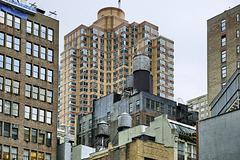
Theme and Variations – Looking Southwest from Broa…
| 14 Jun 2015 |
|
|
The block of 28th Street west of Broadway to 6th Avenue was known as "Tin Pan Alley." Tin Pan Alley is the name given to the collection of New York City music publishers and songwriters who dominated the popular music of the United States in the late 19th century and early 20th century. The name originally referred to a specific place: West 28th Street between Fifth and Sixth Avenue in Manhattan, and a plaque (see below) on the sidewalk on 28th Street between Broadway and Sixth commemorates it.
The start of Tin Pan Alley is usually dated to about 1885, when a number of music publishers set up shop in the same district of Manhattan. The end of Tin Pan Alley is less clear cut. Some date it to the start of the Great Depression in the 1930s when the phonograph and radio supplanted sheet music as the driving force of American popular music, while others consider Tin Pan Alley to have continued into the 1950s when earlier styles of American popular music were upstaged by the rise of rock & roll.
Various explanations have been advanced to account for the origins of the term "Tin Pan Alley". The most popular account holds that it was originally a derogatory reference in the New York Herald referring to the sound made by many pianos all playing different tunes being exactly like the banging of many tin pans in an alleyway. According to Katherine Charlton, the "term Tin Pan Alley referred to the thin, tinny tone quality of cheap upright pianos used in music publisher’s offices."
The orange-coloured, 39-storey high-rise residential building in the background is "The Capitol at Chelsea." It was built in 2001 at 26th Street and 6th Avenue on the site of The Racquet Club, the first sports club in NYC. The Raquet Club was built 1876.(It was later known as the University Athletic Club, and finally the Coogan Building). The most interesting structure on this stretch of 6th Avenue, it was slated to be preserved as an historic landmark – but money spoke louder than architecture.
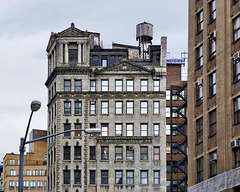
The Baudouine Building – Broadway at 28th Street,…
| 14 Jun 2015 |
|
|
The Baudouine Building is a historic building located at 1181-1183 Broadway at the corner of West 28th Street in the NoMad neighborhood of Manhattan, New York City. It was built from 1895-96 as an office tower with street level store, replacing a hotel which had previously stood on the site, and was designed by Alfred Zucker in the Classical Revival style.
The building is notable for a having small Greco-Roman temple at the top, called "a little Parnassus in the sky" by chairwoman Sherida E. Paulsen of the New York City Landmarks Preservation Commission. It has extensive decorative motifs including escutcheons of anthemions with lion heads over many windows.
The Baudouine family fortune was built by Charles Baudouine (1808-1895), a prominent cabinetmaker; his descendants were high-living celebrities, with his great-granddaughter accusing her father in a lawsuit over the estate of having "lived a life of dissipation, idleness and ostentation."
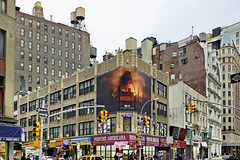
Godzilla Meets ... Perfume – Broadway at 30th Stre…
| 13 Jun 2015 |
|
|
|
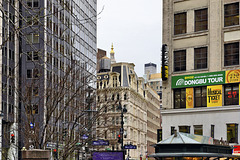
The Former Grand Hotel – Viewed from Broadway and…
| 13 Jun 2015 |
|
The Grand Hotel at 1232-1238 Broadway at the corner of West 31st Street in the NoMad neighborhood of Manhattan, once one of New York City’s grandest accommodations. Designed by Henry Engelbert in the Second Empire style, it was built in 1868. Englebert designed the hotel for Elias S. Higgins, a prosperous carpet manufacturer and merchant.
At the time the Grand Hotel was built, the area of Broadway between Madison Square and Herald Square was the premier entertainment district in the city, teaming with theatres, restaurants and hotels. The sleezier establishments on the side streets soon gave the district a new name, the "Tenderloin". When the theater district moved uptown again, the area became part of the Garment District, and the Grand Hotel became a cut-rate residential hotel. It is now home to wholesale joints like Design Time Watch Inc. Note the mansard roof, a French affectation that allowed Parisians, whose buildings were limited by storeys, to pretend that their top floor was an attic.
The building was designated a New York City Landmark in 1979, and was added to the National Register of Historic Places in 1983. A thoughtless owner painted over the marble facade, in violation of the landmark law.
Jump to top
RSS feed- Jonathan Cohen's latest photos with "NoMad neighborhood" - Photos
- ipernity © 2007-2026
- Help & Contact
|
Club news
|
About ipernity
|
History |
ipernity Club & Prices |
Guide of good conduct
Donate | Group guidelines | Privacy policy | Terms of use | Statutes | In memoria -
Facebook
X
