

Jonathan Cohen's photos with the keyword: Hagwara Tea Garden Drive
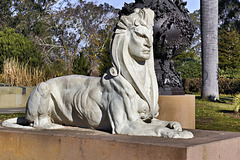
Arthur Putnam's Sphinx – M.H. de Young Museum, Gol…
| 12 Nov 2014 |
|
|
|
Arthur Putnam (1873-1930) was an American sculptor who was recognized for his bronze sculptures of wild animals. As a child growing up in Omaha, Nebraska, Putnam enjoyed drawing animals and modeling them in clay. In 1899 Putnam married and moved permanently to San Francisco where he worked primarily as a sculptor of architectural ornaments. Regarded as an artistic genius in San Francisco, Putnam was also well-known both statewide and nationally during his lifetime. He won a Gold Medal at the 1915 San Francisco world's fair, officially known as the Panama-Pacific International Exposition, and his works were also exhibited in New York, Chicago, Paris, and Rome.
Putnam lived a tragic life and in spite of his short productive career, his output of tabletop bronzes and monumental works is still impressive. He was first and foremost an animalist and his bronzes were masculine and impressionistic, rather than tightly realistic, with their details indicated rather than painstakingly rendered. He often sculpted recumbent figures, men or animals in slumbering repose, rather than in action, giving them a dreamy quality that was typical of the Art Nouveau era. While Putnam’s oeuvre included bronzes of women, children and small animals, it was the species of big cats that seemed to fascinate him the most and their combination of menace and mystery made them his most common subject.
This pair of concrete sphinxes replaces the original black granite sculptures commissioned from Arthur Putnam for the entrance to the Egyptian revival Fine Arts Building of the California Midwinter International Exposition of 1894. He modeled the body of the sphinx after a lifelike cat, but gave the mythological creatures a woman’s face, a face that he modeled on that of his old friend Alice Klauber, the San Diego artist.
The building’s Egyptian Revival architecture reflected a fascination with ancient Egypt, inspired by archeological discoveries such as the 1858 excavation of the Great Sphinx at Giza. The architecture also reinforced the perception of a continuous link between the cultural accomplishments of ancient Egyptian civilization and those of Europe and America. At the fair’s end, this building served as the first incarnation of the M. H. de Young Memorial Museum.
Sometime between 1905 and 1912, the granite sphinxes were removed and new concrete sphinxes based on Putnam’s initial plaster maquettes were placed at the site. The Egyptian Revival building itself was badly damaged in the Earthquake of 1906 and was eventually demolished in 1929 and replaced by a succession of new museum structures. During the construction in 2005 of the new de Young, the museum’s conservators repositioned the statues on new bases and restored them to their original appearance based on documentary photographs.
Jump to top
RSS feed- Jonathan Cohen's latest photos with "Hagwara Tea Garden Drive" - Photos
- ipernity © 2007-2026
- Help & Contact
|
Club news
|
About ipernity
|
History |
ipernity Club & Prices |
Guide of good conduct
Donate | Group guidelines | Privacy policy | Terms of use | Statutes | In memoria -
Facebook
X
