

Jonathan Cohen's photos with the keyword: Strybing Arboretum
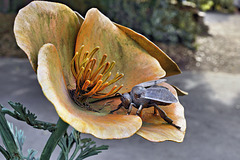
Iron Bumble Bee – San Francisco Botanical Garden,…
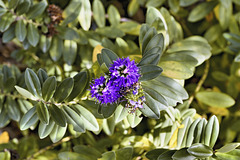
Blue Bursts – San Francisco Botanical Garden, Gold…
| 16 Dec 2014 |
|
|
|
According to Wikipedia, Hebe is a genus of plants native to New Zealand, Rapa in French Polynesia, the Falkland Islands, and South America. It includes about 90 species and is the largest plant genus in New Zealand. The genus is named after the Greek goddess of youth, Hebe.
Hebe has four perpendicular rows of leaves in opposite decussate pairs. The flowers are perfect, the corolla usually has four slightly unequal lobes, the flower has two stamens and a long style. Flowers are arranged in a spiked inflorescence. Identification of Hebe species is difficult, especially if they are not in flower. The plants range in size from dwarf shrubs to small trees up to 7 metres, and are distributed from coastal to alpine ecosystems. Large-leaved species are normally found on the coast, in lowland scrub and along forest margins. At higher altitudes smaller-leaved species grow, and in alpine areas there are whipcord species with leaves reduced to thick scales.
Hebes are grown in many gardens and public areas; they attract butterflies. Hebes cope with most soil types, and can be propagated easily from both seed and cuttings. Wild Hebe hybrids are uncommon; however, there are many cultivated hybrids, such as Hebe × franciscana.

Going Against the Grain – San Francisco Botanical…

Apulca Pine, #2 – San Francisco Botanical Garden,…

Apulca Pine, #1 – San Francisco Botanical Garden,…
| 14 Dec 2014 |
|
Mexico has more native pine species than does any other country. This graceful long-needled pine reaches more than 40 meters in height. It was formerly known as Pinus oaxacana because it is most common in the highlands of Oaxaca in Mexico although its range extends into Guatemala, El Salvador and Honduras. Recently, it has been successfully introduced to New Zealand. It is named after the town of Apulca where it was first collected.
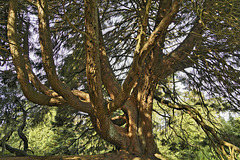
Rock my Soul in the Bosom of Abraham – San Francis…
| 14 Dec 2014 |
|
Rock my soul in the bosom of Abraham;
Rock my soul in the bosom of Abraham;
Rock my soul in the bosom of Abraham;
Oh, rock my soul.
So high, I can’t get over it;
So low, I can’t get under it;
So wide, I can’t get ‘round it;
Oh, rock my soul.
- Peter Yarrow
In the religoin of Bibilcal Israel, Sheol was primarily a place of "silence" to which all mortals were destined to go. However during, or soon after, the exile in Babylon ideas of an afterlife of reward or punishment began to enter Judaism.
During the Second Temple period (roughly 500 BCE–70 CE) the concept of a Bosom of Abraham first occurs in Jewish papyri that refer to the "Bosom of Abraham, Isaac and Jacob." This reflects the belief of Jewish martyrs who died expecting that: "after our death in this fashion Abraham, Isaac, and Jacob will receive us and all our forefathers will praise us" (4 Maccabees 13:17).
Other early Jewish works adapt the Greek mythical picture of Hades to identify the righteous dead as being separated from unrighteous in the fires by a river or chasm. In the pseudepigraphical Apocalypse of Zephaniah the river has a ferryman equivalent to Charon in Greek myth, but replaced by an angel. On the other side in the Bosom of Abraham: "You have escaped from the Abyss and Hades, now you will cross over the crossing place … to all the righteous ones, namely Abraham, Isaac, Jacob, Enoch, Elijah and David." In this myth Abraham was not idle in the Bosom of Abraham, he acted as intercessor for those in the fiery part of Hades.
Later rabbinical sources preserve several traces of the Bosom of Abraham teaching. In the Talmud (Kiddushin 72b) Adda bar Ahavah of the third century, is said to be "sitting in the bosom of Abraham." Likewise, according to Rabbi Levi in the Midrash (Genesis Rabba 67) "In the world to come Abraham sits at the gate of Gehenna, permitting none to enter who bears the seal of the covenant".
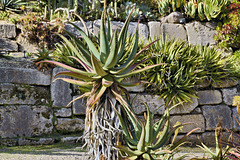
Agave Americana – San Francisco Botanical Garden,…

Gold-Tooth Aloe – San Francisco Botanical Garden,…
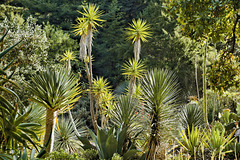
A Bad Hair Day? – San Francisco Botanical Garden,…
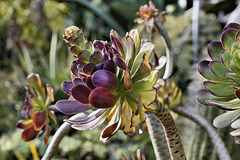
The Side View – San Francisco Botanical Garden, Go…
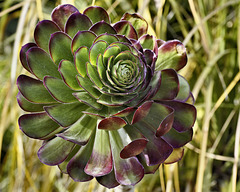
Not a Cabbage – San Francisco Botanical Garden, Go…

Prickly Pears – San Francisco Botanical Garden, Go…
| 09 Dec 2014 |
|
|
|
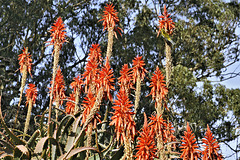
Candelabra Aloe – San Francisco Botanical Garden,…
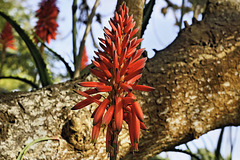
Candelabra Aloe – San Francisco Botanical Garden,…
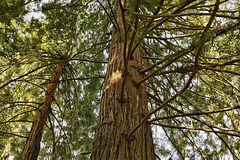
The Redwood Grove – San Francisco Botanical Garden…
| 05 Dec 2014 |
|
|
Among the many beautiful spaces within San Francisco Botanical Garden, the Redwood Grove is consistently cited as a favorite among visitors who are surprised to find that they don’t have to leave the City to see redwood trees. This century-old grove is full of the fog-loving towering giants known as Coast Redwoods or Sequoia sempervirens. These trees are the tallest living things on Earth and among the most well-adapted to their growing conditions.
Their magnificent height creates an otherworldly sanctuary filled with lush shade-loving understory plants like sword ferns, flowering currant, and huckleberry. Stands of old-growth coast redwoods once flourished on more than two million acres but have been reduced by extensive logging during the last 150 years. The coast redwoods at San Francisco Botanical Garden were planted around the turn of the 20th century and are among the oldest trees in the Botanical Garden. More than 100 species of associated plants have been added over the past 40 years to represent a typical redwood forest community.
The Strybing Arboretum – San Francisco Botanical G…
The Moon-Viewing Garden – San Francisco Botanical…

Camellia with Bokeh – San Francisco Botanical Gard…
Jump to top
RSS feed- Jonathan Cohen's latest photos with "Strybing Arboretum" - Photos
- ipernity © 2007-2026
- Help & Contact
|
Club news
|
About ipernity
|
History |
ipernity Club & Prices |
Guide of good conduct
Donate | Group guidelines | Privacy policy | Terms of use | Statutes | In memoria -
Facebook
X
