

Jonathan Cohen's photos with the keyword: Sherbrooke Street West

"When I Grow Up, I Will Remain A Child" – Décarie…
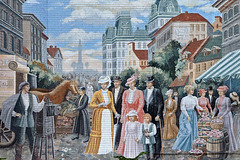
Photography Then and Now – Sherbrooke Street West…
| 26 May 2014 |
|
This mural seems to depict a romanticized view of Place Jacques-Cartier, a public square in Old Montreal as it may have appeared in Victorian times.
In 1723, the Château Vaudreuil was built for Philippe de Rigaud, Marquis de Vaudreuil - it's formal gardens occupying the space that is now the square. The Chateau burned down in 1803 and it was suggested by The Hon. Jean-Baptiste Durocher and The Hon. Joseph Périnault that the space be transformed into a public square, known as New Market Place. In 1809, Montreal's oldest public monument was raised there, Nelson's Column. In 1847, the square was renamed in honour of Jacques Cartier, the explorer who claimed Canada for France in 1535.
The French Second Empire structure depicted in the right-hand background is the Montreal City Hall which was constructed between 1872 and 1878.
The mural is one of several located in a courtyard on Sherbrooke Street, adjacent to the Delta Hotel. The hotel has planted an urban garden whose trees have almost obscured the murals, which are falling victim to the rigours of the Montreal winter.
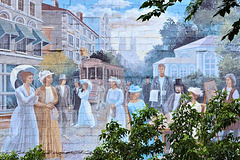
Victorian Montreal – Sherbrooke Street West at Cit…
| 26 May 2014 |
|
|
This mural seems to depict a romanticized view of Place d'Armes, a public square on Notre-Dames Street, as it may have appeared in Victorian times.In those days, Notre Dame Street was Montreal's major street. In the background are the twin spires of Notre-Dame Basilica.
Place d'Armes is the second oldest public site in Montreal. It was called Place de la Fabrique when it was first developed in 1693, at the request of the Sulpician Fathers, then later renamed Place d'Armes in 1721 when it became the stage of various military events. From 1781 to 1813, it was used as a hay and wood market, then developed as a Victorian garden after it was acquired by the city in 1836.
The mural is one of several located in a courtyard on Sherbrooke Street, adjacent to the Delta Hotel. The hotel has planted an urban garden whose trees have almost obscured the murals, which are falling victim to the rigours of the Montreal winter.
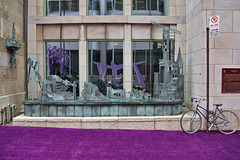
Urban Totem – McCord Museum, Victoria Street below…
| 01 Dec 2013 |
|
Totem ubrain/histoire en dentelles is one of Pierre Granche’s major works. This sculpture was installed to mark the McCord Museum’s official reopening in 1992. It now occupies a prime spot on quiet Victoria Street, which runs alongside the Museum’s west side. Ensconced in a niche formed by joining the old building and its new extension, Totem urbain was designed to bridge the old and the new, the interior and the exterior. Both the form and the title of Granche’s piece allude to the majestic haïda totem in red cedar standing inside the Museum’s Victoria Street entrance.
The work – an allegorical representation of the history of Montreal – is composed of four elements. The first of these is the illuminated elliptical plinth on which the remaining elements stand or from which they radiate outwards. The plinth is made up of three layers of glass fragments sandwiched between two massive translucent slabs that filter the light radiating from the base. The assembly is suggestive of water, an island, or rock strata. In using these pieces of glass, the sculptor makes a direct allusion to the 200,000 glass negatives of the Notman Photographic Archives, one of the McCord’s priceless collections.
The second element, the "urban totem," is a synthesised image depicting the city and three periods of its history. The totem is formed of three cylinders that fit one inside the other to form a small chimney. The first cylinder is inspired by the old buildings on de la Commune Street in Old Montreal; the second represents Montreal townhouses with their characteristic outside staircases, and also the industrial era; while the third evokes the present-day downtown area with its towering skyscrapers.
Then follows the third element: the parade of figures. Granche uses a score of archetypal figures and objects to conjure up moments and objects that are rooted in our collective memory. The sculptor tips his hat to history and geography, with many references to legends, the seasons, traditional trades and industrialisation. Each figure calls on another; associations are thus scrambled, cast into relief, or paralysed by the play and interplay between them. Here as well, the artist gestures to some of the Museum’s collections, such as Costume and Textiles, Ethnology and Archaeology, and the Notman Photographic Archives. This profusion of figures and images is seen through the lens of photographer Notman, which Granche has cleverly integrated into the work.
The final element in the work is a communications tower whose roots are buried in a mountain of books. This image symbolizes knowledge and culture, rooted in our present-day society, and recalls the Museum’s mandate to research and disseminate.
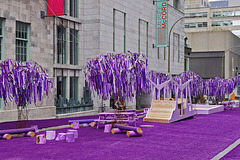
The "Urban Forest" – McCord Museum, Sherbrooke Str…
| 01 Dec 2013 |
|
|
Every summer the McCord Museum welcomes passers-by to its Urban Forest, which runs along Victoria Street between Sherbrooke Street West and President-Kennedy. Inspired by natural forests, this enchanting and entertaining pedestrian mall transforms Victoria Street into an organic installation.
All decked out in purple, the 2012 version of the Urban Forest featured artificial turf, sparkling trees, a giant swing, a picnic area, a terrasse, and a public artwork. There was also free musical entertainment during the evening hours.
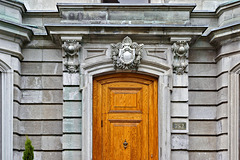
Number 752 – Sherbrooke Street West, Montréal, Qué…
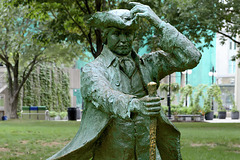
James "Snidely Whiplash" McGill – McGill Universit…
| 30 Nov 2013 |
|
|
This statue of the founder of McGill Univeristy was unveiled in 1998 to commemorate the university's 175th anniversary. It didn't take students long to leave their satirical mark.
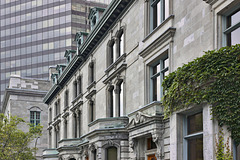
Across from McGill University – Sherbrooke Street…
Jump to top
RSS feed- Jonathan Cohen's latest photos with "Sherbrooke Street West" - Photos
- ipernity © 2007-2026
- Help & Contact
|
Club news
|
About ipernity
|
History |
ipernity Club & Prices |
Guide of good conduct
Donate | Group guidelines | Privacy policy | Terms of use | Statutes | In memoria -
Facebook
X
