

Jonathan Cohen's photos with the keyword: Houston Street
What Fools These Mortals Be! – The Puck Building,…
| 07 Jul 2015 |
|
|
|
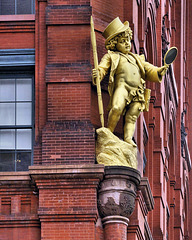
The Puck Building sports two gilded statues by sculptor Henry Baerer of Shakespeare’s character Puck, from A Midsummer’s Night Dream. The cherub-faced and well-attired Puck was the "mascot" of Puck, the illustrated, satirical weekly, and he stands holding a very large pen that is about his height in his right hand. Each Puck sports a top hat and tails. In the proper left hand is a mirror, in the right an oversize writing instrument. Over the left shoulder, on a sash, is slung a book or satchel bearing the magazine’s motto. Beneath their bright gilt, the Pucks are made of zinc, a popular material for late 19th-century sculpture. Should time or money run short, zinc sculptures could be quickly assembled from small pieces – their joints hidden by a coat of paint that simulated more expensive marble or bronze.
The 10-foot Puck depicted above overlooks the corner of Houston and Mulberry Streets.
The Puck Building – Houston Street at Lafayette, N…
| 07 Jul 2015 |
|
|
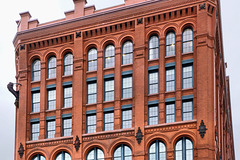
The Puck Building is an historic building located in the So Ho neighborhood of Manhattan, New York City. It occupies the block bounded by Lafayette, Houston, Mulberry and Jersey Streets. An example of the German Rundbogenstil (round-arched neo-Romanesque) style of architecture, the building was designed by Albert Wagner. Structurally, the building is related to the Chicago-Style buildings developed by (among others) Burnham & Root and Sullivan & Adler. The steel frame allowed much larger bands of windows along the ground floor than were possible on the masonry buildings constructed in New York City well into the 1880s.
Puck was America’s first successful humor magazine. Its founder, Joseph Keppler (1838-1894), an immigrant from Austria, named it after the mischievous character in Shakespeare’s Midsummer Night’s Dream, whose famous line he adopted as his magazine’s motto: "What fools these mortals be!" Issued weekly in German from 1876 to 1896 and in English from 1877 to 1918. Puck was a substantial 10 x 13.5 inches with several pages of color illustrations. Keppler was a master lithographer whose cartoons rivaled those of Thomas Nast. Unlike Nast, he attacked both political parties with gusto, as well as Catholics, Mormons, Chinese, Irish, suffragettes, trade unions, Thomas Edison and Joseph Pulitzer.
When Puck Magazine ceased publication in 1918, the building continued to house numerous independent printing firms and related printing services such as typesetters and a printing ink company. Indeed, the odor of printing ink permeated the building for many years. An office stationery company, S. Novick & Son, once occupied the second floor. Notable amongst the firms’ salesmen was Alger Hiss, the former assistant Secretary of State who was brought down in a spy scandal in the 1950s. In the 1980s, the Puck Building was the home of Spy Magazine, whose editors informally dubbed it "The Spy Building". In the early 2000s, the building housed the Manhattan Center of Pratt Institute. New York University, which signed a 15-year lease for three floors of the Puck Building in June 2003, has since been negotiating with the building's owner to secure the rest of the building.
The Puck Building was added to the National Register of Historic Places on July 21, 1983.
Dried Fruit – Russ & Daughters, East Houston Stree…
| 01 Jul 2015 |
|
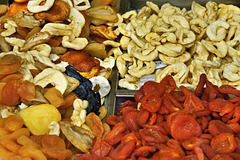
Russ & Daughters is a family-operated food store specializing in appetizers. It is located at 179 East Houston Street, on the Lower East Side of Manhattan, New York City.
Joel Russ, a immigrant from Poland who arrived in Manhattan around 1905, started the business to cater to his fellow immigrants in the Lower East Side of New York. He began by carrying Polish mushrooms on his shoulders, and saved enough money to purchase a pushcart. He then expanded his operation and sold pickled herring as well as mushrooms. Then in 1914, he opened J Russ International Appetizers, a storefront around the corner from the current location. In 1920, Russ moved his store to its current location at 179 East Houston Street.
In 1933, he renamed the business "Russ and Daughters" after making his three daughters, Hattie, Anne, and Ida, partners in the store. Businesses typically took on the name "and sons", but since Russ and his wife Bella had only daughters, his business became Russ & Daughters. However, Joel Russ was not a feminist ahead of his time. For him, getting his daughters into the business was not a matter of women’s rights, but a matter of economic survival. According to Hattie, she and the other daughters had all been working in the store on weekends since they were 8 years old, fishing the herring fillets from the pickle barrels. And as each of the girls finished high school, she started to work full-time.
Jump to top
RSS feed- Jonathan Cohen's latest photos with "Houston Street" - Photos
- ipernity © 2007-2026
- Help & Contact
|
Club news
|
About ipernity
|
History |
ipernity Club & Prices |
Guide of good conduct
Donate | Group guidelines | Privacy policy | Terms of use | Statutes | In memoria -
Facebook
X
