

Jonathan Cohen's photos with the keyword: British Museum

A Pediment to Learning – The British Museum, Great…
| 30 Oct 2016 |
|
Pediments were a common feature in ancient Greek architecture. They were usually triangle-shaped and sat on the top of buildings such as temples. They would be decorated with sculptures and reliefs, which reflected the purpose of the building. The pediment above the Museum’s South entrance was built in the 1850s. It is decorated with sculptures, which illustrate what 19th -century visitors would have found inside the Museum. The original pediment had a Wedgewood blue background and the statues were all painted white.
The core Museum building was designed by Robert Smirke in 1823 in Greek Revival style. This emulated the architecture of ancient Greece, and so the building has Greek features including the pediment and columns at the South entrance. The sculptures in the pediment were designed by Sir Richard Westmacott. They follow the grand theme of the Progress of Civilization (as envisioned, of course, by our Victorian ancestors in decidedly masculine terms).
As you look at the pediment, the left hand side shows the creation of man as he emerges from a rock as an ignorant being. He meets the next character, the Angel of Enlightenment who is holding the Lamp of Knowledge. From this man learns basic skills, such as cultivating land and taming animals. The next step in the progress of civilization is for man to expand his knowledge and understanding. The next eight figures represent the subjects he must learn to do this. From left to right they are architecture and sculpture; painting and science; geometry and drama; music and poetry. (I must add that my recollection of high school does not equip me to see the relationship of geometry to drama). These subjects were all covered in the Museum’s early collection and it was this knowledge which could help to educate man. The final human figure, on the right hand side, represents educated man. Having expanded his knowledge, man can now dominate the world around him.
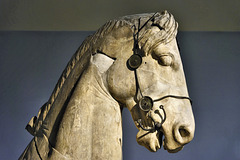
Horsehead from Halikarnassos – British Museum, Blo…
| 30 Oct 2016 |
|
The Mausoleum of Halikarnassos (a Greek polis in modern-day Turkey) dates from about 350 BCE. A four-horse chariot group (quadriga) was positioned on the top of the stepped pyramid that crowned the Mausoleum of Halikarnassos. The entire group would have been about 6.5 metres in length and around 5 metres in height. These two fragments are the largest that survive. They form the head and fore-part of a horse with its original bronze bridle, and the hind-quarters probably of another horse.
The exact significance of this chariot group is uncertain. The quiet and dignified composition may reflect a funerary function. If the chariot was empty, it may have been an offering to the dead king. Though not common in ancient Greece, the practice of offering an empty chariot and horses was more frequent among the dynasts who ruled the outer limits of the ancient Greek world. It is perhaps more likely that the chariot was occupied, certainly by a charioteer and maybe even by Maussollos himself. If this were the case, the whole group would have represented the apotheosis (becoming a god) of Maussollos. The king is shown accompanied by Nike, the goddess of victory, rising up to the heavens. Alternatively, the chariot may have been driven by Apollo, or Helios, the god with whom some scholars believe Maussollos associated himself.
It represents the forepart of a horse belonging to the colossal chariot group which crowned the tomb. The horse stands quietly with its head held down and turned to its left. It conveys a sense of great energy and vitality shown by the bulging muscles, flaring nostrils, open mouth, prominent veins and bulbous right eye. The teeth are carved within the open mouth and the tongue is outlined. The horse’s mane runs along the neck on both sides and a lock of hair flops around the right eye. Around the body are two bands that are part of the harness which are joined at the crest by a collar. It is the regular type of harness for a four-horse chariot. The original bronze bridle and bit are still secured by dowels. The curving cheek-pieces are of the Corinthian type. The statue is reconstructed from several fragments. Traces of paint remain.
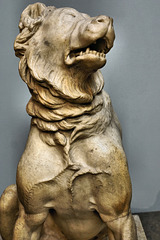
The Molossian Hound – British Museum, Bloomsbury,…
| 30 Oct 2016 |
|
|
Hellenistic realism extended to the expressive portrayal of animals as well as humans. Many bronze animal sculptures of this period are only known to us through Roman marble copies.
The Molossi inhabited ancient Epirus (now northwest Greece and Albania). Molossian hounds were related to the modern mastiff and were famously fierce. They were often used as guard dogs by herdsmen and for household security in cities. Aristophanes, the fifth-century comic dramatist, speaks of the hazards of trying to get past a doorway guarded by a Molossian dog, while the infamous Athenian statesman and general Alcibiades is said to have kept one with a docked tail.
This dog once wore a collar. Its gaping jaws show powerful teeth, but the relaxed pose and upward gaze give it an obedient air. Five other versions of this sculpture, all found near Rome, are thought to be Roman copies of a lost Greek bronze original, probably of the 2nd century BCE. This version is sometimes known as the "Jennings Dog," because it was once owned by Henry Constantine Jennings (1731-1819), who bought it in Rome in the 1750s.
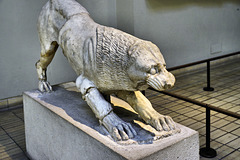
Crouching Lion – British Museum, Bloomsbury, Londo…
| 30 Oct 2016 |
|
This marble figure represents a lion with its mouth open, crouching for a spring. It was placed at the foot of the Monument as a guardian of the tomb. There were perhaps originally four, one at each corner. The style of the sculpture appears earlier than that of the Monument itself. They may be reused from some previous tomb decoration, or is perhaps contemporary with the Nereid Monument, but deliberately archaizing.
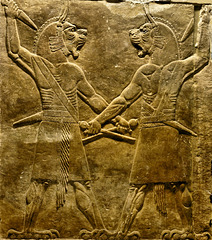
Ugallu and Lulal – British Museum, Bloomsbury, Lon…
| 30 Oct 2016 |
|
|
|
This Assyrian alabaster panel from the palace at Nineveh, 645-635 BCE depicts a pair of protective spirits. Despite appearances, these figures are not fighting one other but rather are protecting against any evil that might approach from either direction.
This kind of spirit was known as an "ugallu" – a protective lion.According to Wikipedia, Ugallu was a lion-headed storm-demon which has the feet of a bird and appears on protective amulets and apotropaic yellow clay or tamarisk figurines. Although the figurines and amulets date from the first millennium BCE, Ugallu had its origins in the early second millennium. He was one of the class of ud-demons (day-demons), personifying moments of divine intervention in human life. The iconography changed over time, with his human feet morphing into an eagle’s talons and his attire into a short skirt.
According to the first tablet of the Epic of Creation, Enûma Eliš, Ugallu was one of the eleven mythical monsters created by Tiamat in her cosmic conflict with the younger gods led by Marduk. The tale describes how Marduk captured and bound these creatures, and rehabilitated them as part of his work of reconstructing the world from the corpses of his vanquished adversaries.
This transformed them into protective charms which would be used to adorn the doors of palaces, for example that of Ashurbanipal’s southwest palace at Nineveh, temples, such as the Esagil of the Marduk temple as described in the Agum-Kakrime Inscription, and private dwellings (the bedrooms of the vulnerable) to ward off evil and disease. Ugallu first appears figuratively in the Old Babylonian period as a porter of the underworld, a servant of Nergal. In later times he is represented on amulets as frequently paired with the Sumerian demon Lulal, who was in many respects fairly similar in appearance. He is portrayed clasping a dagger in one hand and a mace in the other.

The Assyrian Royal Lion Hunt, #2 – British Museum,…
| 29 Oct 2016 |
|
In ancient Assyria, lion-hunting was considered the sport of kings, symbolic of the ruling monarch’s duty to protect and fight for his people. The sculpted reliefs in the British Museum illustrate the sporting exploits of the last great Assyrian king, Ashurbanipal (668-631 BCE) and were created for his palace at Nineveh (in modern-day northern Iraq). The hunt scenes, full of tension and realism, rank among the finest achievements of Assyrian Art. They depict the release of the lions, the ensuing chase and subsequent killing.
In these two panels, we see King Ashurbanipal driving his spear into the mouth of one lion, while a second lion, which had been hit by arrows and left for dead, leaps up to maul the king’s spare horse. Attendants gallop to the rescue from the left. In the next episode, the king has killed both lions. Some attendants admire them; others, kneeling in disgrace, were probably the ones who had allowed their horses to lag too far behind the king’s.

The Assyrian Royal Lion Hunt, #1 – British Museum,…
| 29 Oct 2016 |
|
In ancient Assyria, lion-hunting was considered the sport of kings, symbolic of the ruling monarch’s duty to protect and fight for his people. The sculpted reliefs in the British Museum illustrate the sporting exploits of the last great Assyrian king, Ashurbanipal (668-631 BCE) and were created for his palace at Nineveh (in modern-day northern Iraq). The hunt scenes, full of tension and realism, rank among the finest achievements of Assyrian Art. They depict the release of the lions, the ensuing chase and subsequent killing.
In these two panels, we see King Ashurbanipal driving his spear into the mouth of one lion, while a second lion, which had been hit by arrows and left for dead, leaps up to maul the king’s spare horse. Attendants gallop to the rescue from the left. In the next episode, the king has killed both lions. Some attendants admire them; others, kneeling in disgrace, were probably the ones who had allowed their horses to lag too far behind the king’s.
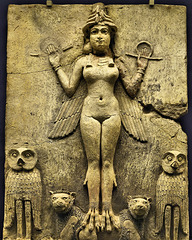
The Queen of the Night – British Museum, Bloomsbur…
| 26 Oct 2016 |
|
|
|
The "Queen of the Night" represents an ancient Mesopotamian goddess. She may have been Ishtar, goddess of sexual love and war, or perhaps Ishtar’s sister and rival, the goddess Ereshkigal, who ruled the Underworld. The goddess was originally painted red. She wears a horned headdress and holds the rod and ring of justice, both Mesopotamian symbols of divinity. Her multi-coloured wings hang down and her legs end in talons, similar to those of the owls beside her. She stands on the backs of two lions flanked by a pair of standing owls. A scaly pattern at the bottom represents mountains. The plaque is made of baked straw-tempered clay and may have been placed in a shrine. It was probably made in Babylonia (southern Iraq) between 1792 and 1750 BCE, during the reign of the Babylonian king Hammurabi.
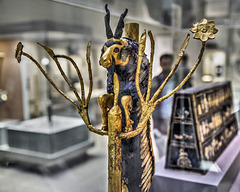
"Ram in a Thicket" – British Museum, Bloomsbury, L…
| 26 Oct 2016 |
|
Although this Sumerian statue, dating from about 2500 BCE, is known as the Ram in a Thicket, it more accurately depicts a goat. The animal stands with its forelegs on the branches of a flowering plant, as goats do when looking for food. This was one of a pair, found by Sir Leonard Wooley in 1928-29 in one of the Royal Tombs of Ur, in a grave that he called the "Great Death Pit" The other is in the University Museum, Philadelphia. Woolley named them "Ram in a Thicket" in reference to the passage in the Hebrew Bible (Genesis 22:13), where Abraham sacrifices a ram caught in a thicket by his horns, in place of his son, Isaac.
Ur was a wealthy and influential city-state in ancient Sumer, and its royal tombs - with their precious objects, many of which were inlaid with gold and precious stones - clearly demonstrate the city's advances in goldsmithing techniques and jewllery art, equalled only by the goldsmiths of Egypt. The plant, with its rosettes and buds, and the face and legs of the goat are made with gold leaf. The goat's ears are copper and its twisted horns and the fleece on its shoulders are lapis lazuli. The body fleece is white shell. The rectangular base is decorated with a mosaic of shell, red limestone and lapis lazuli. It was originally made with a wooden core and the inlay pieces were attached with bitumen. The gold cylinder rising from the back of the goat's neck indicates that it was a support for something, possibly a small table or stand. This portrayal of animal and plant life symbolizes nature and fertility, which were of crucial importance to the Sumerians and featured highly in their religion and art.
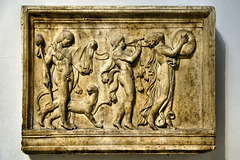
Marble Relief of a Dionysaic Procession – British…
| 25 Oct 2016 |
|
A marble relief depicting part of a Thiasos, or Dionysiac procession. The foremost figure is a maenad playing a tympanum or tambourine. The second is a young satyr playing a double flute. The third is a satyr carrying a thyrsus and attended by the panther of Dionysus (Bacchus). Roman, about 100 CE. Found in 1776 by Gavin Hamilton in the Villa Quintiliana at Gabii, an ancient city of Latium, located 18 km due east of Rome along the Via Praenestina, (which was in early times known as the Via Gabina).
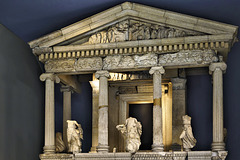
The Nereid Tomb – British Museum, Bloomsbury, Lond…
| 24 Oct 2016 |
|
|
The Nereid Monument is a sculptured tomb from Xanthos in classical period Lycia, close to present-day Fethiye in Mugla Province, Turkey. It took the form of a Greek temple on top of a base decorated with sculpted friezes, and is thought to have been built in the early fourth century BCE as a tomb for Arbinas (Lycian: Erbbina, or Erbinna), the Xanthian dynast who ruled western Lycia.
Although Arbinas ruled Lycia as part of the Persian Empire, the monument is built in a Greek style, influenced by the Ionic temples of the Athenian Acropolis.[5] The rich narrative sculptures on the monument portray Arbinas in various ways, combining Greek and Persian aspects.
The monument is thought to have stood until the Byzantine era, and then to have been destroyed by local Christians for its stones and metals. The ruins and sculptures were rediscovered in the early 1840s by an expedition led by the British archaeologist, Charles Fellows, and also including George Scharf. Fellows’ immediate conclusion was that the monument was to Harpagus, who is the main figure in Lycian history recorded by Herodotus, placing it in the 6th century BCE. Although it was soon realised that the style of the architecture and sculpture meant that it must date from at least a century later, it was only in the late 20th century that a consensus was reached that the tomb must date from around 390 to 380 BCE, and was probably the tomb of Arbinas. Fellows arranged for the shipping of the remains to the British Museum. Without detailed records of where each item was found, the Museum had to rely on expedition drawings, marks on the stones, and the composition and style of the sculpture to estimate how the blocks and sculptures fit together. The current reconstruction of the East façade in the museum dates from 1969. It is in room 17 of the Museum, which also houses many other parts of the monument.
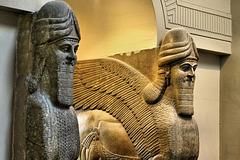
The Lion Twins – British Museum, Bloomsbury, Londo…
| 24 Oct 2016 |
|
|
An entrance to the royal palace of King Ashurnasirpal II (883-859 BCE) at Nimrud was flanked by two colossal winged human-headed lions. These protective spirits guarded the way into what may have been a banqueting hall.
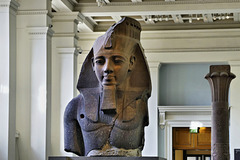
The Name is Ramses, Ramses II – British Museum, Bl…
| 24 Oct 2016 |
|
Head and upper body of pink/grey granite monumental statue of Ramses II (one of a pair placed before the door of the Ramesseum) wearing nemes head-cloth and circlet of uraei (about half now lost), the sculptor has exploited the bichrome nature of the stone to emphasize the division between body and face; the dorsal pillar is inscribed with vertical registers of hieroglyphs giving the name and titles of the king and part of a dedication to Amun-Ra. In 1817 it was noted that there were traces of colour upon the statue and it may have, therefore, been painted red in antiquity.
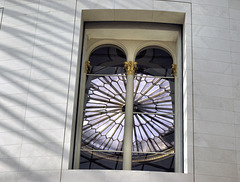
A Peek at the Reading Room – British Museum, Bloom…
| 23 Oct 2016 |
|
|
The Reading Room stands at the heart of the Museum, in the centre of the Great Court. Completed in 1857, it was hailed as one of the great sights of London and became a world famous centre of learning.
By the early 1850s the British Museum Library badly needed a larger reading room. Antonio Panizzi, the Keeper of Printed Books (1837–56), had the idea of constructing a round room in the empty central courtyard of the Museum building. With a design by Sydney Smirke (1798–1877), work on the Reading Room began in 1854. Three years later it was completed. Using cast iron, concrete, glass and the latest heating and ventilation systems, it was a masterpiece of mid-nineteenth century technology. The room had a diameter of 140 feet (approximately 42.6m) and was inspired by the domed Pantheon in Rome. However, it is not a free standing dome in the technical sense. It has been constructed in segments on a cast iron framework. The ceiling is suspended on cast iron struts hanging down from the frame and is made out of papier mache. A number of bookstacks were built surrounding the new Reading Room. They were made of iron to take the weight of the books and protect them against fire. In all they contained three miles (4.8 kilometres) of bookcases and twenty-five miles (forty kilometres) of shelves.
The Reading Room opened on 2 May 1857. Between 8–16 May, the library was opened up for a special one-off public viewing. Over 62,000 visitors came to marvel at the new building. Those wanting to use it had to apply in writing and were issued a reader’s ticket by the Principal Librarian. Among those granted tickets were: Karl Marx, Lenin (who signed in under the name Jacob Richter) and novelists such as Bram Stoker and Sir Arthur Conan Doyle.
The Reading Room is currently closed.
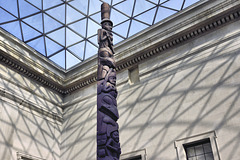
Kayung Totem Pole – British Museum, Bloomsbury, Lo…
| 23 Oct 2016 |
|
The Kayung totem pole is a 12-metre (39 ft) totem pole made by the Haida people. Carved and originally located in the village of Kayung on Graham Island in British Columbia, it dates from around 1850. Before being sold to collectors, the pole was located in a village called Kayung on Graham Island in British Columbia’s Haida Gwaii archipelago. Kayung had been an important village for the Haida before European contact. After the population was decimated by successive smallpox epidemics in the late 1800s, Henry Wiah, the town chief, encouraged the remaining population to move to nearby Masset.
The Great Court – British Museum, Bloomsbury, Lond…
| 23 Oct 2016 |
|
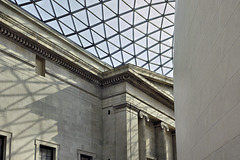
Designed by Foster and Partners, the Queen Elizabeth II Great Court transformed the Museum’s inner courtyard into the largest covered public square in Europe. It is a two-acre space enclosed by a spectacular glass roof with the world-famous Reading Room at its centre. In the original Robert Smirke design the courtyard was meant to be a garden. However, in 1852–7 the Reading Room and a number of bookstacks were built in the courtyard to house the library department of the Museum and the space was lost.
In 1997, the Museum’s library department was relocated to the new British Library building in St Pancras and there was an opportunity to re-open the space to public. The Great Court was opened on 6 December 2000 by Her Majesty the Queen.
The design of the Great Court was loosely based on Foster’s concept for the roof of the Reichstag in Berlin, Germany. A key aspect of the design was that with every step in the Great Court the vista changed and allowed the visitor a new view on their surroundings. Work on the Great Court's magnificent glass and steel roof began in September 1999. It was constructed out of 3,312 panes of glass, no two of which are the same. At two acres, the Great Court increased public space in the Museum by forty per cent, allowing visitors to move freely around the main floor for the first time in 150 years.
"The Atomic Apocalypse: Will Death Die?" – British…
| 22 Oct 2016 |
|
|
|
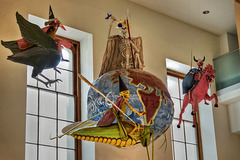
Pedro Linares (1906-1992) was the original creator of a bestiary of mythical, dragon-like beasts made from reeds or wire, paper, paint and an inspired imagination. It is said that Pedro Linares had an amazing dream whilst recovering from an illness in which these fantastical creatures appeared. They called these creatures "Alebrijes."
Popular artists such as the Linares in Mexico are known as " cartoneros." Pedro Linares created and subsequent generations now create alebrijes which include fantastical dragons, beasts and winged fish on legs, floral decorated skulls, devils and skeleton figures. Although many other Mexican craft shops sell items described as "Alebrijes" it is the Linares families and further generations thereof who produce the true "alebrijes". Pedro’s sons and grandsons now continue the tradition and their works are widely collected.
The "alebrijes" are still made with the same method to this day. The process is quite simple : an armature is made from reed or wire in the shape of the final body. To build up certain areas newspaper can be taped on when dry before adding the glued layers. A home made paste is produced using flour heated up in boiling water. Sheets of plain brown paper or newspaper are added in layers to cover the frame until it is firm. This may take some time as some of these creatures are extremely large. The figure then has to dry thoroughly. In Mexico, the sunny weather speeds up this process. All sorts of wondrous extremities are then added including wings, horns, tails, fierce teeth, bulgy eyes and a whole host of other creative additions. The final figure is painted white. Then is the time for the colourful painting. The Linares use brushes of cat hair to achieve the fine lines.
Colours which would normally clash are painted side by side in intricate patterns and produce stunning results. The attention to detail is quite amazing with a series of repeated scales, and intricate patterns including tear drops wiggly lines and series of dots. A steady hand and eye is a must to produce such a carefully detailed vision of colour.
These "alebrijes" are now transported all over the world and the bigger ones may be made in sections that fit together to aid transport. In 1990 the Mexican Government awarded Pedro Linares the National Prize for Popular Arts and Traditions (Premio Nacional de Ciencias y Artes en la Rama VI, Artes y Tradiciones Populares). The work of the Linares is now being avidly collected by European and American museums and collectors.
In London, at the Museum of Mankind, papier mâché figures by Felipe and Leonardo were included in the exhibition "The Skeleton and the Feast: the Day of the Dead in Mexico" (1991-1993). This included a huge installation entitled "The Atomic Apocalypse: Will Death Die?" showing the figures of Famine, War, Pestilence and Death presiding over a selection of scenes depicting the evils of the modern world.
Lion Around – British Museum, Montague Place, Bloo…
| 22 Oct 2016 |
|
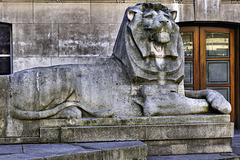
This is one of the two stone lions, sculpted in 1914 by Sir George Frampton RA, imperiously guarding the less-well-known northern entrance to the British Museum, on Montague Place. The vast majority of visitors use the main entrance on Great Russell Street, so sadly miss these glorious examples of New Sculpture.
The term "New Sculpture" was coined by the first historian of the movement, the critic Edmund Gosse, who wrote a four-part series for The Art Journal in 1894. After a protracted period of a stylized neoclassicism, sculpture in the last quarter of the century began to explore a greater degree of naturalism and wider range of subject matter. The French sculptor Jules Dalou, in his eight-year English exile after the Paris Commune events in 1871, taught modelling at the South Kensington School of Art, and then at the Lambeth School of Art. He profoundly influenced a new generation of British sculptors, helping to usher in a new approach to the medium.
The catalyst for this development is usually understood to be the exhibition, in 1877, of Frederic Leighton’s Athlete Wrestling with a Python. This was Leighton’s first major sculpture, and he intended it as a challenge to the prevailing styles of sculpture. It reflected his interest in a more dynamic and vibrant representation of the human body and a shift from easily legible and didactic subject matter. Many sculptors looked to the Athlete and created responses to it in the following years.
The New Sculpture represents an alternate formulation of a new direction for sculpture at the end of the nineteenth century. Whereas the major French alternative to mid-19th-century sculpture, Auguste Rodin, increasingly left the accurate representation of the human body behind, the New Sculptors by and large chose to grapple with issues arising from the naturalistic representation of the body and the detailed rendering of its surface variations. The New Sculpture does not represent one singular style, but rather a range of options developed to make sculpture more vital and lifelike.
Jump to top
RSS feed- Jonathan Cohen's latest photos with "British Museum" - Photos
- ipernity © 2007-2026
- Help & Contact
|
Club news
|
About ipernity
|
History |
ipernity Club & Prices |
Guide of good conduct
Donate | Group guidelines | Privacy policy | Terms of use | Statutes | In memoria -
Facebook
X
