

Jonathan Cohen's photos with the keyword: I.M. Pei
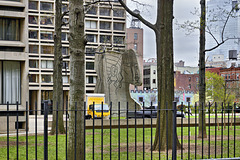
Bust of Sylvette – Between Bleecker and Houston St…
| 12 Jul 2015 |
|
|
|
New York University is a large presence in the area adjacent to Greenwich Village. The brutalist "Silver Towers" off Bleecker Street were designed as student housing in the 1960’s by the architectural firm of I.M. Pei. (Pei’s firm was most famous for designing the pyramid glass structure at the Louvre in Paris). Pei who chose to adorn the courtyard of the Silver Towers by enlarging one of five busts sculpted in 1934 by Pablo Picasso. The series of busts was inspired by a woman named Sylvette David.
In 1967 Pei hired Norwegian sculptors Carl Nesjar and Sigurd Frager to recreate the bust (although Picasso oversaw the project through drawings and photos). First cast in black basalt, it was then coated in cement and sandblasted by Nesjar to create the dark permanent lines. The rough cement of the sculpture was meant to compliment the harsh surface of the three identical apartment towers which surrounded it. Resting on a hidden cement base, this keeps it from sinking into the underground parking garage directly beneath it. The enlarged reproduction is some 36 feet in height and weighs 60 tons. The rough cement of the giant bust compliments the harsh surface of the three identical apartment towers which surround it. It was declared a landmark in 2008.
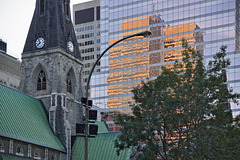
Place Ville-Marie, #2 – Reflected in the Place de…
| 28 May 2014 |
|
|
The spire in the foreground is that of Christ Church Cathedral, the seat of the Anglican Diocese of Montreal. Modeled after the 14th century Gothic-style churches of the English countryside, the cathedral features a square crossing tower
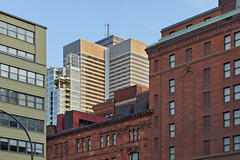
Place Ville-Marie, #1 – Viewed from de Maisonneuve…
| 28 May 2014 |
|
1 Place Ville-Marie is a 188 m (617 ft) with 47-storey, cruciform office tower built in the International style in 1962. Place Ville-Marie was one of the first designs of Henry N. Cobb and I. M. Pei, who was later to become a famous master of Modernist architecture. Mayor Jean Drapeau chose the name himself. Ville-Marie was the name of the French settlement founded at what is now Montreal in 1642.
Place Ville-Marie is arguably the most distinctive building in Montreal, Quebec, Canada. Along with an underground shopping mall, it forms the nexus of Montreal’s Underground City, the world’s largest, with indoor access to over 1,600 shops, restaurants, offices and businesses, as well several metro stations in Montreal, a suburban transportation terminal, and tunnels extending all over downtown. A rotating beacon on the rooftop (turning counter-clockwise) lights up at night, illuminating the surrounding sky with up to four white horizontal beams that can be seen as far as 50 km away.
The brown brick building in the foreground is the Bay department store. It was built as the flagship store of Morgan’s (formally Henry Morgan & Company) – a Montreal-based Canadian department store chain. At its peak, the company had stores in Quebec and Ontario. The first Morgan’s store was opened in Montreal in 1845 by Scottish immigrant Henry Morgan. Morgan’s was purchased in 1960 by Hudson’s Bay Company.
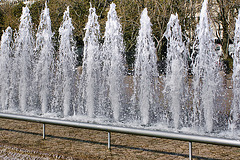
Overflowing Fountains – National Gallery of Art, W…
| 11 May 2011 |
|
“The cistern contains: the fountain overflows.”
- William Blake
The Marriage of Heaven and Hell
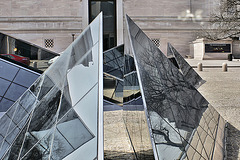
The Square of Pei – National Gallery of Art, Washi…
| 10 May 2011 |
|
I.M. Pei's signature pyramid skylights are located on the terrace that connects the East and West Wings of the National Gallery of Art. (It has been a long time since high school ... Now I remember what a tetrahedron is!)
Jump to top
RSS feed- Jonathan Cohen's latest photos with "I.M. Pei" - Photos
- ipernity © 2007-2025
- Help & Contact
|
Club news
|
About ipernity
|
History |
ipernity Club & Prices |
Guide of good conduct
Donate | Group guidelines | Privacy policy | Terms of use | Statutes | In memoria -
Facebook
X
