

Jonathan Cohen's photos with the keyword: Financial District
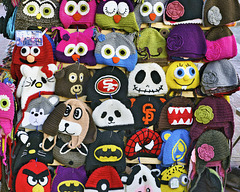
Hats for Sale – Market Street, San Francisco, Cali…
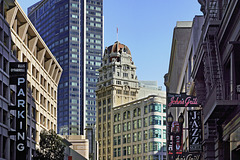
John's Grill – Ellis Street near Market Street, Sa…
| 30 Oct 2014 |
|
|
|
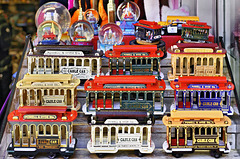
"Where Little Cable Cars …" – Powell Street, Union…
| 29 Oct 2014 |
|
|
"I left my heart in San Francisco
High on a hill, it calls to me
To be where little cable cars climb halfway to the stars …"
George Cory (1920-1978) and Douglass Cross (1920-1975)
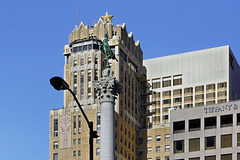
The Victory Monument – Union Square, San Francisco…
| 29 Oct 2014 |
|
|
Union Square is a 2.6-acre (1.1 ha) public plaza bordered by Geary, Powell, Post and Stockton Streets in downtown San Francisco, California. "Union Square" also refers to the central shopping, hotel, and theater district that surrounds the plaza for several blocks. The area got its name because it was once used for rallies and support for the Union Army during the American Civil War.
Originally a tall sand dune, the square was set aside as a public park in 1850 by San Francisco’s first American mayor, John Geary. Since then the plaza has undergone many notable changes, one of the most significant happening in 1903 with the dedication of a 97 ft (30 m) tall monument to Admiral George Dewey’s victory at the Battle of Manila Bay during the Spanish-American War. It also commemorates U.S. President William McKinley, who had been recently assassinated. Executed by Robert Aitken, the statue at the top of the monument, "Victory," was modeled after a voluptuous, six-foot (1.8 m) tall Danish-American stenographer and artist’s model, Alma de Bretteville, who eventually married sugar magnate Adolph B. Spreckels, one of San Francisco’s richest citizens.
Another significant change happened between 1939 and 1941 when a large underground parking garage was built under the square; this meant the plaza’s lawns, shrubs and the Dewey monument were now on the garage "roof." It was the world’s first underground parking garage and was designed by Timothy Pflueger.
Today, this one-block plaza and surrounding area is one of the largest collections of department stores, upscale boutiques, gift shops, art galleries, and beauty salons in the United States, making Union Square a major tourist destination, a vital, cosmopolitan gathering place in downtown San Francisco, and one of the world’s premier shopping districts. Grand hotels and small inns, as well as repertory, off-Broadway, and single-act theaters also contribute to the area’s dynamic, 24-hour character. (In the background of this photo you can see the Sir Francis Drake Hotel and the Tiffany Building, an 11 story, 100,000-square-foot (9,300 m2) the bottom two floors of which contain a Tiffany & Co. store, while the upper floors contain offices.)
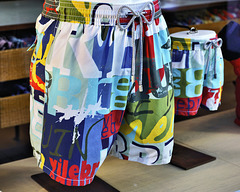
Two Pairs of Trunks – A Shop Window on Union Squar…

The Graystone Hotel – Geary Street, Between Kearne…
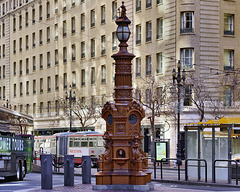
Lotta's Fountain – Market Street at the Intersecti…
| 28 Oct 2014 |
|
|
Standing at the corner of Market, Geary and Kearny streets in San Francisco, Lotta’s Fountain is a twenty-four-foot cast iron sculpture, painted bronze and adorned with lion’s heads, griffins, and other ornaments. It was commissioned by Lotta Crabtree, a Vaudeville actress, entertainer and comedian, as a gift to the city of San Franscisco. Lotta loved the city and had gotten her start there during the Gold Rush days, when she would dance on barrels in saloons for miners who would throw gold nuggets at her feet. Said to posses "the most beautiful ankle in the world," she was famous for her red hair, dark eyes, and her dances. She was especially known for the "Spider Dance, involving bodily gyrations intended to indicate shaking off of imaginary spiders and entangling spider webs." In the 1880s, she the highest paid actress in America, earning sums of up to $5,000 per week.
The cast iron fountain was dedicated on September 9, 1875. Lotta’s Fountain served as a meeting point during the 1906 San Francisco earthquake and resulting fires, which is commemorated by a metal panel attached to the monument. Another panel, installed in 1911, mentions legendary opera soprano Luisa Tetrazzini, who sang for the people of San Francisco at the fountain on Christmas Eve, 1910. The bronze column was added in 1916 to equal the height of new lights being installed along Market Street.
Commemorations of the earthquake, including a dwindling pool of survivors, are held every year at 5:12 a.m. on April 18 at the intersection. It was relocated from its original location at 3rd, Market and Kearny in 1974 during the renovation of Market Street. In 1999, the fountain, which had suffered neglect in the previous decades, was totally refurbished to its 1875 appearance. It is painted with a metallic gold-brown paint. The lion's head-motif fountain stations located on the sides of the column flow during daytime hours.

The Hearst Building – Market Street, Financial Dis…
| 27 Oct 2014 |
|
|
The Examiner was founded in 1863 as the Democratic Press, a pro-Confederacy, pro-slavery, pro-Democrat party newspaper opposed to Abraham Lincoln, but after his assassination in 1865 the paper's offices were destroyed by a mob, and starting on June 12, 1865 it was called the Daily Examiner. In 1880, mining engineer and entrepreneur George Hearst acquired the Examiner as partial payment of a poker debt. Seven years later, after being elected to the U.S. Senate, he gave it to his son, William Randolph Hearst, who was then 23 years old.
William Randolph Hearst hired S.S. (Sam) Chamberlain, who had started the first American newspaper in Paris, as managing editor and Arthur McEwen as editor. He changed the Examiner from an evening to a morning paper. Under him, the paper's popularity increased greatly, with the help of such writers as Ambrose Bierce, Mark Twain, and the San Francisco-born Jack London. The paper’s circulation was also boosted by the splashy coverage of scandals such as two entire pages of cables from Vienna about the Mayerling Incident, and by the ample use of foreign correspondents. Hearst used his papers to stir up patriotic enthusiasm for the Spanish–American War and the 1898 annexation of the Philippines.
An earlier home of the San Francisco Examiner had also been located at the corner of Market and Third Streets, but it burned in the 1906 fire. (The competing dailies the Call and the Chronicle were also located at the same intersection which became known as the "Newspaper Angle.") But Hearst was thwarted in his attempt to have the building that housed the Examiner dwarf the buildings of its competitors: the Chronicle and the Call. Following the earthquake and fire of 1906, the city imposed a height limit of 12 stories, which ended Hearst’s plan to construct a 26-story structure with a clock tower. The new building opened in 1909, and in 1937 the facade, entranceway and lobby underwent an extensive remodeling designed by architect Julia Morgan
Making his home in the 12th floor penthouse of the Hearst Building, William Randolph Hearst stayed close to the Examiner’s operations until his death in 1951. The newspaper occupied the building until 1965. Through the middle third of the twentieth century, the Examiner was one of several dailies competing for the city's and the Bay Area's readership; the San Francisco News, the San Francisco Call-Bulletin, and the Chronicle all claimed significant circulation, but ultimately attrition left the Examiner one chief rival – the Chronicle. Strident competition prevailed between the two papers in the 1950s and 1960s. The Examiner boasted, among other writers, such columnists as veteran sportswriter Prescott Sullivan, the popular Herb Caen, and Kenneth Rexroth, one of the best-known men of California letters and a leading San Francisco Renaissance poet, who contributed weekly impressions of the city from 1960 to 1967.
Ultimately circulation battles ended in a merging of resources between the two papers. For 35 years starting in 1965, the San Francisco Chronicle and Examiner operated under a Joint Operating Agreement whereby the Chronicle published a morning paper and the Examiner published in the afternoon. The Examiner published the Sunday paper's news sections and glossy magazine, and the Chronicle contributed the features. Circulation was approximately 100,000 on weekdays and 500,000 on Sundays. By 1995, discussion was already brewing in print media about the possible shuttering of the Examiner due to low circulation and an extremely disadvantageous revenue sharing agreement for the Chronicle.
Early in the 21st century, the Examiner, the longtime "Monarch of the Dailies" and flagship of the Hearst Corporation chain, converted to free distribution and is now independently owned by the San Francisco Media Company.
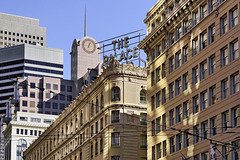
The Palace Hotel – Market Street, Financial Distri…
| 27 Oct 2014 |
|
|
|
The Palace Hotel is a landmark historic hotel in San Francisco, California, located at the southwest corner of Market and New Montgomery streets.
The original Palace Hotel was built by San Francisco banker and entrepreneur William Chapman Ralston who heavily depended on his shaky banking empire to help finance the $5 million project. Although Ralston’s Bank of California collapsed in late August 1875, and Ralston himself unexpectedly drowned in San Francisco Bay on the same day that he lost control of the institution, the Palace Hotel opened two months later on October 2, 1875. Ralston’s business partner in the project was U.S. Senator William Sharon who had helped cause the collapse of the Bank when he dumped his stock in the Comstock Lode. Sharon ended up in control of the hotel as well as both the Bank and Ralston’s debts – both of which he paid off at just pennies on the dollar
With 755 guest rooms, the original Palace Hotel (also known colloquially as the "Bonanza Inn") was at the time of its construction the largest hotel in the Western United States. At 120 feet (37 m) in height, the hotel was San Francisco’s tallest building for over a decade. The monarch of the Kingdom of Hawaii, King Kalakaua, died in this hotel on January 20, 1891. Although the hotel survived the initial damage from the early morning April 18, 1906, San Francisco earthquake, by late that afternoon it had been consumed by the subsequent fires. Notably, tenor Enrico Caruso (who had sung the role of Don José in Carmen the night before) was staying in the hotel at the time of the quake, and swore never to return to the city. The urban legend is Caruso, "stood in his nightshirt holding a personally autographed photograph of President Theodore Roosevelt and demanded special treatment."
Completely rebuilt from the ground up, the "New" Palace Hotel opened on December 19, 1909. It quickly resumed the role of its namesake predecessor as an important San Francisco landmark and host to many of the city’s great events. While externally much plainer then the original Palace, the new "Bonanza Inn" is in many ways as elegant, sumptuous, and gracious on the inside as the 1875 building. The "Garden Court" (also called the "Palm Court") – which occupies the same area that the Grand Court did in the earlier structure – has been one of San Francisco’s most prestigious hotel dining rooms since the day it opened. Equally famous was the "Pied Piper" Bar located just off the gleaming polished marble lobby which was overseen by its famous Maxfield Parrish painting of the same name. The 16 by 6 foot, 250-pound mural was removed on March 23, 2013 for sale at a planned auction at Christie’s which was anticipated to bring between up to five million dollars. In the light of strong public opposition to its removal, however, the hotel’s owners relented and instead had the painting cleaned, restored, and returned to the bar where it was rehung with considerable fanfare on August 22, 2013. The Ralston Room, named for co-founder William Ralston, is off the main lobby to the left.
The building in the background with the large clock tower culminating in a spike at its top is located at 33 New Montgomery Street.

The Humboldt Savings Bank Building – Market Street…
| 26 Oct 2014 |
|
|
|
The Humboldt Bank Building is a 19 floor office building in San Francisco, California.
In 1905, the President and Directors of the Humboldt Savings Bank embarked on plans to build an elegant high-rise tower at 785 Market Street and Fourth Street. They commissioned the architectural partnership of Meyer & O’Brien to design and construct their fabulous new headquarters. Yet not long after work started, nature intervened to halt the ambitious venture. On April 18, 1906, downtown San Francisco was ravaged by a massive earthquake followed by three days of fire. The building was completely destroyed.
Despite the devastation, plans to construct the building were not abandoned – in fact, a still more lavish structure was planned. The architect used this opportunity to incorporate every known fire and safety feature of the time into the new structure. And, within a year, the steel frame of the new Humboldt Bank rose against the empty San Francisco skyline.
In 1908, the Humboldt Saving Bank at last settled in to its new offices and became a significant force in refinancing and rebuilding the new San Francisco that was to rise out of the ashes. The building was praised by one and all as an architectural masterpiece. It is a classic Beaux Arts building. One of the many Beaux Arts principals Meyer incorporated into the design was a hierarchy of space. In this case, a grand entrance lobby is topped by 19 floors of functional office space. Magnificent details on granite, a marble and tile, over reinforced concrete and steel created a visual wonder, topped by a joyous wedding cake dome.
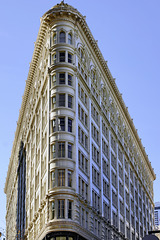
The Phelan Building – Market and O’Farrell Streets…
| 26 Oct 2014 |
|
|
|
Flatiron buildings are among the earliest skyscrapers. Their triangular shape was determined by real estate parcels created by diagonal streets, such as Market Street, that sliced through streets designed on a grid. They were named for their resemblance to clothes irons of the period. Situated at the prominent gore of Market and O’Farrell Streets at Grant, the eleven-story Phelan Building stretches 328 feet on the Market Street side alone and boasts 31,000 square feet, inspiring the 1907 Call headline "Huge Phelan Building Already a Landmark." It is one of the few remaining flatirons on Market Street.
Elected to "clean up City Hall," James Duval Phelan was responsible for several reforms during his term as mayor (1897-1902). In the years following the earthquake and fire he was also pivotal in bringing an end to the extortion, graft and corruption perpetrated by Abe Ruef and his puppet Mayor Eugene Schmitz. Phelan served as U.S. Senator from 1913 to 1919 and maintained his office on the 6th floor.
Phelan commissioned architect William Curlett to build this dignified flatiron on the site of his father’s (pioneer banker and capitalist James Phelan) earlier version. The original structure was destroyed in the 1906 fire and this gave Phelan an opportunity to express in steel, glass and glazed terra cotta his advocacies of the City Beautiful Movement and the Burnham Plan, both of which were scrapped by the city in the haste to rebuild after the earthquake. This impressive building is a masterpiece of Renaissance/Baroque ornamentation with a beautifully restored two-story white marble lobby.
The Union Trust Bank Building – Grant Avenue, Fina…
| 24 Oct 2014 |
|
|
|
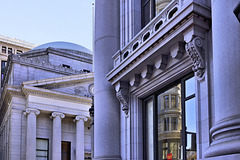
The old Union Trust Bank building, designed by Clinton Day, now houses a branch of Wells Fargo Bank.
The Wells Fargo Bank and the Savings Union Bank building and building across the street are a gateway to Grant Avenue. These two buildings along with the adjacent Phelan Building (which is reflected in the glass door) and other immediate neighbors form a splendid group of contemporary designs embodying the ideals of the City Beautiful Movement. This gateway to Grant Avenue is perhaps the best of the older Market Street intersections.
Grant Avenue at Market Street – Financial District…
| 23 Oct 2014 |
|
|
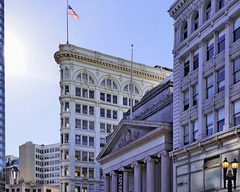
The building with the classical pillars in front of it was built in 1910 to house the Savings Union Bank. This local landmark in Ecole des Beaux Arts style was modeled after the Pantheon in Rome. The designers and architects William Danforth Bliss and William Baker Faville, graduated from MIT and began their San Francisco practice in 1898. Until 1925 they were responsible for many distinguished homes and commercial buildings including the Bank of California, the Geary Theater, the St. Francis Hotel, the Southern Pacific Headquarters and Southern Pacific Depot, and several 1915 Panama-Pacific International Exposition buildings.
The Savings Union Trust Company building opened on Jan. 1, 1911, as home to the institution resulting from the 1910 merger of the Savings Union and Loan Society, incorporated in 1857, and the San Francisco Savings Union, the very first bank incorporated under California’s 1862 savings bank law. The merged bank quickly added a commercial department and then a trust department, resulting in the name "Savings Union Bank and Trust."
The bank building is of Ionic order, with a dome, an attic story, and a pediment supported by six massive Ionic columns. The 16x21x 8-1/2 foot high vault was constructed by the Bethlehem Steel Company of Harveyized nickel-steel, face-hardened steel plate; the main door of the vault weighed 23 tons, and the vault contained 5,063 safe deposit boxes. The building’s bronze doors featured panels designed by the noted California artist Arthur Mathews. The Savings Union Trust Bank Building now houses the retailer Emporio Armani, which includes a café with a marble bar and a store stocked with some of the Italian designer’s most expensive lines.
A Fine Feathered Flower – Nespresso Boutique, Gran…
| 23 Oct 2014 |
|
|
|
The White House (West Coast Version) – Sutter Stre…
| 22 Oct 2014 |
|
|
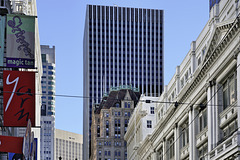
Exquisite goods and impeccable service marked the golden age of department stores. After the great earthquake and fire in 1906, San Francisco’s major retailers couldn’t wait to rebuild – and on an even grander scale than before the disaster.
The brilliant Beaux Arts-style building – commonly known as the White House – on the corner of Sutter and Grant was home to Raphael Weill & Company. The building was designed by Albert Pissis. He was one of the first Americans to study at the legendary École des Beaux-Arts in Paris and was a key figure in introducing that style to San Francisco.
Raphael Weill, a French Jew, came to San Francisco in 1855 and in three years became a partner in the J.W. Davidson Dry Goods Store, one of the biggest dry goods dealers in California. By 1885, the store was all his. Weill was one of the legendary figures of San Francisco. His store regularly closed at 6 o’clock (one of the first to adopt such a policy), he offered his employees annual vacation and sick time with pay, and they earned sales commissions. Following the 1906 earthquake, he ordered 5,000 dresses and suits to be quietly distributed to the displaced women of the city. When 1,500 employees were drafted to fight in World War I, Weill had half their salary put into their bank accounts for a year. He was a founding member of the Bohemian Club, too, and regularly cooked lavish Sunday morning breakfasts at the club. The popular dish, Chicken Raphael Weill, is named after him.
In addition to its impeccable customer service and exquisite goods imported from France, the White House boasted a lavish Parisian style tearoom that was a social center, art galleries, and lectures on art and fashion.
The store closed in 1965 and the building was eventually broken up into small retail storefronts. The property deteriorated. In 1996 it was taken over by The Gap clothing company which renovated and reunited all the parts of the original White House department store, restoring much of the splendor of Pissis’s design. The building currently house the flagship store of Banana Republic, a subsidiary of the Gap company
In the background, you can see the Hunter-Dulin Building constructed between 1925 and 1927 to house the West Coast headquarters for the National Broadcasting Company. Behind it, is 44 Montgomery Street, a 43-story, 172 m (564 ft) office skyscraper in the heart of San Francisco’s Financial District. When completed in 1967, it was the tallest building west of Dallas until 555 California Street was erected in 1969. The building was once the world headquarters for Wells Fargo Bank.
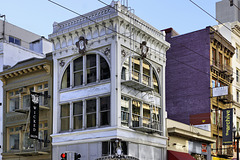
The Hammersmith Building – Grant Avenue at Sutter…
| 22 Oct 2014 |
|
|
|
Although it occupies one of the smallest sites in the retail area, the Art Nouveau Hammersmith Building, designed in 1907 by Lansburgh & Joseph, makes a contribution to the streetscape which is wholly disproportionate to its size. The building has a large amount of glass for the time it was built, and one motif, that of a building-wide arch, running through all floors. It has maintained its integrity, having been little remodeled in its seventy-two year existence. One of the architects, G. Albert Lansburgh, earned local fame particularly as a designer of theatres.
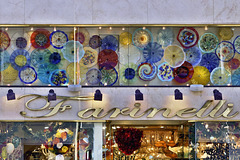
Farinelli's– Grant Avenue between Harlan Place and…
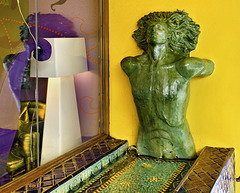
The Fountain at the Hotel Triton – Grant Avenue be…
| 21 Oct 2014 |
|
A vibrant and colourful fountain in front of the Hotel Triton on Grant Avenue in San Francisco. The water comes out of the turquoise bust.
Jump to top
RSS feed- Jonathan Cohen's latest photos with "Financial District" - Photos
- ipernity © 2007-2026
- Help & Contact
|
Club news
|
About ipernity
|
History |
ipernity Club & Prices |
Guide of good conduct
Donate | Group guidelines | Privacy policy | Terms of use | Statutes | In memoria -
Facebook
X
