

Jonathan Cohen's photos with the keyword: diorama
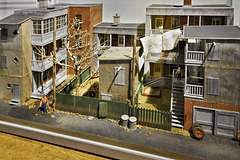
Diorama of an Iconic Montreal Alleyway – Centre d’…
| 17 Oct 2016 |
|
|
|
According to the Centre d’histoire de Montréal, alleyways as we know them first appeared in Montreal around 1845 when large farm-lots were being subdivided into smaller properties. Prior to this, inner courtyards were accessible through private carriage doors, but not from the street. Ever since, working class Montreal houses have had a front side that faced the street and a back side that faced the alleyway.
Out front is the facade -- the carefully swept wooden sidewalk and the inevitable neighbour keeping a close eye on everything. Out back is the alley -- a world of constant activity. Heating oil (and in the old days wood and coal) is delivered in winter; and fruit and vegetables in the summer. (And in the old days there would be ice for the ice box, too.) People would set out their garbage for weekly pickup. Kids would play hide-and-seek, street hockey and "church." Sometimes, conditions are right for an improvised ice rink, or even a stolen kiss …
As indicated by the laundry lines hanging heavy with clothes, the bare trees and the fallen leaves, this diorama depicts a wash-day Monday in late October or early November. And have you noticed the hangars – those practical storage sheds? Unfortunately, they had a bad habit of catching fire and are now illegal!
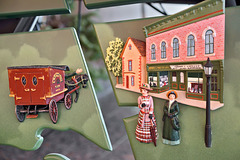
Ontario Street – Canada Hall, Canadian Museum of C…
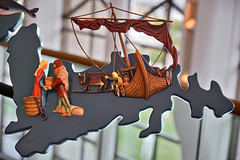
The Vikings in Newfoundland – Canada Hall, Canadia…
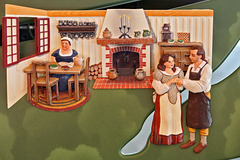
La Nouvelle France – Canada Hall, Canadian Museum…
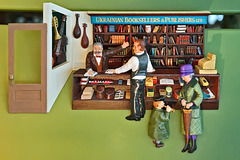
Ukrainian Booksellers and Publishers – Canada Hall…
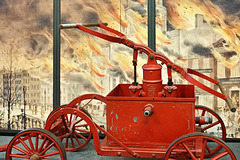
Fire All About – Museum of Waterways and Industry,…
| 07 Oct 2013 |
|
A devastating fire occurred in the summer of 1890, leaving half of Main Street in ashes. This was a cruel irony given that Seneca Falls was the place where the world’s first steam operated fire engine was built. It was the product of the Silsby Manufacturing Company, and used Birdsall Holly’s patented rotary pump and engine. It consisted of two elliptical cams working into each other within an air-tight case. They contained four chambers, upon which the stream would act alternately, so as to secure great power with low pressure and a constant supply of water. While one chamber had just discharged, another was discharging, a third was ready, and a fourth would be filling.
The invention was wildly successful and was sold worldwide. By 1885 their five-acre plant on the island flats behind Trinity Episcopal Church was the largest of its kind in the world. Over two hundred employees produced half the steam engines in America, with a new engine being completed every week.
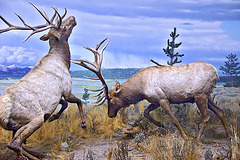
Rocky Mountain Elk Diorama – Carnegie Museum of Na…
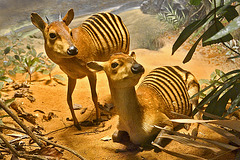
Zebra Duikers Diorama – Carnegie Museum of Natural…
| 28 May 2013 |
|
The zebra duiker (Cephalophus zebra) is a small antelope found in Ivory Coast, Guinea, Sierra Leone and Liberia. It has also been recently discovered in south east Guinea. They have gold or red-brown coats with distinctive zebra-like stripes, dark markings on their upper legs, and russet faces. They grow to 90 cm (35 in) in length, 45 cm in height, and 20 kg (44 lb) in weight. Their prong-like horns are about 4.5 cm long in males, and half that in females.
Their arched backs, short forelimbs and longer hindlimbs enable the them to slip easily through the dense vegetation of the coastal rain forests of West Africa. Here only very thin shafts of light penetrate the closed canopy (leafy treetops) of the jungle to reach the floor of the forest. The duiker’s striking black stripes help it to blend with these intricate patterns of light and shadow. Zebra duikers probably defend strict territories, form exclusive pairs, and may even mate for life.
They are considered vulnerable due to continuing deforestation and overhunting within their range. The wild population is estimated at 28,000 individuals.
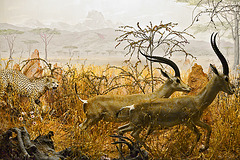
A Cheetah Giving Chase, Diorama – Carnegie Museum…
| 28 May 2013 |
|
|
Fast, agile, and extremely vigilant, Grant’s gazelles rarely fall prey to large predators on the savanna. But these two gazelles have clearly met their match in the cheetah, the fastest land mammal in the world. This specialized speedster can accelerate rapidly and attain a top speed of 112 kilometers per hour (approximately 70mph). A long lightly built body, elongated legs, and small feet with nonretractable claws help the cheetah to maneuver expertly, meeting its prey’s every move at very high speeds.
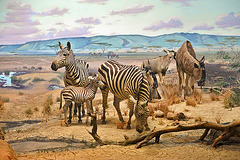
Zebras and Wildebeest Diorama – Carnegie Museum of…
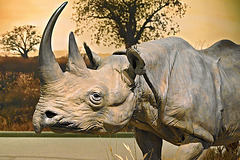
Black Rhinoceros – Carnegie Museum of Natural Hist…
| 27 May 2013 |
|
Although this species of rhinoceros is referred to as "black," its actual colours vary from brown to gray. The other African rhinoceros is the white rhinoceros (Ceratotherium simum). The word "white" in the name "white rhinoceros" is a misinterpretation of the Afrikaans word wyd, itself derived from the Dutch word wijd for wide, referring to its square upper lip, as opposed to the pointed or hooked lip of the black rhinoceros. These species are now sometimes referred to as the square-lipped (for white) or hook-lipped (for black) rhinoceros.
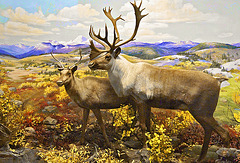
Caribou Diorama – Carnegie Museum of Natural Histo…
| 27 May 2013 |
|
"Taxidermy involves sculpture and anatomy and realism. And when you add a background painting in the dioramas, it’s the whole package. It’s as complete as you can get."
- Steve Rogers, Collection Manager, Birds, Reptiles, and Amphibians
Carnegie Museum of Natural History
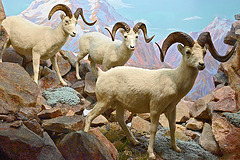
Dall Sheep Diorama – Carnegie Museum of Natural Hi…
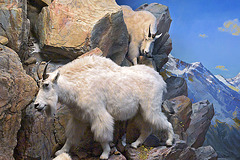
Mountain Goats Diorama – Carnegie Museum of Natura…
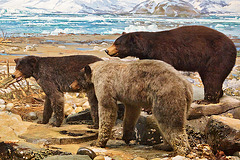
Alaskan Black Bears Diorama – Carnegie Museum of N…
| 26 May 2013 |
|
Black bears are the smallest of the North American bears. Adult bears stand about 29 inches (.73 m) at the shoulders and measure about 60 inches (1.5 m) from nose to tail. The tail is about two inches long. Males are larger than females. An average adult male in spring weighs about 180-200 pounds (81.8 to 90.9 kg). They are considerably lighter when they emerge from winter dormancy and may be 20 percent heavier in the fall when they are fat.
The color of this bear over its entire range varies from jet black to white. A very rare white or creamy phase occurs on Kermode Island and vicinity in British Columbia. Three colors are common in Alaska. Black is the most often encountered color, but brown or cinnamon bears are often seen in South-central Alaska and the Southeast mainland. The rare blue (glacier) phase may be seen in the Yakutat area and has been reported in other parts of Southeast Alaska. Only the black color phase is seen on the islands of Southeast. Black bears may have a patch of white hair on the fronts of their chests.
Black bears are most easily distinguished from brown bears by their straight facial profile and their claws which are sharply curved and seldom over 1½ inches in length. Positive identification can be made by measuring the upper rear molar which is never more than 1¼ inches long in the black bear and is never less than that in a brown bear. Black bears have adequate senses of sight and hearing. They do have, however, an outstanding sense of smell.
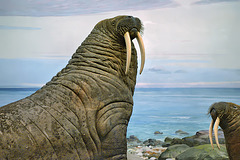
"For They Had Eaten Every One" – Carnegie Museum o…
| 03 Apr 2011 |
|
|
'The time has come,' the Walrus said,
'To talk of many things:
Of shoes -- and ships -- and sealing wax --
Of cabbages -- and kings --
And why the sea is boiling hot --
And whether pigs have wings.'
- Lewis Carroll (The Walrus and the Carpenter)
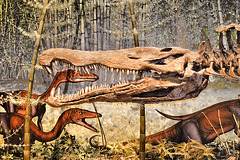
I'd Be Worried Too – Redondasaurus at the Carnegie…
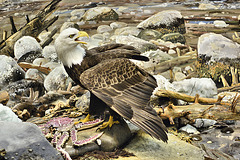
Bald Eagle Diorama – Carnegie Museum of Natural Hi…
Jump to top
RSS feed- Jonathan Cohen's latest photos with "diorama" - Photos
- ipernity © 2007-2026
- Help & Contact
|
Club news
|
About ipernity
|
History |
ipernity Club & Prices |
Guide of good conduct
Donate | Group guidelines | Privacy policy | Terms of use | Statutes | In memoria -
Facebook
X
