

Jonathan Cohen's photos with the keyword: St Pancras railway station
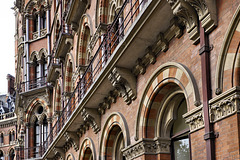
Victorian Gingerbread – St Pancras Railway Station…
| 26 Nov 2016 |
|
|
In 1865 the Midland Railway Company held a competition for the design of a 150-bed hotel to be constructed next to its railway station, St Pancras, which was still under construction at the time. Eleven designs were submitted, including one by George Gilbert Scott, which, at 300 rooms, was much bigger and more expensive than the original specifications. Despite this, the company liked his plans and construction began. The east wing opened in 1873, and the rest followed in the spring of 1876. The hotel was expensive, with costly fixtures including a grand staircase, rooms with gold leaf walls and a fireplace in every room. It had many innovative features such as hydraulic lifts, concrete floors, revolving doors and fireproof floor constructions, though (as was the convention of the time) none of the rooms had bathrooms. The hotel was taken over by the London, Midland and Scottish Railway in 1922 before closing in 1935, by which time its utilities were outdated and too costly to maintain, requiring armies of servants to carry chamber pots, tubs, bowls and spittoons.
After closing as a hotel, the building was renamed St Pancras Chambers and used as railway offices, latterly for British Rail. British Rail had hoped to demolish it, but was thwarted in a high-profile campaign by Jane Hughes Fawcett and her colleagues at the Victorian Society, a historic preservationist organization founded in part to preserve the Victorian railway buildings. Officials dubbed Jane Fawcett the "furious Mrs. Fawcett" for her unceasing efforts, and in 1967, the Hotel and the St. Pancras station received Grade I listed status. The building continued its use as rail offices, until the 1980s when it failed fire safety regulations and was shut down. In the 1990's the exterior was restored and made structurally sound at a cost of around £10 million.
Planning permission was granted in 2004 for the building to be redeveloped into a new hotel. The main public rooms of the old Midland Grand were restored, along with some of the bedrooms. The former driveway for taxis entering St. Pancras station, passing under the main tower of the building, was converted into the hotel's lobby. In order to cater for the more modern expectations of guests, a new bedroom wing was constructed on the western side of the Barlow train shed. As redeveloped the hotel contains 244 bedrooms, 2 restaurants, 2 bars, a health and leisure centre, a ballroom, and 20 meeting and function rooms. The architects for the redevelopment were Aedas RHWL. At the same time, the upper floors of the original building were redeveloped as 68 apartments by the Manhattan Loft Corporation. The St. Pancras Renaissance Hotel opened on 14 March 2011 to guests; however, the formal Grand Opening was on 5 May – exactly 138 years after its original opening in 1873.

The Champagne Bar – St Pancras Railway Station, Eu…
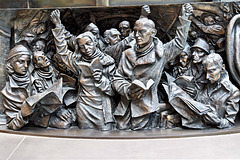
Weary Straphangers – Frieze below the "Meeting Pla…
| 22 Nov 2016 |
|
|
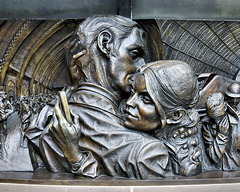
Paul Day (born 1967) is a British sculptor. His high-relief sculptures in terracotta, resin, and bronze have been exhibited widely in Europe and his work is known for its unusual approach to perspective. The Meeting Place, a 9 m (30 ft) tall bronze statue in St Pancras railway station in London, surrounded by a frieze around its base.
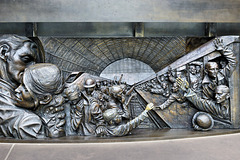
In 2008 a high-relief frieze was added to the base of the Meeting Place sculpture as part of refurbishments at St Pancras, featuring images from the history of the Tube and train: people queuing on platforms or traveling in carriages; soldiers departing for war and returning injured, and repair works following the 7 July 2005 London bombings. The work was the object of controversy when first erected, as one panel depicted a commuter falling into the path of a train driven by the Grim Reaper. However, following discussions with London and Continental Railways (LCR), this panel was replaced with another.
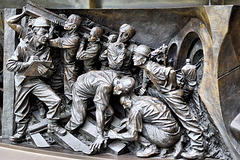
Laying Track – Frieze below the "Meeting Place" St…
| 22 Nov 2016 |
|
Paul Day (born 1967) is a British sculptor. His high-relief sculptures in terracotta, resin, and bronze have been exhibited widely in Europe and his work is known for its unusual approach to perspective. The Meeting Place, a 9 m (30 ft) tall bronze statue in St Pancras railway station in London, surrounded by a frieze around its base.
In 2008 a high-relief frieze was added to the base of the Meeting Place sculpture as part of refurbishments at St Pancras, featuring images from the history of the Tube and train: people queuing on platforms or traveling in carriages; soldiers departing for war and returning injured, and repair works following the 7 July 2005 London bombings. The work was the object of controversy when first erected, as one panel depicted a commuter falling into the path of a train driven by the Grim Reaper. However, following discussions with London and Continental Railways (LCR), this panel was replaced with another.
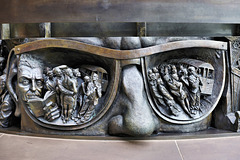
In the Eye of the Beholder – Frieze below the "Mee…
| 22 Nov 2016 |
|
Paul Day (born 1967) is a British sculptor. His high-relief sculptures in terracotta, resin, and bronze have been exhibited widely in Europe and his work is known for its unusual approach to perspective. The Meeting Place, a 9 m (30 ft) tall bronze statue in St Pancras railway station in London, surrounded by a frieze around its base.
In 2008 a high-relief frieze was added to the base of the Meeting Place sculpture as part of refurbishments at St Pancras, featuring images from the history of the Tube and train: people queuing on platforms or traveling in carriages; soldiers departing for war and returning injured, and repair works following the 7 July 2005 London bombings. The work was the object of controversy when first erected, as one panel depicted a commuter falling into the path of a train driven by the Grim Reaper. However, following discussions with London and Continental Railways (LCR), this panel was replaced with another.
A Different Perspective – Frieze below the "Meetin…
| 22 Nov 2016 |
|
|
Paul Day (born 1967) is a British sculptor. His high-relief sculptures in terracotta, resin, and bronze have been exhibited widely in Europe and his work is known for its unusual approach to perspective. The Meeting Place, a 9 m (30 ft) tall bronze statue in St Pancras railway station in London, surrounded by a frieze around its base.
In 2008 a high-relief frieze was added to the base of the Meeting Place sculpture as part of refurbishments at St Pancras, featuring images from the history of the Tube and train: people queuing on platforms or traveling in carriages; soldiers departing for war and returning injured, and repair works following the 7 July 2005 London bombings. The work was the object of controversy when first erected, as one panel depicted a commuter falling into the path of a train driven by the Grim Reaper. However, following discussions with London and Continental Railways (LCR), this panel was replaced with another.
Oh, What a Lovely War – Frieze below the "Meeting…
| 22 Nov 2016 |
|
Paul Day (born 1967) is a British sculptor. His high-relief sculptures in terracotta, resin, and bronze have been exhibited widely in Europe and his work is known for its unusual approach to perspective. The Meeting Place, a 9 m (30 ft) tall bronze statue in St Pancras railway station in London, surrounded by a frieze around its base.
In 2008 a high-relief frieze was added to the base of the Meeting Place sculpture as part of refurbishments at St Pancras, featuring images from the history of the Tube and train: people queuing on platforms or traveling in carriages; soldiers departing for war and returning injured, and repair works following the 7 July 2005 London bombings. The work was the object of controversy when first erected, as one panel depicted a commuter falling into the path of a train driven by the Grim Reaper. However, following discussions with London and Continental Railways (LCR), this panel was replaced with another.
"The Meeting Place Statue" – St Pancras Railway St…
| 22 Nov 2016 |
|
|
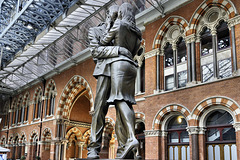
Paul Day (born 1967) is a British sculptor. His high-relief sculptures in terracotta, resin, and bronze have been exhibited widely in Europe and his work is known for its unusual approach to perspective. The Meeting Place, a 9 m (30 ft) tall bronze statue in St Pancras railway station in London, surrounded by a frieze around its base
Day studied at art schools in the UK at Colchester and Dartington, completing his training at Cheltenham in 1991. He now lives in a village near Dijon, France, with his French wife, Catherine. Their Anglo-French relationship is an explicit and repetitive reference in his works. The Meeting Place, which is modelled on an embrace between Paul and Catherine, standing as a metaphor for St. Pancras's role as the terminus of the rail link between England and France.
The Barlow Train Shed – St Pancras Railway Station…
| 22 Nov 2016 |
|
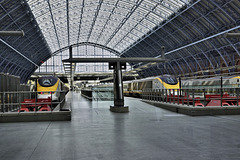
Widely known for its Victorian architecture, St Pancras station stands between the British Library, King's Cross station and the Regent's Canal. It was opened in 1868 by the Midland Railway as the southern terminus of its main line which connected London with the East Midlands and Yorkshire. When it opened, the arched Barlow train shed was the largest single-span roof in the world. William Henry Barlow FRS FRSE FICE MIMechE (10 May 1812 – 12 November 1902) was an English civil engineer of the 19th century, particularly associated with railway engineering projects.
Between 1862 and 1869, Barlow was consultant engineer for the Midland Railway's southern extension from Bedford to London, including the layout of the London terminus station at St Pancras on Euston Road. To deal with the sloping site and the need to cross the Regent's Canal a short distance to the north, the platforms were constructed on a raised structure supported on cast iron columns and girders. Under this structure, a storage space was laid out for beer from the breweries at Burton upon Trent. With assistance from Rowland Mason Ordish, Barlow also designed the arched, cast iron station canopy which spans 240 feet (73 m) across the platforms without intermediate support – then the widest of its kind in the world. It was designed as a cost effective and efficient means of avoiding the need for additional solid structure in the lower level. George Gilbert Scott designed the hotel in front of the train shed.
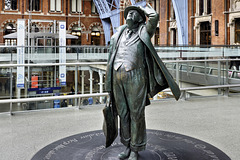
Sir John Betjeman – St Pancras Railway Station, Eu…
| 22 Nov 2016 |
|
The poet laureate, Sir John Betjeman, was responsible for saving the Station and the Chambers from demolition in the 1960's. In tribute to the famous poet and railway enthusiast an 8.5ft sculpture by Martin Jennings has been designed to celebrate the man and his poetry.
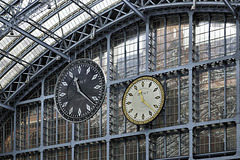
"One More Time" – St Pancras Railway Station, Eust…
| 15 Nov 2016 |
|
|
Dent was a London manufacturer of luxury clocks and watches, founded by Edward John Dent. Dent began making watches in 1814. Perhaps the company’s biggest coup is winning the contract to make the clock for the new palace of Westminster – or Big Ben as it’s more commonly known. Dent’s chronometers accompanied some of the 19th century’s most influential explorers. Robert FitzRoy took Dent chronometer no. 633 aboard HMS Beagle in 1831 the voyage that eventually led to the publication of The Origin of the Species – Darwin’s revolutionary theory of evolution. Two decades later, David Livingstone purchased Dent chronometer no. 1800 for his African explorations. And in 1890, the explorer H.M. Stanley was moved to write to Dent that "the Chronometers supplied by you, and which were taken across Africa in my last Expedition, proved a very great service to me and were in every way thoroughly satisfactory and reliable."
The Dent clock at St Pancras railway station is a reproduction of the original, destroyed in the 1970s, in part made from castings taken from the remains of the original. For much of the year 2015 a black-and-silver replica of the famous DENT clock dangled from the roof. The copycat chronometer was the work of Cornelia Parker, and was punningly known as "One More Time." It was a functioning timepiece; a horological redundancy; the embodiment, perhaps, of having too much time. In the artist’s own words: "The clock is the most conscious focus of a railway station, a dominant force. Everyone is watching the clock, checking if they are late. The piece will introduce the idea of a parallel frame of reference, that of a slower astronomical time."
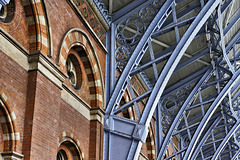
Supporting Casts – St Pancras Railway Station, Eus…
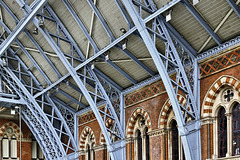
A Cathedral of Steel and Brick – St Pancras Railw…
| 15 Nov 2016 |
|
|
Close-up of the arched cast-iron roof supports at St Pancras International Station
A Truly Grand Hotel – St Pancras Railway Station,…
| 15 Nov 2016 |
|
|
|
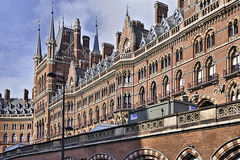
In 1865 the Midland Railway Company held a competition for the design of a 150-bed hotel to be constructed next to its railway station, St Pancras, which was still under construction at the time. Eleven designs were submitted, including one by George Gilbert Scott, which, at 300 rooms, was much bigger and more expensive than the original specifications. Despite this, the company liked his plans and construction began. The east wing opened in 1873, and the rest followed in the spring of 1876. The hotel was expensive, with costly fixtures including a grand staircase, rooms with gold leaf walls and a fireplace in every room. It had many innovative features such as hydraulic lifts, concrete floors, revolving doors and fireproof floor constructions, though (as was the convention of the time) none of the rooms had bathrooms. The hotel was taken over by the London, Midland and Scottish Railway in 1922 before closing in 1935, by which time its utilities were outdated and too costly to maintain, requiring armies of servants to carry chamber pots, tubs, bowls and spittoons.
After closing as a hotel, the building was renamed St Pancras Chambers and used as railway offices, latterly for British Rail. British Rail had hoped to demolish it, but was thwarted in a high-profile campaign by Jane Hughes Fawcett and her colleagues at the Victorian Society, a historic preservationist organization founded in part to preserve the Victorian railway buildings. Officials dubbed Jane Fawcett the "furious Mrs. Fawcett" for her unceasing efforts, and in 1967, the Hotel and the St. Pancras station received Grade I listed status. The building continued its use as rail offices, until the 1980s when it failed fire safety regulations and was shut down. In the 1990's the exterior was restored and made structurally sound at a cost of around £10 million.
Planning permission was granted in 2004 for the building to be redeveloped into a new hotel. The main public rooms of the old Midland Grand were restored, along with some of the bedrooms. The former driveway for taxis entering St. Pancras station, passing under the main tower of the building, was converted into the hotel's lobby. In order to cater for the more modern expectations of guests, a new bedroom wing was constructed on the western side of the Barlow train shed. As redeveloped the hotel contains 244 bedrooms, 2 restaurants, 2 bars, a health and leisure centre, a ballroom, and 20 meeting and function rooms. The architects for the redevelopment were Aedas RHWL. At the same time, the upper floors of the original building were redeveloped as 68 apartments by the Manhattan Loft Corporation. The St. Pancras Renaissance Hotel opened on 14 March 2011 to guests; however, the formal Grand Opening was on 5 May – exactly 138 years after its original opening in 1873.
Railway Clock Towers – St Pancras Railway Station,…
Jump to top
RSS feed- Jonathan Cohen's latest photos with "St Pancras railway station" - Photos
- ipernity © 2007-2026
- Help & Contact
|
Club news
|
About ipernity
|
History |
ipernity Club & Prices |
Guide of good conduct
Donate | Group guidelines | Privacy policy | Terms of use | Statutes | In memoria -
Facebook
X
