

Jonathan Cohen's photos with the keyword: Huntington Avenue
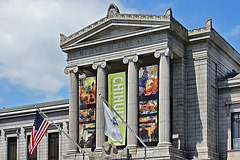
Museum of Fine Arts – Boston, Massachusetts
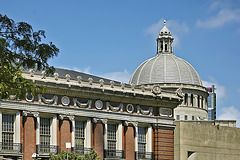
Horticultural Hall – Huntington Avenue at Massachu…
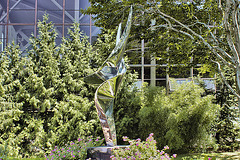
The Flame of Hope – Northeastern University Campus…
| 10 Dec 2011 |
|
Flame of Hope, located on the corner of Forsyth Street and Huntington Avenue on the campus of Northeastern University, was designed by sculptor Leonardo Nierman in 1994. The 9-foot tall stainless steel sculpture rests atop a polished marble base.
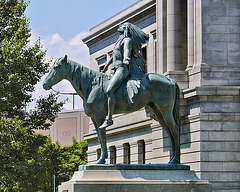
Appeal to the Great Spirit – Museum of Fine Arts,…
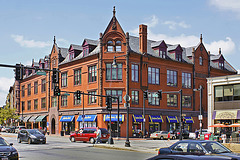
The Symphony Market – Huntington Avenue at Gainsbo…
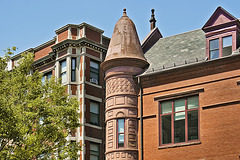
Getting into Shapes – Huntington Avenue, Boston, M…
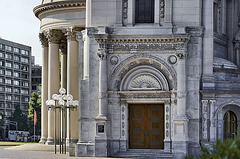
Portico, Christian Science Mother Church – Boston,…
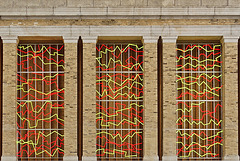
Waiting in Lines – Cafeteria, Museum of Fine Arts,…
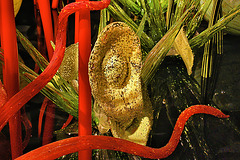
Golden Ears – Chihuly's "Mille Fiori", Museum of F…
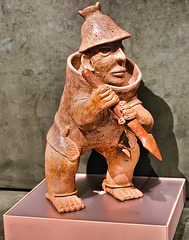
Jalisco Warrior – Museum of Fine Arts, Boston, Mas…
| 22 Dec 2011 |
|
Crouching in a pose of readiness found often in Jalisco sculptures, this earthenware warrior sports unusually detailed attire, including, his protective basketry helmet and tunic, a decorated hip wrap, and the circular motifs painted on his face. The carefully rendered finger and toenails and red-painted spear highlight the sculptor’s attention to detail. The statue dates from some time between 300 BCE and 200 CE.
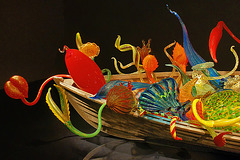
Chihuly's "Ikebana Boat" – Museum of Fine Arts, Bo…
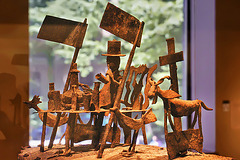
Benin in Boston – Museum of Fine Arts, Boston, Mas…
| 14 Dec 2011 |
|
An asen is an altar commemorating a deceased person in the Fon culture. Family members in the world of the dead maintain an active role in the world of their living relatives and the asen facilitates communion between these two realms. Periodically, food offerings are placed upon the asen, or libations are poured over it, in order to please the deceased.
This asen was made in the coastal city of Ouidah in the Republic of Benin. Ouidah was infamous as a slave port for France, Britain, Holland, and Portugal. By the end of the slave trade in the 19th century Ouidah’s most important inhabitants were Afro-Brazilians, freed slaves returning from the Portuguese plantations of Brazil. The Brazilian influence is seen in the tableau of objects on the platform. The commemorated person sits on an ornate chair instead of an African stool, wearing a European stovepipe hat and clothes (status symbols indicating the wealth and standing of the deceased). The Christian cross indicates a familiarity with Portuguese Catholicism and coexists alongside older Fon symbolic motifs. For example, The tethered goat and roosters represent food offerings made to the deceased.
This asen is made of iron, with iron oxide encrustations. It dates from the mid-19th century.

Making Waves – Chihuly's Persian Wall, Museum of F…
| 17 Dec 2011 |
|
"Have you considered that if you don't make waves, nobody including yourself will know that you are alive?"
- Theodore Isaac Rubin
Over the Top – Museum of Fine Arts, Boston, Massac…
| 13 Dec 2011 |
|
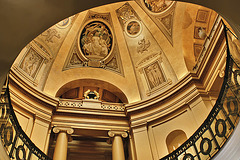
Webster’s Dictionary defines a cupola as "a rounded vault resting on a usually circular base and forming a roof or a ceiling." In other words, it is literally over the top.
The ceiling above the rotunda of the Boston Museum of Fine Arts is also "over the top" in the collquial sense of the term. When he was commissioned to create decorations for a library entrance, the ceiling above the grand stairway and the dome of the gallery's rotunda, artist John Singer Sargent chose as the theme of his creations a celebration of the arts. Sargent (1856-1925) was an American expatriate who was trained in Paris prior to moving to London where he found fame as a portraitist of America's Gilded Age and Edwardian England. He worked for almost 10 years on the commission in a rented Boston studio, where he constructed a model of the dome and experimented with decorative schemes using plaster studies. When his decorations were unveiled at the Museum of Fine Arts in 1925, reviewers compared his achievement with that of Michelangelo. Sargent never saw the final installation, however, having died in London on the eve of his departure to Boston.
Rather than creating his murals as frescoes – that is, applying the paint directly to wet plaster walls – Sargent produced monumental oil paintings in his studios in London and in Boston’s South End. The finished canvases were then adhered to the Museum’s walls. Sargent also created plaster reliefs, the frames for his paintings and sculptures, the ornaments that adorn the spandrels, and even the classical-style urns and sphinxes in the balconies above the rotunda’s three doorways.
To complement the building’s classically influenced architecture, Sargent depicted scenes from ancient mythology. He also invented subjects using mythological figures to illustrate the Museum’s role as guardian of the arts. The key painting – the first work of art that visitors see as they ascend the grand staircase – features Athena, the Greek goddess of wisdom, turning away a figure representing Time, while sheltering with her cape three personifications of the visual arts: Sculpture (left); Painting (right); and, in the pose of Michelangelo’s Bruges Madonna (one of Sargent’s many quotations from great art of the past), Architecture.
Bau and Baru – Museum of Fine Arts, Boston, Massac…
| 25 Dec 2011 |
|
I’ve always been a bit of a history wonk. Every now and then I see something about or from an ancient civilization that transforms my view of the past.
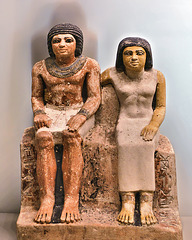
I had always thought of Egyptian art as being literally and emotionally stylized to death. Within a tomb, statues of the deceased were often placed for protection in a sealed room called a "serdab ." The ancient Egyptians believed that the "ka" or spirit of the deceased could inhabit a statue in the serdab , peering into the tomb chapel through a slit in the wall Food for the ka was placed on an offering table nearby.
One such statue is this painted limestone representation of a couple – whose names are Bau and Baru – seated on a cube-like chair. They lived at the time of the 5th dynasty of Egypt's Old Kingdom period – about 4,500 years ago. The husband, Bau, wears a short, curly wig, broad collar, and knee-length kilt. He sits with his hands in his lap, his right hand holding a handkerchief and his left palm open. Baru sits with her left hand flat on her lap and her right arm around her husband’s waist. She wears a full wig, broad collar, and tightly-fitting white sheath dress. The chair is painted pink in imitation of granite.
What so impresses me about this statue is how natural and unstylized it seems to be. Bau and Baru seem to me people not essentially different from the people whom I meet every day in amy own life, with their joys and their sorrows and their love for one another.
The Prudential Center – Boston, Massachusetts
Procession of Male Offering Bearers – Museum of Fi…
| 28 Dec 2011 |
|
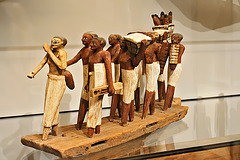
This procession is led by a priest, followed by a scribe holding his writing board and palette under his arm. The remainder of the figures bear food offerings, including loaves of bread stacked on one man's arms.
From the Deir el-Bersha tomb; Egyptian, Middle Kingdom, late Dynasty 11 – early Dynasty 12, 2010–1961 B.C.E.
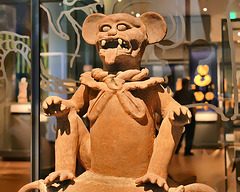
A Bat Attitude – Museum of Fine Arts, Boston, Mass…
| 23 Dec 2011 |
|
The K’iché (Quiché in Spanish) are a Mayan people who live in Guatemala. The semi-hemispherical lid of this burial or cache urn is embellished with a sculpted and painted rendering of a seated anthropomorphic bat with large round ears, open mouth, protruding tongue, and front paws resting on bent knees. The bat wears a twisted scarf and crenelated collar, which may make reference to one of the supernatural jaguars associated with the underworld and sacrifice.
Jump to top
RSS feed- Jonathan Cohen's latest photos with "Huntington Avenue" - Photos
- ipernity © 2007-2026
- Help & Contact
|
Club news
|
About ipernity
|
History |
ipernity Club & Prices |
Guide of good conduct
Donate | Group guidelines | Privacy policy | Terms of use | Statutes | In memoria -
Facebook
X
