

Jonathan Cohen's photos with the keyword: Walnut Street
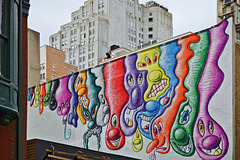
Philly Chunk Pack – 13th Street between Walnut and…
| 20 Mar 2014 |
|
|
Philadelphia, the fifth-largest city in the United States, prides itself on its public art. In 1872 the Fairmount Art Association was the first private body in the US to focus on integrating art into public planning. It continues to commission works and claims there are 1,700 pieces in the city and its network of 63 neighbourhood and regional parks. Philadelphia was also the first American city to legislate a percentage garnish on development projects, which has resulted in the siting of more than 200 works. The streets and other public spaces of Philadelphia contain pieces by Oldenburg, Remington and Calder, among almost 400 artists. Philadelphia is also considered to be one of the mural capitals of the world. Its Mural Arts Program (MAP) is the largest public arts program in the USA. It is responsible for the creation of over 3,000 murals throughout the city.
The real estate developer Tony Goldman, who died in 2012, was largely responsible for the transformation of 13th Street in Center City, Philadelphia. Towards the end of his life, he collaborated with the Mural Arts Program to endow the city with imaginative works of contemporary art by highly regarded artists. The Goldman-Mural Arts collaboration began in the summer of 2011 with the installation of "Philly Chunk Pack," by Brooklyn-based artist Kenny Scharf. The artist worked with 15 students enrolled in the Mural Arts Program’s Big Picture project. The graffiti-inspired mural, located on a wall above Graffiti Bar at 120 South 13th Street, between Walnut and Sansom, is a contemporary scene of cartoon-like characters painted with bright, acrylic spray paint. Scharf explains that the mural is "Inspired by all the colourful characters in Philadelphia – there seem to be a lot of them here – and also by the wall itself and how it is viewed from the street."
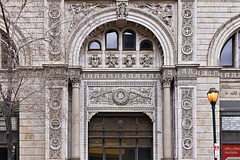
The Witherspoon Building – 1319-23 Walnut Street,…
| 19 Mar 2014 |
|
|
Witherspoon Building is a historic office building located in the Market East neighborhood of Philadelphia, Pennsylvania. It was designed by architect Joseph M. Huston (1866–1940) and built between 1895 and 1897. It was built for the Presbyterian Board of Publications and Sabbath School Work. It is an 11-story, steel frame "E"-shaped building, faced with brick and granite. It has terra cotta decorative elements. Its exterior features Corinthian order and Ionic order columns, statues, medallions, seals of various boards and agencies of the Presbyterian Church and of related Reformed churches, as well as medallions representing the four evangelists of the Christian Bible. Six of the statues and some of the medallions were designed by sculptor Alexander Stirling Calder (1870–1945). It is named for John Witherspoon (1723–1794), founder of Princeton University. It was added to the National Register of Historic Places in 1978.

Art Deco Grill – Walnut and 16th Streets, Philadel…

The Latham Hotel – Walnut and 17th Streets, Philad…

The Facade of Privilege – The Former Rittenhouse C…
| 16 Mar 2014 |
|
In 1878, the Social Art Club, founded in 1875 as a literary society, moved from 1525 Chestnut Street to 1811 Walnut Street, the first house built on Rittenhouse Square by James Harper in the 1840s (with the marble portico). To celebrate its move, the organization changed its name to the Rittenhouse Club. Founding member Frank Furness redesigned the building, covering the red brick facade with white marble. In 1890, the club purchased 1813 Walnut Street and connected the two buildings' interiors. By 1900, the Rittenhouse Club was one of the city’s most fashionable retreats for men, described by one guide as a "junior ultra swell club." The author Henry James, who praised it for its "large friendliness, ordered charm and perfect peace," used to sit at a window and view this Square with his worldly eye.
The club – long a bastion of white, male, Anglo-Saxon privilege, lost its clubhouse but continues to exist as an "inner club" of the Acorn Club, a women’s club – itself a bastion of white, female, Anglo-Saxon privilege. The building that formerly housed the club was recently demolished except for its facade, which now fronts a new high-rise condominium.
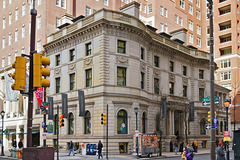
The Fell-Van Rensselaer House #2 – Rittenhouse Squ…
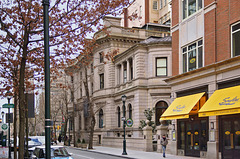
The Fell-Van Rensselaer House #1 – Rittenhouse Squ…
| 15 Mar 2014 |
|
Facing Rittenhouse Square on the northeast corner is the former home of financier Alexander Van Rensselaer. It is one of the few splendid old mansions to survive demolition.The house was completed in 1901 at the corner of 18th and Walnut, it is the work of the famous Boston architectural firm of Peabody and Stearns. In 1898, Alexander Van Rensselaer had the good sense, and apparently the pedigree, to marry the recently widowed daughter of Anthony Drexel. The former Sara Drexel Fell is said to have paid for the house herself, hence the appellation Fell-Van Rensselaer house.
It exemplifies the "Beaux Arts" style of architecture as applied to private residences. It is a beautifully balanced composition, erudite in its detail, gracious in scale and proportion, and totally appropriate to the lives of the people who built it. Besides finance, Mr. Van Rensselaer was a founder and longtime President of the Philadelphia Orchestra, as well as a Board President of Drexel Institute. His wife died in 1929, he followed her in 1933, after which the house remained shut throughout the Depression. In 1942 the estate finally rented it to the Pennsylvania Athetic Club rowing association. No doubt overjoyed to at last get warm bodies in the place, they probably took whatever the club could pay for rent. Penn Athletic’s tenancy wasn’t long term, however, and the house was soon empty again. Most recently, the building has been subdivided into luxury condominiums.
The Alison Building next door contains the offices of the Presbyterian Ministers’ Fund, the oldest life insurance company in the world (1717). Adjacent to it, at 1811 Walnut Street and also facing the Square, is the Rittenhouse Club, another of the city’s old and exclusive clubs. The author Henry James used to sit at a window and view this Square, too, with his worldly eye.
Jump to top
RSS feed- Jonathan Cohen's latest photos with "Walnut Street" - Photos
- ipernity © 2007-2026
- Help & Contact
|
Club news
|
About ipernity
|
History |
ipernity Club & Prices |
Guide of good conduct
Donate | Group guidelines | Privacy policy | Terms of use | Statutes | In memoria -
Facebook
X
