

Jonathan Cohen's photos with the keyword: Wanamaker's department store
Meet Me in St. Louis, Louis – Wanamaker Grand Cour…
| 03 Jul 2011 |
|
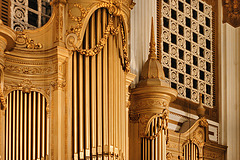
The Wanamaker Organ was originally built for the 1904 St. Louis World's Fair. It was designed to be the largest organ in the world, an imitation of a full-size orchestra with particularly complete resources of full organ tone including mixtures. Despite its then-unprecedented size (more than 10,000 pipes), it was judged inadequate to fill the seven-story Grand Court in which it was located, so Wanamaker's opened a private organ factory in the store attic, which was charged with enlarging the organ. The first project to enlarge the organ was the addition of 8,000 pipes between 1911 and 1917.
"Meet me in St. Louis, Louis,
Meet me at the Fair
Don't tell me the lights are shining
Anyplace but there
We will dance the 'Hoochie-Koochie'
I will be your 'Tootsie-Wootsie'
If you will meet me in St. Louis, Louis,
Meet me at the Fair."
- Andrew B. Sterling
Meet Me at the Eagle – Wanamaker's (Now Macy's) Gr…
| 03 Jul 2011 |
|
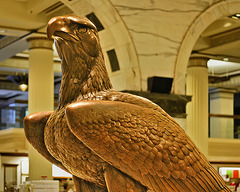
Like the Organ, the Eagle, also came from the St. Louis World's Fair, where it was part of the German Exhibit of Arts and Crafts. All of the heavy plates that form the inner structure, as well as the feathers and other surface features, were separately wrought by hand with chisel, file and hammer. Each individual feather on the head and body was carefully modeled and fitted into place. There are 1,600 feathers on the head alone, and 5,000 on the entire Eagle. The sculpture weighs 2,500 pounds and sits on a granite base. The floor of the Grand Court had to be strengthened with girders to accommodate it.
There is an old Philadelphia custom to rendezvous in Center City by saying "Meet me at the Eagle."
Welcome to Wanamaker's – Center City, Philadelphia…
| 06 Jul 2011 |
|
Maxine Dalsemer works in the Visitor Center of Macy’s and gives an informative tour of the Wanamaker Building. During the tour she talks extensively about the history of the Wanamaker building, its architecture, and the business conducted within. She states that the building is made up of cement and steel with a façade of granite from Maine and an interior of the finest marble. "Wanamaker," she says, "didn’t think of the space in terms of dollars per square foot as most retailers do but was more concerned with the grandeur and beauty of the space."
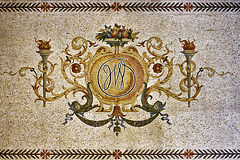
She points out that the columns on the second floor lining the Grand Court are Corinthian, the ones on the third floor are Ionic, and the columns on all the floors supporting the ceilings are Doric. She brings the tour to a vestibule to show the very intricate mosaics made of Terrazzo Marble tiles that are placed painstakingly to create the Wanamaker’s logo
Ms Dalsemer claims that at one point there were a tennis court and a jogging track on the roof for the benefit of the store’s employees, but that they regrettably have been replaced with air conditioning units. As she walks through the store she reveals that most of the walls that the shoppers see are false walls used to camouflage stock rooms. She leads the tour past what used to be the Egyptian room on the 3rd floor but remorsefully declares that it has been converted to the executive offices. She explains that it once was a sales floor/auditorium that sold and auctioned off pianos. For special occasions the pianos were disassembled and stored to make room for the seating of 700 or more people. The tour is then brought to the Greek Hall also on the 3rd floor. This dark wood-paneled room with Tiffany Stained Glass Windows has intricately carved wood ceilings featuring Hellenistic patterns, molding featuring large plaster cameos of Roman generals, and elaborate inlayed wood designs on the walls.
Jump to top
RSS feed- Jonathan Cohen's latest photos with "Wanamaker's department store" - Photos
- ipernity © 2007-2026
- Help & Contact
|
Club news
|
About ipernity
|
History |
ipernity Club & Prices |
Guide of good conduct
Donate | Group guidelines | Privacy policy | Terms of use | Statutes | In memoria -
Facebook
X
