

Jonathan Cohen's photos with the keyword: Lower East Side
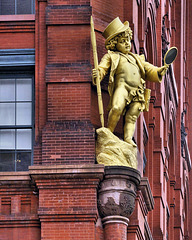
What Fools These Mortals Be! – The Puck Building,…
| 07 Jul 2015 |
|
|
|
The Puck Building sports two gilded statues by sculptor Henry Baerer of Shakespeare’s character Puck, from A Midsummer’s Night Dream. The cherub-faced and well-attired Puck was the "mascot" of Puck, the illustrated, satirical weekly, and he stands holding a very large pen that is about his height in his right hand. Each Puck sports a top hat and tails. In the proper left hand is a mirror, in the right an oversize writing instrument. Over the left shoulder, on a sash, is slung a book or satchel bearing the magazine’s motto. Beneath their bright gilt, the Pucks are made of zinc, a popular material for late 19th-century sculpture. Should time or money run short, zinc sculptures could be quickly assembled from small pieces – their joints hidden by a coat of paint that simulated more expensive marble or bronze.
The 10-foot Puck depicted above overlooks the corner of Houston and Mulberry Streets.
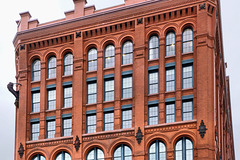
The Puck Building – Houston Street at Lafayette, N…
| 07 Jul 2015 |
|
|
The Puck Building is an historic building located in the So Ho neighborhood of Manhattan, New York City. It occupies the block bounded by Lafayette, Houston, Mulberry and Jersey Streets. An example of the German Rundbogenstil (round-arched neo-Romanesque) style of architecture, the building was designed by Albert Wagner. Structurally, the building is related to the Chicago-Style buildings developed by (among others) Burnham & Root and Sullivan & Adler. The steel frame allowed much larger bands of windows along the ground floor than were possible on the masonry buildings constructed in New York City well into the 1880s.
Puck was America’s first successful humor magazine. Its founder, Joseph Keppler (1838-1894), an immigrant from Austria, named it after the mischievous character in Shakespeare’s Midsummer Night’s Dream, whose famous line he adopted as his magazine’s motto: "What fools these mortals be!" Issued weekly in German from 1876 to 1896 and in English from 1877 to 1918. Puck was a substantial 10 x 13.5 inches with several pages of color illustrations. Keppler was a master lithographer whose cartoons rivaled those of Thomas Nast. Unlike Nast, he attacked both political parties with gusto, as well as Catholics, Mormons, Chinese, Irish, suffragettes, trade unions, Thomas Edison and Joseph Pulitzer.
When Puck Magazine ceased publication in 1918, the building continued to house numerous independent printing firms and related printing services such as typesetters and a printing ink company. Indeed, the odor of printing ink permeated the building for many years. An office stationery company, S. Novick & Son, once occupied the second floor. Notable amongst the firms’ salesmen was Alger Hiss, the former assistant Secretary of State who was brought down in a spy scandal in the 1950s. In the 1980s, the Puck Building was the home of Spy Magazine, whose editors informally dubbed it "The Spy Building". In the early 2000s, the building housed the Manhattan Center of Pratt Institute. New York University, which signed a 15-year lease for three floors of the Puck Building in June 2003, has since been negotiating with the building's owner to secure the rest of the building.
The Puck Building was added to the National Register of Historic Places on July 21, 1983.
Leon of Juda – Bowery between Stanton and East Hou…
| 06 Jul 2015 |
|
|
Regent Restaurant Equipment – Rivington at Bowery,…
| 05 Jul 2015 |
|
|
|
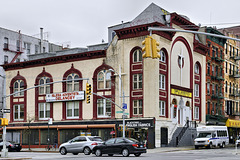
Templo Adventista del Septimo Dia – Delancey Stree…
| 05 Jul 2015 |
|
|
|
Today the church at 126 Forsyth Street is known as the Templo Adventista del Septimo Dia (Seventh Day Adventist Church). But this wasn’t always the case. Look closely at the tan-and-red facade and you will notice evidence of the building’s Jewish past. Many Jewish stars are quite visible within the ornate window arches. Regardless of religious affiliation, however, this house of worship is an icon of Lower East Side history.
The Romanesque Revival building was erected in 1890 by a renowned architect named Josiah Cleveland Cody, and was a temporary home to a missionary group attempting to proselytize among the Jewish people. Their efforts did not bear fruit and they soon sold the building to the Chevrah Poel Zedek Anschei Illia. The Chevrah was founded by a small group of immigrants from the shtetl of Illia, in the province of Vilna, Lithuania. These immigrants longed for a taste of home in the midst of a foreign land. They decided to form a fellowship in order to have a place to pray together and meet with their fellow countrymen, to help each other, and to hear news from the old home.
For approximately the first ten years of its existence, the congregation had wandered from one small rented location to another on the Lower East Side. As time went on, some of the members became rich and more Americanized. They wanted to have a large synagogue of their own with a cantor, choir, and rabbi. A renovation in 1909 brought retail storefronts, and extra money to the congregation. But by the mid-1920s, the synagogue was in decline, thanks in part to "changes in the neighborhood." Nevertheless, the tight-knit community remained there until the 1960s when the building was finally sold. The new owners removed both the dome on the roof and the rose window above the main entrance – as attested by the photo below.
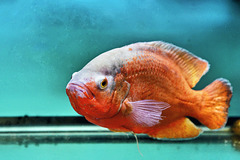
Red Melon Oscar Fish – Pacific Aquarium & Plant, D…
| 05 Jul 2015 |
|
|
|
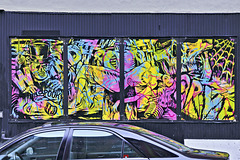
GHOST on Eldridge – Eldridge and Broome Streets, L…
| 05 Jul 2015 |
|
GHOST is an Art Lounge serving the local community and art enthusiasts of the Lower East Side, New York City. The name comes from photos and eyewitness accounts of a ghostly apparition in front of the space when it was first built on this historic block! GHOST is an extension of Woodward Gallery's Project Space with rotating street art exhibitions on the exterior and interior walls.

Not Quite Symmetrical – Eldridge and Broome Street…

Mini Ivy – Eldridge and Broome Streets, Lower East…

Hua Kee Glass – Eldridge and Broome Streets, Lower…
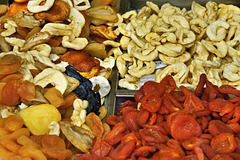
Dried Fruit – Russ & Daughters, East Houston Stree…
| 01 Jul 2015 |
|
Russ & Daughters is a family-operated food store specializing in appetizers. It is located at 179 East Houston Street, on the Lower East Side of Manhattan, New York City.
Joel Russ, a immigrant from Poland who arrived in Manhattan around 1905, started the business to cater to his fellow immigrants in the Lower East Side of New York. He began by carrying Polish mushrooms on his shoulders, and saved enough money to purchase a pushcart. He then expanded his operation and sold pickled herring as well as mushrooms. Then in 1914, he opened J Russ International Appetizers, a storefront around the corner from the current location. In 1920, Russ moved his store to its current location at 179 East Houston Street.
In 1933, he renamed the business "Russ and Daughters" after making his three daughters, Hattie, Anne, and Ida, partners in the store. Businesses typically took on the name "and sons", but since Russ and his wife Bella had only daughters, his business became Russ & Daughters. However, Joel Russ was not a feminist ahead of his time. For him, getting his daughters into the business was not a matter of women’s rights, but a matter of economic survival. According to Hattie, she and the other daughters had all been working in the store on weekends since they were 8 years old, fishing the herring fillets from the pickle barrels. And as each of the girls finished high school, she started to work full-time.
Congregation Chasam Sopher – Clinton Street below…
| 01 Jul 2015 |
|
|
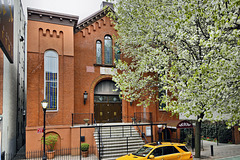
Congregation Chasam Sopher is an Orthodox synagogue located at 10 Clinton Street on the Lower East Side of Manhattan. It was formed in 1892 by the merger of two congregations of immigrants from Poland. It occupies a historic Romanesque Revival synagogue building built in 1853 by Congregation Rodeph Sholom. It is among the oldest synagogue buildings still standing in the United States, the second-oldest synagogue building in New York State, and the oldest still in use in the state.
Renovation of the upstairs, completed in 2006, included conservation of the Torah ark, the installation of new stained-glass windows, and stripping the interior of paint to expose the original wood. The outside was also landscaped, creating a garden for the neighborhood.
The congregation bears the name of Moses Schreiber (1762–1839), known to his own community and Jewish posterity by his pen name, Chatam Sofer (literally: "Seal of the Scribe" – pronounced "Chasam" in the accent of east and central European Jewry). The Chatam Sofer was one of the founders of ultra-Orthodox Judaism in first half of the nineteenth century.
The Old Streit’s Matzah Bakery – Rivington Street…
| 01 Jul 2015 |
|
|
|
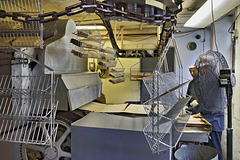
Matzah is the Hebrew word for the unleavened bread eaten by Jews during the springtime festival of Passover. Aron Streit, Inc. (sold under the brand name Streit's) is a kosher food company based in New York City. It is the only remaining family-owned and operated matzah company in the United States. The company was founded in 1916 by Aron Streit, a Jewish immigrant from Austria. Its first factory was on Pitt Street in the Lower East Side of Manhattan. There, Streit and his business associate Rabbi Weinberger made each piece of matzah by hand. In 1925, with the growing number of Jewish immigrants congregating in the Lower East Side, Streit, along with his two sons, moved his business to nearby Rivington Street. Soon thereafter, they bought the adjacent buildings where the company operated until April, 2015.
Streit’s 47,000-square-foot (4,400 m2) matzah factory, along with Katz’s Delicatessen and Yonah Schimmel’s Knish Bakery, was a surviving piece of the Lower East Side’s Jewish heritage. At the turn of the 20th century Jews, along with other European Immigrants, were crammed into the many unsanitary tenements of the Lower East Side. In 1915 they made up 60 percent of the Lower East Side population. Because of the large Jewish presence, Jewish-centric businesses like Streit’s opened and flourished. However, because of the poor living conditions, many Jewish families moved out of the tenements as soon as could afford to new areas of New York City, namely uptown and Brooklyn. Slowly Streit’s became a relic of the past.
Since the 1980s the Lower East Side has experienced hyper gentrification. The neighborhood is now a burgeoning area for glass luxury high rise buildings such as the Blue Condo and the Hotel on Rivington – a stark contrast to Streit's modest brick factory. Despite the changing neighborhood, the factory still tried to integrate itself with the community. It gave out fresh pieces of matzah to passing pedestrians. (I can vouch for this myself -- you've never tasted matzah until you've eaten it still warm from the oven!). At one time its adjacent shop even served as a community art gallery. The Streit family even considered opening a café or bar that served matzah, to go with the Lower East Side’s new nightlife scene.
In April 2015, they sold the building for a reported $25 millionand moved the operation to a location in New Jersey. It is worth noting that any employee who chose to make the move was guaranteed his or her old job in the new location.

The Fish on the Subway Wall – Delancey Street Stat…
| 07 May 2015 |
|
|
|
The Delancey Street subway station houses two large wall-sized pieces of artwork, one on each wall where the staircase exits and transfers are located. Both glass mosaics are the work of artist Ming Fay. The artwork on the downtown side is titled Shad Crossing and details two giant shad fish swimming, along with another wall mosaic of blue waters. In the late 19th century, shad were found along the Hudson River when new immigrants came to New York, many of whom settled on the Lower East Side.
Ming Fay is a Shanghai-born and New York City-based sculptor and professor. His work focuses on the concept of the garden as a symbol of utopia and the relationship between man and nature. Drawing upon an extensive knowledge of plants both Eastern and Western, real and mythical, Fay creates his own calligraphic floating forest of reeds, branches and surreal species. Ming Fay was born in Shanghai in 1943 and raised in Hong Kong. His mother was an artist, and his father worked in the then-burgeoning Hong Kong movie industry as an art director. Both were students of Shanghai-based sculptor Zhang Chongren, who had studied Western sculpture in Europe. Ming came to the United States in 1961 to study at the Columbus College of Art and Design and later at the Kansas City Institute of Art. Subsequently, Fay earned a graduate degree in sculpture at the University of California, Santa Barbara in 1975. He currently teaches sculpture at William Paterson University in Wayne, New Jersey.
The Odd One Out – Orchard Street, Lower East Side,…
| 07 May 2015 |
|
|
|
One Way; Full Stop – Orchard and Broome Streets, L…
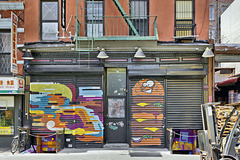
Fries With That? – Ludlow Street, Lower East Side,…
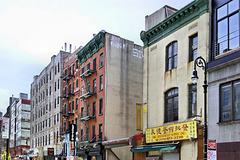
Restaurant Supply – Ludlow Street, Lower East Side…
Jump to top
RSS feed- Jonathan Cohen's latest photos with "Lower East Side" - Photos
- ipernity © 2007-2026
- Help & Contact
|
Club news
|
About ipernity
|
History |
ipernity Club & Prices |
Guide of good conduct
Donate | Group guidelines | Privacy policy | Terms of use | Statutes | In memoria -
Facebook
X
