

Jonathan Cohen's photos with the keyword: rue Atwater
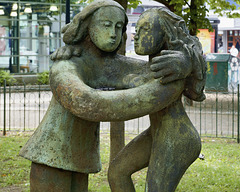
"Les amoureux" – Cabot Square, Saint Catherine Str…
| 24 Jun 2014 |
|
Cabot Square is an urban square in Montreal, between the former Montreal Forum and the Montreal Children's Hospital. The square is located in the Shaughnessy Village neighbourhood, an area which has been recently re-dubbed the Quartier des Grands Jardins and has been slated for redevelopment.
The square opened in 1870 and the monument to Italian-born English explorer John Cabot, by Italian sculptor Guido Casini (1892-1956), was unveiled on May 25, 1935. The square is unusual by Montréal standards in that it has multiple short fences and hedges employed to direct traffic and prevent too much through-traffic from ruining the grass, a design concept that hasn't entirely worked out. The square is well-used but generally by a population of homeless or otherwise impoverished people. It remains a popular destination for members of those groups wishing to drink alcohol outdoors. For this reason there is generally a visible police and public security presence in the area.
Of late, installation artwork and conceptual sculptures have been integrated into the square as part of a broad urban beautification plan. In late summer/early fall 2013, the city began a major cleanup of the square including: cleaning the statue of Cabot, pruning the trees and collecting debris.
Robert Lorrain (born in Saint-Jean-sur-Richelieu, Québec in 1940) is a Canadian painter and sculptor and a long-time devotee of Sri Aurobindo. He is largely a self-taught artist, describing technique as "only a necessity." "What truly marks high art," he says "is when you sense that beauty has been expressed through intensity of dedication." Reminiscing about the time he studied at the École des Beaux Arts in Montreal, he says, "There was only one teacher there whom I inwardly recognised as an artist, someone with a burning dedication which infused all his teaching." And passionately: "When you make a piece of art, you concentrate, you give the utmost of what you can. You ask a lot of yourself because you know that that is the only circumstance under which true beauty will manifest. It all depends on what the artist puts into the work." He believes that many artists don’t go deep enough and and avoid questioning themselves. "They should be asking themselves ‘Is this work really beautiful?’ There should be a burning need for continuous self-improvement. For only then does one get towards the spiritual aspect of art."
This sculpture is entitled "The Lovers." The artist describes his work: "Tenderness, sharing, equality. The couple is idealized here in its quest for union. The man, quiet, relying on his strength, brings his protection. The woman, naked, offers her sensuality in response."
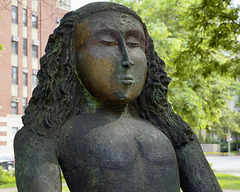
"Le dignitaire" – Cabot Square, Saint Catherine St…
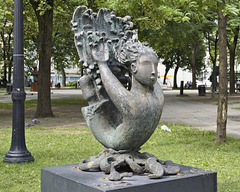
"L'élan" – Cabot Square, Saint Catherine Street at…
| 23 Jun 2014 |
|
Cabot Square is an urban square in Montreal, between the former Montreal Forum and the Montreal Children's Hospital. The square is located in the Shaughnessy Village neighbourhood, an area which has been recently re-dubbed the Quartier des Grands Jardins and has been slated for redevelopment.
The square opened in 1870 and the monument to Italian-born English explorer John Cabot, by Italian sculptor Guido Casini (1892-1956), was unveiled on May 25, 1935. The square is unusual by Montréal standards in that it has multiple short fences and hedges employed to direct traffic and prevent too much through-traffic from ruining the grass, a design concept that hasn't entirely worked out. The square is well-used but generally by a population of homeless or otherwise impoverished people. It remains a popular destination for members of those groups wishing to drink alcohol outdoors. For this reason there is generally a visible police and public security presence in the area.
Of late, installation artwork and conceptual sculptures have been integrated into the square as part of a broad urban beautification plan. In late summer/early fall 2013, the city began a major cleanup of the square including: cleaning the statue of Cabot, pruning the trees and collecting debris.
Robert Lorrain (born in Saint-Jean-sur-Richelieu, Québec in 1940) is a Canadian painter and sculptor and a long-time devotee of Sri Aurobindo. He is largely a self-taught artist, describing technique as "only a necessity." "What truly marks high art," he says "is when you sense that beauty has been expressed through intensity of dedication." Reminiscing about the time he studied at the École des Beaux Arts in Montreal, he says, "There was only one teacher there whom I inwardly recognised as an artist, someone with a burning dedication which infused all his teaching." And passionately: "When you make a piece of art, you concentrate, you give the utmost of what you can. You ask a lot of yourself because you know that that is the only circumstance under which true beauty will manifest. It all depends on what the artist puts into the work." He believes that many artists don’t go deep enough and and avoid questioning themselves. "They should be asking themselves ‘Is this work really beautiful?’ There should be a burning need for continuous self-improvement. For only then does one get towards the spiritual aspect of art."
This sculpture is entitled "L'élan" which translates into English as "Life Force." The artist describes this sculpture: "This being is a vital gracious forceful and dynamic link, stretched between earth and sky, between clouds and roots. Its hair blends with the mist of sparking clouds, its belly connects with the nourishing soil, where the roots have a serpentine vitality."
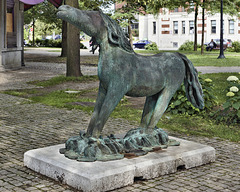
"The Great Horse" – Cabot Square, Saint Catherine…
| 23 Jun 2014 |
|
|
Cabot Square is an urban square in Montreal, between the former Montreal Forum and the Montreal Children's Hospital. The square is located in the Shaughnessy Village neighbourhood, an area which has been recently re-dubbed the Quartier des Grands Jardins and has been slated for redevelopment.
The square opened in 1870 and the monument to Italian-born English explorer John Cabot, by Italian sculptor Guido Casini (1892-1956), was unveiled on May 25, 1935. The square is unusual by Montréal standards in that it has multiple short fences and hedges employed to direct traffic and prevent too much through-traffic from ruining the grass, a design concept that hasn't entirely worked out. The square is well-used but generally by a population of homeless or otherwise impoverished people. It remains a popular destination for members of those groups wishing to drink alcohol outdoors. For this reason there is generally a visible police and public security presence in the area.
Of late, installation artwork and conceptual sculptures have been integrated into the square as part of a broad urban beautification plan. In late summer/early fall 2013, the city began a major cleanup of
the square including: cleaning the statue of Cabot, pruning the trees and collecting debris.
Robert Lorrain (born in Saint-Jean-sur-Richelieu, Québec in 1940) is a Canadian painter and sculptor and a long-time devotee of Sri Aurobindo. He is largely a self-taught artist, describing technique as "only a necessity." "What truly marks high art," he says "is when you sense that beauty has been expressed through intensity of dedication." Reminiscing about the time he studied at the École des Beaux Arts in Montreal, he says, "There was only one teacher there whom I inwardly recognised as an artist, someone with a burning dedication which infused all his teaching." And passionately: "When you make a piece of art, you concentrate, you give the utmost of what you can. You ask a lot of yourself because you know that that is the only circumstance under which true beauty will manifest. It all depends on what the artist puts into the work." He believes that many artists don’t go deep enough and and avoid questioning themselves. "They should be asking themselves ‘Is this work really beautiful?’ There should be a burning need for continuous self-improvement. For only then does one get towards the spiritual aspect of art."
The artist describes this sculpture: "The great horse. It wants to rear up, full of youthful audacity and humor, a touch of irony in its assertion. He hesitates."
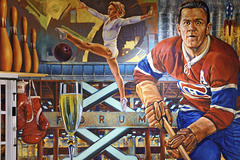
Memories of the Forum – Saint Catherine Street at…
| 22 Jun 2014 |
|
|
|
This mural decorates an out-of-the-way corner of the former Montreal Forum.
Located at the northeast corner of Atwater and Saint Catherine West, the Montreal Forum (French: Le Forum de Montréal) has been called "the most storied building in hockey history." It was the home of the National Hockey League’s Montreal Maroons from 1924 to 1938 and the Montreal Canadiens from 1926 to 1996. The building was home to 24 Stanley Cup championships (22 of the Canadiens and two of the Montreal Maroons, for whom the arena was originally built). It was also home to the Montreal Roadrunners and Montreal Junior Canadiens.
The Forum also hosted other sports, including indoor soccer, boxing and tennis. The Forum was a site of five events in the 1976 Summer Olympics: gymnastics, handball (final), basketball (final), volleyball (final), and boxing (final). The gymnastics event included Nadia Comaneci’s famous perfect 10, the first in Olympic history. The Forum was the site of many major professional wrestling matches, as shown in the 1961 National Film Board of Canada documentary Wrestling (La Lutte).
On March 11, 1996, the Montreal Canadiens played their last game at the Forum. After the game, many previous hockey greats were presented to the crowd, most notably Maurice Richard (said to be the Canadiens’ most beloved player of all time), who received a sixteen-minute standing ovation from the crowd as he broke down in tears. A symbolic torch – representative of a line quoted from the poem In Flanders Fields, "To you from failing hands we throw the torch; be yours to hold it high," displayed in the Forum’s home dressing room – was carried by Emile Bouchard out of the Canadiens dressing room to the playing surface. The flaming torch was passed on to each of the former Canadiens captains (Jean Beliveau, Yvan Cournoyer, Henri Richard, Serge Savard, Bob Gainey, and Guy Carbonneau), and finally to the then-current captain Pierre Turgeon. The next day, a parade was organized in which the torch was carried down the route to the Molson Centre (which has since been renamed the Bell Centre).
After the Canadiens left the Forum, the building was completely gutted and converted into a downtown entertainment centre called the Pepsi Forum, consisting of a multiplex theatre, shops and restaurants. Centre ice has been recreated in the centre of the complex complete with a small section of the grandstand, along with a statue of a fan leaning forward in delight, while original seats are used as benches throughout the complex. A statue of Maurice Richard can be found next to the grandstand. On the Saint Catherine Street entrance there is a Quebec Walk of Fame consisting of Richard and Celine Dion. Both were on hand for their bronze star’s respective unveiling. The Atwater street entrance has a large bronze Montreal Canadiens logo surrounded by 24 bronze Stanley Cup banners cemented into the sidewalk. Inscribed in French are the words "forever proud." The entire building is themed after the Forum’s storied history with special emphasis on the Montreal Canadiens. The building was declared a National Historic Site of Canada in 1997
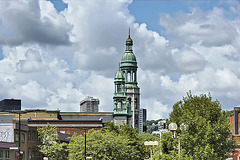
Saint-Irénée Church – Atwater Street, Montréal, Qu…
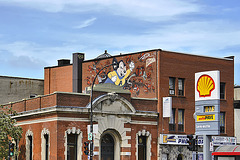
Atomik Mouse – Atwater at Notre Dame, Montréal, Qu…
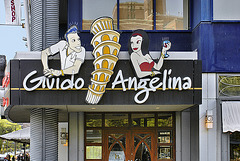
Guido and Angelina – Saint Catherine Street at Atw…
Jump to top
RSS feed- Jonathan Cohen's latest photos with "rue Atwater" - Photos
- ipernity © 2007-2026
- Help & Contact
|
Club news
|
About ipernity
|
History |
ipernity Club & Prices |
Guide of good conduct
Donate | Group guidelines | Privacy policy | Terms of use | Statutes | In memoria -
Facebook
X
