

Jonathan Cohen's photos with the keyword: Japanese stone lantern
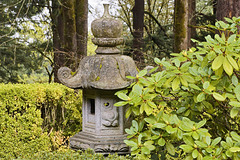
The Stag Lantern – Japanese Garden, Portland, Oreg…
| 23 May 2014 |
|
|
The Stag lantern in the Flat Garden. This is a classic pedestal lantern named after the Kasuga shrine where this type of lantern was first used. The design dates back to the 8th century.
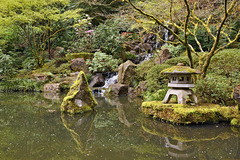
The Larger Waterfall – Japanese Garden, Portland,…
| 11 May 2014 |
|
The large stone is overgrown with moss. Stones represent the eternal in nature. Their placement is very precise and should look as if it happened naturally instead of by human hands.
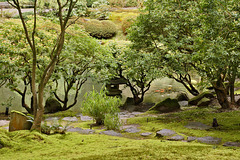
Koi in the Pond – Japanese Garden, Portland, Orego…
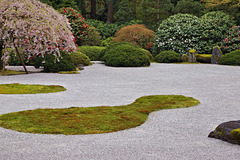
The Flat Garden from the Verandah of the Garden Pa…
| 04 May 2014 |
|
The Flat Garden (hira niwa) is meant to be viewed from the verandah of the Garden Pavilion, a low-slung structure used for exhibitions and special events. According to the official map of the Portland Japanese Garden, the Flat Garden is designed using a sea of raked sand. The two islands of plantings depict a round sake cup and gourd-shaped bottle, signifying pleasure and a wish for the visitor’s happiness.
Weeping Cherry Tree in Full Bloom – Japanese Garde…
| 04 May 2014 |
|
|
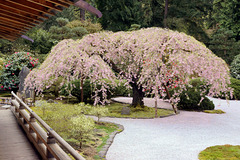
The Flat Garden is meant to be viewed from the verandah of the Garden Pavilion, a low-slung structure used for exhibitions and special events. This photo features the magnificent Pendula Weeping Cherry in full bloom.
The Flat Garden With Its Lantern – Japanese Garden…
| 04 May 2014 |
|
|
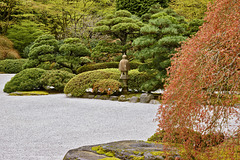
The Portland Japanese Garden is actually composed of five distinct garden styles, each a different degree of formality. The Flat Garden (hira niwa) is typical of urban garden design, but here it contrasts with the park's folds and contours. Raked white sand represents water and vividly contrasts with lawn, moss, evergreens, and azaleas
Kasuga Lantern by the Pavilion – Japanese Garden,…
| 04 May 2014 |
|
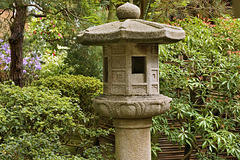
A Kasuga lantern typically has a cylindrical column surmounted by an annulet (small ring). Above this is the lantern box, generally hexagonal and topped by a hexagonal roof with pronounced scrolls at the points. The top is often in the form of a stylised lotus flower. The name "Kasuga" refers to a Shinto shrine. The Kasuga Grand Shrine in Nara was established in 768 CE and at first used solely by the Fujiwara family. Reaching the shrine involves a long walk through three gates (torii) along a path lined with tall imposing lanterns. This type of lantern (with a long pedestal and massive construction) is therefore called a Kasuga lantern in reference to this shrine.
Reflections in the Pond – Nitobe Memorial Gardens,…
Kasuga Lantern – Nitobe Memorial Gardens, Vancouve…
| 15 Mar 2012 |
|
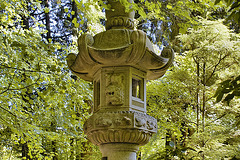
A Kasuga lantern typically has a cylindrical column surmounted by an annulet (small ring). Above this is the lantern box, generally hexagonal and topped by a hexagonal roof with pronounced scrolls at the points. The top is often in the form of a stylised lotus flower. The name "Kasuga" refers to a Shinto shrine. The Kasuga Grand Shrine in Nara was established in 768 AD and at first used solely by the Fujiwara family. Reaching the shrine involves a long walk through three gates (torii) along a path lined with tall imposing lanterns. This type of lantern (with a long pedestal and massive construction) is therefore called a Kasuga lantern in reference to this shrine.
The Nitobe lantern has carved in it a lotus blossom (flower of paradise and symbol of purity) and a dog (Nitobe’s birth sign). Also carved are the 12 zodiacal signs or "earthly branches" (rat, ox, tiger, rabbit, dragon, snake, horse, sheep, monkey, rooster, dog, pig). On the Nitobe lantern, the rat is aligned to the north, taking precedence as the first sign: as such it indicates the month of December and the first (midnight) double-hour of the day. As one goes around the base of the Nitobe lantern, the passage of time is marked.
The Nitobe lantern has been interpreted to symbolise the male principle or "Father figure" as well as memorialising Nitobe himself. This lantern predates the Nitobe Memorial Garden. It was installed in the UBC Botanical Garden (then situated in the centre of Campus) in 1939 by the Japan Society and by the Japanese Associations of British Columbia with the inscription: "I.M., Inazo Nitobe, 1861-1933, Apostle of Goodwill Among Nations, Erected by his friends".
Snow-Viewing Lantern – Nitobe Memorial Gardens, Va…
| 14 Mar 2012 |
|
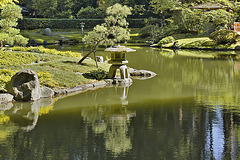
An important feature in Japanese gardens, lanterns symbolize light dispelling darkness. Often placed at the junction of paths, they indicate choices in life. Lanterns were originally introduced into Japan by China. The first ones were made of metal and primarily used to light doorways to shrines and temples. They were later made of stone for use in gardens, but it wasn’t until they were introduced into Japanese tea gardens by tea-master Sen-no-Rikkyu did they become a major garden element. Japanese tea ceremonies were often held in the evenings and light was needed to guide guests to the tea-room.
The squat and broad-roofed, snow-viewing lantern dates back to the early Edo period (i.e., the 17th century) and is probably so named because of the attractive capture of snowfall on the broad roof. The snow-viewing lantern in the Nitobe Memorial Garden is situated on the Island of Eternity and is thought to represent the "mother figure" in the cycle of life. The island resembles the shape of a turtle, the animal symbol of immortality.
Behind the Teahouse – Nitobe Memorial Gardens, Van…
The Remembering Lantern – Nitobe Memorial Gardens,…
| 14 Mar 2012 |
|
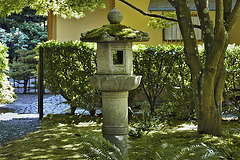
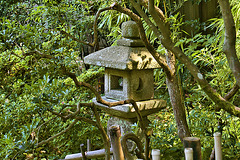
This lantern may commemorate Nitobe’s Christian faith. It is named after its inventor, tea master Oribe Furuta (1544-1615). Japanese Christians could attach figures of the virgin Mary onto the flat front shaft of the lantern, buried underground, and so were able to worship secretly. In the Nitobe Memorial Garden, the image of the virgin on this lantern is kept half-exposed.
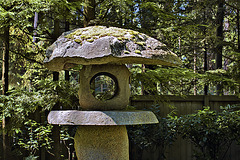
Nitobe Family Crest Lantern – Nitobe Memorial Gard…
| 19 Mar 2012 |
|
The Nitobe family crest lantern (shizen doro) is made of local stone from Morioka (Dr. Nitobe’s birth place). It bears the moon and stars familiar to many Japanese as the Nitobe family crest.
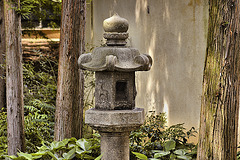
Japanese Stone Lantern #3 – National Arboretum, Wa…
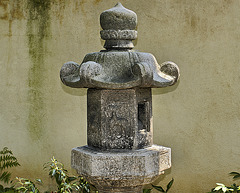
Japanese Stone Lantern #2 – National Arboretum, Wa…
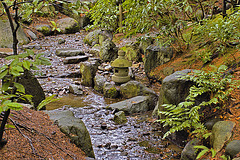
A Lantern by the Stream – Nitobe Memorial Garden,…
Japanese Stone Lantern #1 – National Arboretum, Wa…

Moon Gate – National Arboretum, Washington D.C.
Jump to top
RSS feed- Jonathan Cohen's latest photos with "Japanese stone lantern" - Photos
- ipernity © 2007-2026
- Help & Contact
|
Club news
|
About ipernity
|
History |
ipernity Club & Prices |
Guide of good conduct
Donate | Group guidelines | Privacy policy | Terms of use | Statutes | In memoria -
Facebook
X
