

Jonathan Cohen's photos with the keyword: Japanese crane

The Girl Who Loved Red-crowned Cranes #1 – Mosaïcu…
| 20 Jul 2014 |
|
|
|
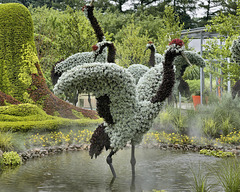
The entry of the city of Shanghai, China in the 2013 Mosaïcultures Internationales competition illustrates the story of a girl who loved Red-crowned Cranes. The red-crowned crane (Grus japonensis) is an endangered species and, contrary to what its Latin name implies, is not found solely in Japan. This stunningly graceful bird with a bright red crown winters in China and Korea, and is also found in Siberia and on Hokkaido Island, at the northern end of the Japanese archipelago. In some parts of its range, it is known as a symbol of luck, longevity and fidelity.
Red-crowned cranes are gregarious animals that live in flocks. Early each spring, before the nesting season, they engage in a very unique ballet: a mating dance in which the potential partners combine jumps, bows, greetings and flapping of wings with other carefully calculated movements.
Xu Xiu Juan was born in a city in northern China. From her earliest childhood she had loved red-crowned cranes. After graduating from university in the 1980s, she traveled very far – to the Yangcheng Nature Reserve on the coast of central China – to care for these birds. But one day, when she tried to save an injured crane, she slipped into a swamp. The crane was saved but Xu Xiu Juan never came up again to the surface.
The moving story of this girl, told far and wide across the breadth of China, has touched the hearts of thousands of people. To pay tribute to the wonderful spirit of the girl who saved the crane but lost her own life, a song has been composed to tell this story. The song’s title is "A True Story."
The Girl Who Loved Red-crowned Cranes #2 – Mosaïcu…
| 20 Jul 2014 |
|
|
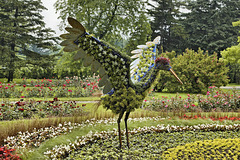
The entry of the city of Shanghai, China in the 2013 Mosaïcultures Internationales competition illustrates the story of a girl who loved Red-crowned Cranes. The red-crowned crane (Grus japonensis) is an endangered species and, contrary to what its Latin name implies, is not found solely in Japan. This stunningly graceful bird with a bright red crown winters in China and Korea, and is also found in Siberia and on Hokkaido Island, at the northern end of the Japanese archipelago. In some parts of its range, it is known as a symbol of luck, longevity and fidelity.
Red-crowned cranes are gregarious animals that live in flocks. Early each spring, before the nesting season, they engage in a very unique ballet: a mating dance in which the potential partners combine jumps, bows, greetings and flapping of wings with other carefully calculated movements.
Xu Xiu Juan was born in a city in northern China. From her earliest childhood she had loved red-crowned cranes. After graduating from university in the 1980s, she traveled very far – to the Yangcheng Nature Reserve on the coast of central China – to care for these birds. But one day, when she tried to save an injured crane, she slipped into a swamp. The crane was saved but Xu Xiu Juan never came up again to the surface.
The moving story of this girl, told far and wide across the breadth of China, has touched the hearts of thousands of people. To pay tribute to the wonderful spirit of the girl who saved the crane but lost her own life, a song has been composed to tell this story. The song’s title is "A True Story."
The Crane Dance, #2 – Mosaïcultures Internationale…
| 17 Jul 2014 |
|
|
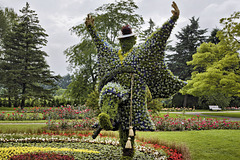
Busan (Latinized as "Pusan" before 2000) is a port city at the far southeastern corner of the Korean peninsula. Busan is South Korea’s second largest metropolis after Seoul, with a population of approximately 3.6 million. It is the largest port city in South Korea and the world’s fifth busiest seaport by cargo tonnage.
This sculpture is entitled "Coexistence." It symbolically evokes the principle of the harmony between development and conservation that the city has set as a priority. Through sustainable development, a variety of habitats have been maintained within the city for species such as Japanese cranes. This is one of the four species of cranes that pass through South Korea during one stage in their migration and it is a species that is threatened by human activity. The Demilitarized Zone along the boundary between North and South Korea provides a sanctuary for these birds and for the white-naped crane as well.
The man in traditional Korean costume is performing the Dongnae Crane Dance (Dongnae-Hak-chum) and imitating the crane’s movements, highlighting the interaction between humans and nature in the past. The dancers are costumed all in white, including a tunic with wide sleeves that imitate the crane’s wings. Their black hat evokes the bird’s head. This flowing, poetic dance is regularly performed by Korea’s leading dance companies.
For a description of the art of Mosaiculture and of the Mosaïcultures Internationales de Montréal competition, please turn to the first photo in this series at:
www.ipernity.com/doc/jonathan.cohen/33872015
The Crane Dance, #1 – Mosaïcultures Internationale…
| 17 Jul 2014 |
|
|
Busan (Latinized as "Pusan" before 2000) is a port city at the far southeastern corner of the Korean peninsula. Busan is South Korea’s second largest metropolis after Seoul, with a population of approximately 3.6 million. It is the largest port city in South Korea and the world’s fifth busiest seaport by cargo tonnage.
This sculpture is entitled "Coexistence." It symbolically evokes the principle of the harmony between development and conservation that the city has set as a priority. Through sustainable development, a variety of habitats have been maintained within the city for species such as Japanese cranes. This is one of the four species of cranes that pass through South Korea during one stage in their migration and it is a species that is threatened by human activity. The Demilitarized Zone along the boundary between North and South Korea provides a sanctuary for these birds and for the white-naped crane as well.
The man in traditional Korean costume is performing the Dongnae Crane Dance (Dongnae-Hak-chum) and imitating the crane’s movements, highlighting the interaction between humans and nature in the past. The dancers are costumed all in white, including a tunic with wide sleeves that imitate the crane’s wings. Their black hat evokes the bird’s head. This flowing, poetic dance is regularly performed by Korea’s leading dance companies.
For a description of the art of Mosaiculture and of the Mosaïcultures Internationales de Montréal competition, please turn to the first photo in this series at:
www.ipernity.com/doc/jonathan.cohen/33872015
Jump to top
RSS feed- Jonathan Cohen's latest photos with "Japanese crane" - Photos
- ipernity © 2007-2026
- Help & Contact
|
Club news
|
About ipernity
|
History |
ipernity Club & Prices |
Guide of good conduct
Donate | Group guidelines | Privacy policy | Terms of use | Statutes | In memoria -
Facebook
X
