

John Sheldon's photos with the keyword: World War II
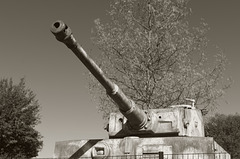
German Tiger Tank
| 05 Mar 2020 |
|
|
|
At Vimoutiers in Normandy this German Tiger Tank from World War II stands near the place when it ran out of fuel during the Battle of the Falaise Pocket in August 1944. An American bulldozer pushed the tank into a ditch in order to clear the road. It was left in the ditch until 1975 when it was dug out, restored and placed where it is now. A fearsome weapon, a single one of these Tiger Tanks is reputed to have destroyed several enemy tanks in just 3 or 4 minutes.
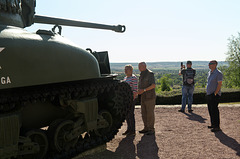
Sherman Tank at the Montormel Memorial
| 05 Mar 2020 |
|
|
|
A restored USA Sherman M4A1 tank, used by Polish troops in World War II and named General Maczek. It is at the Montormel Memorial Museum in Normandy.
Montormel, code named Hill 262, was defended by the 1st Polish Armoured Division under General Maczek during the Battle of the Falaise Pocket in August 1944. It was of great strategic importance, to both sides. The Division held its position here and was instrumental in plugging the “Falaise Gap” escape route for retreating German troops, despite being only 1500 men strong, under equipped and short of supplies, against a foe of many thousands.

Tread not gently …
| 05 Mar 2020 |
|
|
|
I wanted to emphasise the metal Tank Track (or Caterpillar Tread) on this vehicle and found that adopting a ‘pseudo HDR’ approach was the best way to do that. Not a technique I have ever used much but it has its place in the resources available to the picture maker.
A restored World War II Churchill Tank on the Hill of Peace Memorial in Normandy.
The Hill of Peace Memorial is near the World War II battle site in the Normandy Bocage that was code named Hill 112, not far from the city of Caen. It was the scene of one of the bloodiest battles in that war; carnage is the word usually used. The Memorial is not on Hill 112 itself because residual material left there in 1944 is a danger to life.
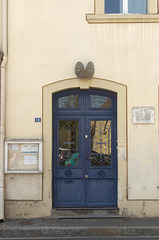
A quiet street in Chambois, Normandy
| 03 Mar 2020 |
|
|
Otherwise known as the 'Corridor of Death'. In August of 1944, many thousands of German soldiers were killed or injured in the 10 km corridor that runs from Trun to Chambois, as their retreating army became trapped in what is known as the Falaise Gap or Falaise Pocket. This had been the escape route that the German commanders had been relying on in the event of a withdrawal but when it was closed off by a pincer movement of Polish, Canadian and USA troops it became a 'killing field'. Eye witnesses still alive in Chambois still find August a difficult month every year.
When US General Dwight D. Eisenhower arrived at the site he said: “The battlefield at Falaise was unquestionably one of the greatest ‘killing fields’ of any of the war areas. Forty-eight hours after the closing of the Gap I was conducted through it on foot, to encounter scenes that could be described only by Dante.”
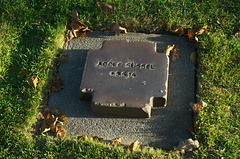
There but for fortune …
| 29 Feb 2020 |
|
|
|
… may go you or I. (Phil Ochs / Joan Baez.)
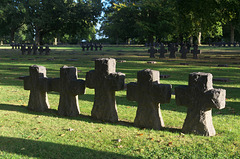
Adolf Süssel (September 1914 – ? 1944) seems to have spent the first few years and the last few years of his short life in a Europe at war. We can imagine that like most people, his fate was determined by the place and time in which he was born and by his responses to whatever social engineering was in fashion.
In the German Military Cemetery at La Cambe, Normandy, he shares his last resting place with more than 21,000 others, many of whose lives would have been similar; but (death being a great leveller) he also shares it with SS-Hauptsturmführer Michael Wittmann (a professional soldier who has commanded respect as a ‘Tiger Tank Ace’) and SS-Sturmbannführer Adolf Diekmann (who was responsible for one of the worst atrocities in the European Theatre of War).
In the German Cemetery at La Cambe
| 29 Feb 2020 |
|
|
|
In the German Military Cemetery at La Cambe, Normandy. This is the largest German war cemetery in Normandy and contains the graves of more than 21,000 German servicemen. Most of them died between June and August 1944 in the fighting following the D-Day landings. The ages of the dead range from 16 to 72 but as usual in these cemeteries the majority were young men.
The sign at the entrance says: “With its melancholy rigour, it is a graveyard for soldiers not all of whom had chosen either the cause or the fight. They too have found rest in our soil of France.”
“Hang Tough”
| 26 Feb 2020 |
|
|
|
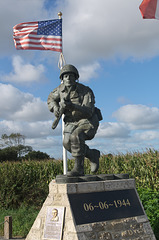
The Major Richard Winters Memorial at Sainte-Marie-du-Mont, Normandy. Major Winters inspired a TV series, Band of Brothers. He served in the 101st Airborne Division (the ‘Screaming Eagles’) and was noted for his exceptional leadership when American forces parachuted into Normandy for the D-Day invasion on 6 June 1944. He led ‘Easy Company’ a name that sits strangely with his motto ‘Hang Tough’.
On the plinth:
"Wars do not make men great, but they do bring out the greatness in good men.
Les guerres ne font pas les grands hommes, mais elles révélent la grandeur des hommes justes;" and “In honour of Dick Winters and all those American junior officers who led the way on D-Day, June 6, 1944. May we never forget their leadership under fire.”
The Eagle will always scream
| 26 Feb 2020 |
|
|
|
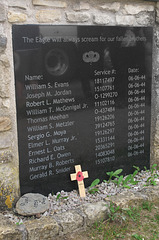
A partial record of American lives lost in the D-Day invasion on 6 June 1944, that forms part of the 101st Airborne Division (U.S Army) memorial at Sainte-Marie-du-Mont, Normandy.
This picture has been slightly modified in order to remove some colours patches which were detracting from its impact.
"Ever Forward" - bronze statue
| 13 Feb 2020 |
|
|
|
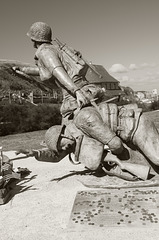
This bronze statue by Yannec Tomada depicts a USA soldier aiding an injured comrade during the 6 June 1944 D-Day landing at ‘Omaha Beach’ in Normandy, France. The landing of USA troops on this beach is the factual event behind the film “Saving Private Ryan”. The plaque by the sculpture reads:
“In commemoration of the determined efforts by the soldiers of the 29th Division's 116th Infantry Regimental Combat Team who landed the morning of June 6, 1944 on this section of Omaha Beach … to open the Vierville Draw … to begin the liberation of Europe.”
The Vierville Draw was a paved road that cut between cliffs. Capture of that road was essential so that the vehicles and armaments, that were being unloaded from the invasion fleet, could be taken inland in order to drive back the occupying German forces.

Mosaic Ceiling, Normandy American Cemetery Chapel
| 07 Feb 2020 |
|
|
|
In the Normandy American Cemetery and Memorial in Colleville sur Mer, Normandy.
On the ceiling lies a mosaic by Leon Kroll. In this detail the allegorical figure of Marianne bestows a laurel wreath on the lifeless body of a young USA soldier who has fallen in the fight to liberate France.
"Spirit of American Youth Rising from the Waves"
| 16 Dec 2019 |
|
|
|
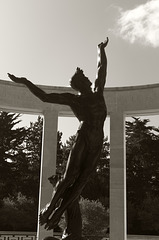
At the Normandy American Cemetery and Memorial at Coleville-sur-Mer in Normandy, France. This is close to the coastline that was code-named Omaha Beach during the Invasion of Normandy in June 1944. This was the beach where most of the troops from the USA landed on D-Day.
The Memorial area is organized around this 22-foot tall bronze statue, “The Spirit of American Youth Rising From the Waves.” The statue faces west toward the headstones of the 9,380 USA service personnel buried in the cemetery area. Most of these lost their lives in the D-Day landings and ensuing operations.
"Spirit of American Youth Rising from the Waves"
| 16 Dec 2019 |
|
|
|
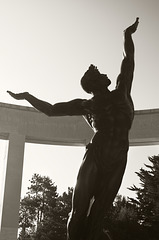
At the Normandy American Cemetery and Memorial at Coleville-sur-Mer in Normandy, France. This is close to the coastline that was code-named Omaha Beach during the Invasion of Normandy in June 1944. This was the beach where most of the troops from the USA landed on D-Day.
The Memorial area is organized around this 22-foot tall bronze statue, “The Spirit of American Youth Rising From the Waves.” The statue faces west toward the headstones of the 9,380 USA service personnel buried in the cemetery area. Most of these lost their lives in the D-Day landings and ensuing operations.
Urn at the Normandy American Memorial
| 16 Dec 2019 |
|
|
|
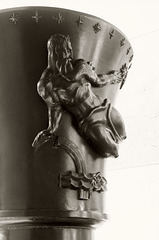
My picture gives no sense of scale, but this is one of four urns each about 4 feet (1.2 metres) tall. The Memorial is linked with a cemetery in which 9,380 USA service personnel are buried, most of whom lost their lives in the D-Day landings in 1944 or in the ensuing operations.
This urn represents words with which troops from both Jewish and Christian backgrounds will have been familiar: “The spirit of the lord moved on the face of the waters.” This seems to be fitting, since the Cemetery contains the graves of Christians and Jews, who fell together serving a common purpose.
On the water, a spray of laurel recalls to memory those who lost their lives at sea; a rainbow emanates from each hand of the figure symbolizing hope and peace.
At the Normandy American Memorial
| 16 Dec 2019 |
|
|
|
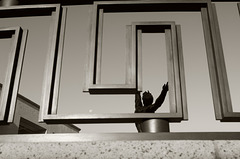
The Normandy American Cemetery and Memorial is at Coleville-sur-Mer in Normandy, France. It overlooks the coastline that was code-named Omaha Beach during the Invasion of Normandy in June 1944. This was the beach where most of the troops from the USA landed on D-Day. The Memorial area is organized around a 22-foot tall bronze statue, “The Spirit of American Youth Rising From the Waves,” which can be glimpsed through the wall in this picture.
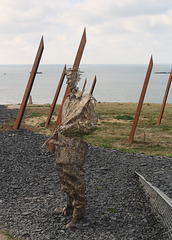
A beach of death, now a garden
| 08 Dec 2019 |
|
|
|
In the D-Day Garden at Arromanches-sur-Mer, Normandy, metal sculptures have been placed to suggest scenes from the invasion of Normandy in June 1944. The sculptures have been made out of small metal washers, individually welded together. This area of coastline was code-named Gold Beach and was where mostly British troops landed. This beach saw 1100 allied casualties on the D-Day itself, including 350 killed.
The D-Day Garden was opened in June 2019, the 75th anniversary of D-Day.
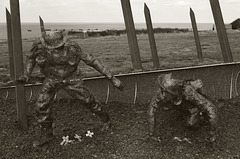
A beach of death, now a garden
| 08 Dec 2019 |
|
|
|
In the D-Day Garden at Arromanches-sur-Mer, Normandy, metal sculptures have been placed to suggest scenes from the invasion of Normandy in June 1944. The sculptures have been made out of small metal washers, individually welded together. This area of coastline was code-named Gold Beach and was where mostly British troops landed. This beach saw 1100 allied casualties on the D-Day itself, including 350 killed.
The D-Day Garden was opened in June 2019, the 75th anniversary of D-Day.
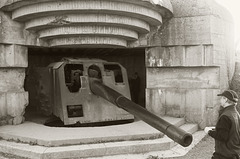
Gun emplacement, Normandy - 2nd World War
| 08 Dec 2019 |
|
|
|
German big gun placed during the occupation of France so as to defend the Normandy Coast from attack from La Manche / the 'English Channel'. This gun, thankfully out of action forever now, is near Arromanches-sur-Mer / Gold Beach.
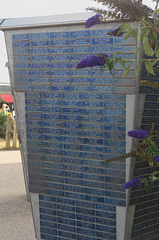
The Canadian Dead
| 08 Dec 2019 |
|
|
|
This is one of many memorials placed outside the Juno Beach Centre, Courseulles-sur-Mer, Normandy, France. The number of names recorded is horrifying.
"The Juno Beach Centre is Canada’s Second World War museum and cultural centre located in Normandy, France. The Centre pays homage to the 45,000 Canadians who lost their lives during the War, of which 5,500 were killed during the Battle of Normandy and 359 on D-Day. Opened in 2003 by veterans and volunteers with a vision to create a permanent memorial to all Canadians who served during the Second World War, the Centre’s mandate is to preserve this legacy for future generations through education and remembrance." (The Centre's own website.)
Jump to top
RSS feed- John Sheldon's latest photos with "World War II" - Photos
- ipernity © 2007-2026
- Help & Contact
|
Club news
|
About ipernity
|
History |
ipernity Club & Prices |
Guide of good conduct
Donate | Group guidelines | Privacy policy | Terms of use | Statutes | In memoria -
Facebook
X
