

m̌ ḫ's photos with the keyword: Catalonia |||| Catalunya
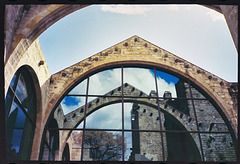
Maritime Museum
| 26 Sep 2025 |
|
|
|
The Maritime Museum of Barcelona offers visitors a journey through centuries of seafaring history, all set within the breathtaking Royal Shipyards—a masterpiece of Catalan Gothic architecture built in the 13th century for the construction of naval fleets. Inside its soaring stone naves, guests can explore a treasure trove of ship models, historical maps, navigational tools, and the stunning full-scale replica of the Royal Galley used at the Battle of Lepanto. The grandeur and craftsmanship of the vaulted halls make the building itself as impressive as the exhibitions, immersing guests in the legacy of Barcelona’s maritime power.
But those expecting the same warmth from the museum’s bar and restaurant may be surprised. The service here is best described as memorably unfriendly—a true contrast to Barcelona’s usual hospitality.
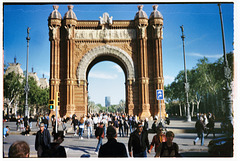
L'Arc de Triomf
| 14 Sep 2025 |
|
|
|
A rather striking memorial arch situated at the northern end of the grand Passeig de Lluís Companys, the Arc de Triomf was erected in 1888 as the gateway to the Barcelona World Fair. Conceived by Josep Vilaseca i Casanovas, it is fashioned from reddish brick in the Neo-Mudéjar style — a nod to the Moorish architectural influences found throughout Spain. This flourish of design distinguishes it from Barcelona’s predominantly modernist and Gothic buildings.
Unlike traditional triumphal arches commemorating military victories, the Arc de Triomf represents openness and progress. Its main façade features a sculptural frieze entitled “Barcelona welcomes the nations,” while the rear displays “Recompense,” symbolising the recognition of participants in the fair. Ornamental details include carved bats on the pillars (emblems of King Jaume I) and shields representing every Spanish province, prominently topped by Barcelona’s own crest. The arch leads directly to Ciutadella Park, serving as both an historic monument and a gateway to one of the city’s most popular green spaces.

The port seen from La Barceloneta

Forged in Iron, Bound by History
| 27 Jul 2025 |
|
|
|
Step inside the History Museum of Catalonia and you’ll find yourself surrounded by the preserved fabric of Barcelona’s last remaining industrial port building. The lofty brick arches, sturdy cast-iron columns, and exposed beams visible in this photograph are anything but mere decoration—they are original features of Palau de Mar, constructed between 1881 and 1902 as the General Warehouses of Commerce. Designed by the engineer Maurici Garrán and inspired by English dockside architecture, the robust style was selected to withstand the immense flow of goods arriving at the city’s busy harbour.
Its practical, industrial layout — generous spaces, resilient materials, and technical innovations such as early lifts — made the building a landmark of Barcelona’s maritime trade. This is why the museum’s interior retains such a strong sense of its industrial origins.
When Palau de Mar was restored in the 1990s to house the History Museum, particular care was taken to honour its industrial heritage. As the sole surviving warehouse from Barcelona’s old port, it stands as both a monument to the city’s industrious past and a significant piece of architectural heritage—mirroring the pioneering English warehouses that once lined docks across Britain and Europe.
Today, these historic walls and ironwork house the narrative of Catalonia. As you wander through, you are not merely exploring the region’s history—you are standing within a rare example of 19th-century industrial design, a silent witness to both Barcelona’s transformation and Catalonia’s enduring identity.
The Dragon and the Sword: Gaudí’s Rooftop Tale in…
| 25 Jul 2025 |
|
|
|
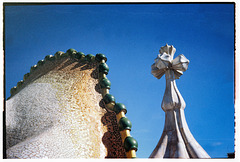
On the roof of Casa Batlló, you’ll spot a long, curved structure covered in gleaming tiles. This striking feature is meant to evoke the back of a dragon—one of the most enduring figures in Catalan legend. Antoni Gaudí, the celebrated architect, used vividly colored ceramics so the “scales” shimmer in the sunlight, giving the dragon a lifelike, magical appearance.
According to local legend, the brave knight Sant Jordi (Saint George), patron saint of Catalonia, defeated a dragon to save a princess—a story cherished across the region. The most distinctive feature on the roof, however, is the unusual four-armed cross. This isn’t just a religious symbol; it was crafted to resemble Sant Jordi’s sword. Look closely and you’ll see that Gaudí positioned the cross so it seems to pierce the dragon’s back, capturing the legendary moment the hero vanquished the beast. Through this subtle yet clever detail, Gaudí transforms the roof into a dramatic scene from Catalan folklore.
The dragon’s shimmering scales are made from scraps of ceramic, using a mosaic technique called trencadís, which Gaudí favored for its vibrant texture and playful sparkle. As a final touch, some say the tiles are so numerous you could count one for each day of the year—a whimsical nod from the architect himself.
Bubbles & the street
| 23 Jul 2025 |
|
|
|
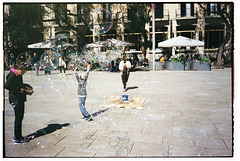
There’s something universally magical about bubbles floating through the air on a busy street. Children, especially those traveling through new, unfamiliar places, light up at the sight, laughter chasing after each rising, shimmering sphere. In that moment, all the novelty and uncertainty of travel fade away, replaced by pure awe and giddy excitement.
What makes it so special is its simplicity. Bubbles need nothing but breath and a little soap, yet bring an instant playground to life right there on the sidewalk. Kids forget they’re strangers in a strange town. Each bubble is an invitation to jump higher, to run faster, to forget homesickness and language barriers and just play. Their joy is infectious... smiles spread among parents, passersby, and anyone who stops to watch.
Jump to top
RSS feed- m̌ ḫ's latest photos with "Catalonia |||| Catalunya" - Photos
- ipernity © 2007-2026
- Help & Contact
|
Club news
|
About ipernity
|
History |
ipernity Club & Prices |
Guide of good conduct
Donate | Group guidelines | Privacy policy | Terms of use | Statutes | In memoria -
Facebook
X
