

m̌ ḫ's photos with the keyword: Czechoslovakia
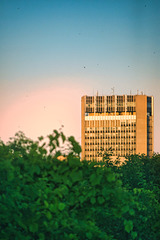
Slovak TV building
| 01 May 2025 |
|
|
|
Tucked into the leafy expanse of Mlynská dolina in Bratislava, the Slovak Television Building rises above the treetops like a silent guardian of Bratislava’s modern era. For decades, its 108-metre appearance has marked the skyline, a landmark visible from the hills of Karlova Ves, especially striking at sunset when its windows catch the last golden light.
The story of this tower began in the 1960s, when Slovakia’s growing television industry needed a new home. Architect Jozef Struhar, along with Vaclav Curilla and Olga Mankova, won the competition to design a complex that would reflect both ambition and cutting-edge technology. Construction started in 1965 and, after years of effort, the high-rise was ceremonially opened in December 1975. At the time, it was a record-breaker: the first building in Czechoslovakia to surpass 100 metres, and the tallest in the country for nearly three decades.
The building itself is a feat of engineering, with a reinforced concrete core housing all the elevators, services, and washrooms, leaving the rest of each floor open for flexible office space. Four concrete cross-bracing walls not only strengthen the structure but also give the facade its distinctive, rhythmic appearance. The entire television complex was built in stages, with the high-rise as its dominant feature, and was equipped with some of the most advanced broadcast technology of its time.
For years, the tower was the bustling headquarters of Slovak National Television, later Radio and Television of Slovakia. It even boasted a restaurant on its 28th floor, offering panoramic views of the city. But as times changed and media operations moved elsewhere, the building gradually emptied out. Today, it stands mostly unused, maintained only minimally, a preserved relic of the city’s broadcasting history.
Still, the Slovak Television Building remains a symbol of Bratislava’s aspirations during the late 20th century-a monument to the era when the city was reaching upward, determined to make its mark. To outsiders, it may seem just another office tower, but to locals, it is a familiar companion, a silent witness to decades of Slovak stories and the changing face of the capital.
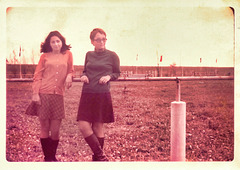
Mom and aunt Iva
| 28 Dec 2023 |
|
|
|
The 1960s brought winds of cultural and social change around the world, which also reached communist Czechoslovakia. While restrictions were loosening during the Prague Spring of 1968, shorter skirts and fashions from the West challenged traditional norms.
Younger Czechs and Slovaks enthusiastically embraced youthful styles like mini skirts paired with boots, viewing them as freedoms long denied under communist rule. However, shorter skirts tended to be worn only privately or when socializing, remaining largely unacceptable in schools, workplaces or formal settings. State authorities and older generations saw them as symbols of Western decadence and individualism, clashing with the regime’s values of modesty and conformity.
So while avantgarde designers like Mary Quant inspired Czech/Slovak fashion followers, uptake of radically short skirts was generally more underground. Most women navigated a delicate balance, cautiously adopting modern fashion elements from the West while paying lip service to communist dress codes and sensibilities in public life. Shorter skirts may have represented liberty for youth cultures, but came with an implicit risk of censure for being perceived as anti-socialist, dissident behaviors.
The complex politics around fashion leave the popularity of 1960s mini skirts in Czechoslovakia is difficult to fully assess from a modern-day vantage point.
Jump to top
RSS feed- m̌ ḫ's latest photos with "Czechoslovakia" - Photos
- ipernity © 2007-2026
- Help & Contact
|
Club news
|
About ipernity
|
History |
ipernity Club & Prices |
Guide of good conduct
Donate | Group guidelines | Privacy policy | Terms of use | Statutes | In memoria -
Facebook
X
