

Götz Kluge's photos with the keyword: The Art of Deniability
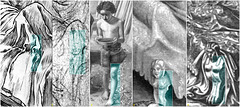
Holiday - Millais - Anonymous - Galle; detail
| 08 Aug 2014 |
|
|
|
#1, left - (allusion to the bedpost #3): 1876, Henry Holiday (engraver: Joseph Swain): The illustration detail on the very left side is a vectorized scan from Holiday's illustration to an 1910 edition of Lewis Carroll's The Hunting of the Snark .
#1, right: Additionally you see a segment from Holiday's preperatory draft.
#2 - (allusion to the bedpost #3 and to Philip Galle's print #4): 1850, the young John the Baptist in John Everett Millais : Christ in the House of His Parents (aka The Carpenter's Shop ). The left leg of the boy looks a bit deformed. This is no mistake. Probably Millais referred to #3 and to #4.
#3 - (Henry VIII's bedpost): 16th century, anonymous: Redrawn segment of Edward VI and the Pope, An Allegory of Reformation , (mirror view).
#4 - (bedpost #3 alludes to bedpost #4): 1564, Redrawn segment of a print Ahasuerus consulting the records by Philip Galle after Maarten van Heemskerck. The resemblance of #4 to the image #3 (the bedpost) was shown by the late Dr. Margaret Aston in 1994 in The King's Bedpost: Reformation and Iconography in a Tudor Group Portrait (p. 68). She also compared the bedpost to Heemskerck's Esther Crowned by Ahasuerus .
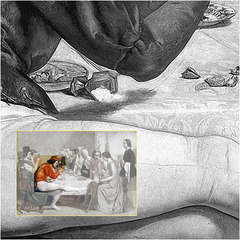
John Everett Millais: Lorenzo and Isabella (detail…
| 01 Jul 2013 |
|
|
|
John Everett Millais' painting Lorenzo and Isabella (National Museums Liverpool, Walker Art Gallery) was inspired by John Keats poem Isabella .
The reproduction displayed above shows a detail from the depiction of one of Lorenzo's brothers. Here young Millais left quite visible traces when he re-positioned the elbow of that thug.
In November 2012 the Liverpool museums page said (but doesn't say ist anymore): "[...] On the table there is spilled salt, symbolic of the blood which will later be spilled. The shadow of the arm of the foremost brother is cast across this salt, thus linking him directly with the future bloodshed. [...]"
In June 2013 I noticed that the "shadow of the arm" and all that is gone. Another page says: "[...] salt, symbol of life, is spilt on the table; [...]"
By the way, did you notice that the white salt partially covers the "shadow of the arm"? What a miraculous shadow that is! Has this already been discussed in the past 164 years?
See also: www.academia.edu/10907558/More_salt_To_see_or_not_to_see
Some quotes, which may be related to this image:
“peindre n’est pas affirmer"
Michel Foucault. This is Not a Pipe , Chapter 6 ( excerpt ), 1968
"An anti-subject painting might effectly conceal its subject, hiding it from everyone except the painter; or it might tease viewers with clues; or it might be so arcane that few people can see its subject: What counts is the retreat from the obvious, unambiguous primary meaning."
James Elkins (The School of the Art Institute of Chicago): Why are our Pictures Puzzles? , p. 129, 1999 (see also book review )
"To say it fully, a cryptomorph is an image that is hidden at its making, remains invisible for some period, and then is revealed so that it becomes an image that once was hidden (and the can no longer be hidden again)."
James Elkins ..., p. 184
"The act of revealing fully hidden cryptomorphs is an act of terrorism against pictorial sense."
James Elkins ..., p. 203
"Only those questions that are in principle undecidable, we can decide."
Heinz von Foerster: Ethics and Second-Order Cybernetics , 1990-10-04 (Système et thérapie familiale, Paris)
Honi soit qui mal y pense
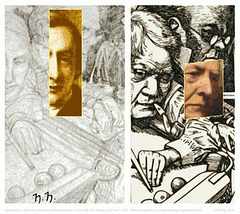
Billiard-Marker & Henry George Liddell
| 25 Jun 2013 |
|
|
|
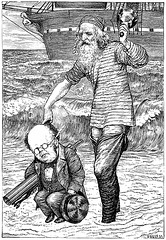
[right]: Henry Holiday's depiction of the Billiard marker in Lewis Carroll's The Hunting of the Snark . The face in color is Henry George Liddell's face (by Hubert von Herkomer) . Liddell was Carroll's (Dodgson's) superior in Christ Church, Oxford. (In the image I wrote "George Henry Liddell". But I am to lazy to correct that mistake now.)
[left]: The left image shows Holiday's draft for the right picture and an image depicting Liddell at age 28. That clear resemblance in Holiday's draft of the Billiard marker to Carroll's boss perhaps was a bit too much for Carroll. In the right picture the resemblance is weaker, but the asymmetry of the eyes and eyebrows still is there. In that final illustration Holiday was more cautious: He gave an older Liddell a wig (which slipped a bit out of position) and chopped of his chin.
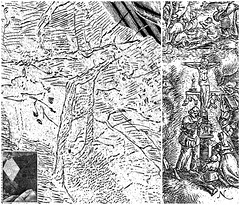
"But if ever I meet with a Boojum, that day, I sha…
| 23 Jun 2013 |
|
|
Patterns from an illustration by Henry Holiday (and Joseph Swain) to the chapter The Vanishing in Lewis Carroll's The Hunting of the Snark (1876) and a segment of the Allegory of Iconoclasm (or The Image Breakers ) by Marcus Gheeraerts the Elder (c. 1567).
(1st version on Flickr: 2010-08-24 )
The Paranoiac-Critical Method serves the Art of De…
| 15 Nov 2014 |
|
|
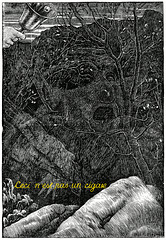
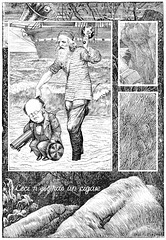
Ceci n'est pas un cigare.
Hendry Holiday was an underestimated artist.
In Lewis Carroll's The Hunting of the Snark , Holiday made sure that it is you who will be hold responsible for your perceptions. Both, Holiday and Carroll/Dodgson, were masters of the art of deniability. They applied the " paranoiac-critical method " a few years before Dalí invented it to pull our legs.
Holiday's illustration to the last Snark chapter:
See also: www.academia.edu/9907524/The_Art_of_Deniability
Weeds turned Horses (BW)
| 01 Jun 2013 |
|
|
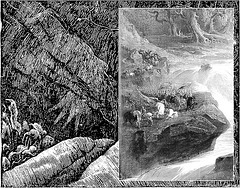
Dithered B&W graphics, optimized fpr printing:
105 x 82 mm at 1200 dpi or 210 x 164 mm at 600 dpi
(1) Henry Holiday: "The Vanishing"
Illustration to Lewis Carroll's "The Hunting of the Snark" (1876), lower half
(2) John Martin: "The Bard" (detail)
commons.wikimedia.org/wiki/File:John_Martin_-_The_Bard_-_Google_Art_Project.jpg
ca. 1817
Yale Center for British Art
Based on a Thomas Gray poem, inspired by a Welsh tradition that said that Edward I had put to death any bards he found, to extinguish Welsh culture; the poem depicts the escape of a single bard.
h10
| 01 Jun 2013 |
|
|
|
· · · · 001 · · "Just the place for a Snark!" the Bellman cried,
· · · · 002· · · · As he landed his crew with care;
· · · · 003· · Supporting each man on the top of the tide
· · · · 004· · · · By a finger entwined in his hair.
Henry Holiday's illustration to the first "fit" in Lewis Carroll's The Hunting of the Snark (1876)
Holiday - Millais- Anonymous - Galle, detail
| 31 May 2013 |
|
|
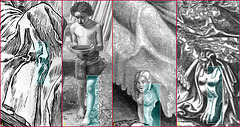
#1 - (allusion to the bedpost #3): 1876, Henry Holiday: Segment of an illustration to Lewis Carroll's The Hunting of the Snark (vectorized after a scan from an 1910 edition of the Snark )
#2 - (allusion to the bedpost #3 and to Philip Galle's print #4): 1850, the young John the Baptist in John Everett Millais : Christ in the House of His Parents (aka The Carpenter's Shop ). The left leg of the boy looks a bit deformed. This is no mistake. Probably Millais referred to #3 and to #4.
#3 - (Henry VIII's bedpost): 16th century, anonymous: Redrawn segment of Edward VI and the Pope, An Allegory of Reformation , (mirror view).
#4 - (bedpost #3 alludes to bedpost #4): 1564, Redrawn segment of a print Ahasuerus consulting the records by Philip Galle after Maarten van Heemskerck. The resemblance of #4 to the image #3 (the bedpost) was shown by the late Dr. Margaret Aston in 1994 in The King's Bedpost: Reformation and Iconography in a Tudor Group Portrait (p. 68). She also compared the bedpost to Heemskerck's Esther Crowned by Ahasuerus .
The Art of Deniability
| 17 Nov 2013 |
|
|
001 · · “Just the place for a Snark!” the Bellman cried,
002 · · · · As he landed his crew with care;
003 · · Supporting each man on the top of the tide
004 · · · · By a finger entwined in his hair.
Whose hair?
Source images:
from Henry Holiday's illustrations to Lewis Carroll's The Hunting of the Snark
Some quotes:
"Nothing in the world requires more courage than to applaud the destruction of values we still cherish. If a work of art or a new style disturbs you, then it is probably good work. If you hate it, it is probably great."
Leo Steinberg
"We have neglected the gift of comprehending things through our senses. Concept is divorced from percept, and thought moves among abstractions. Our eyes have been reduced to instruments with which to identify and to measure; hence we suffer a paucity of ideas that can be expressed in images and in an incapacity to discover meaning in what we see. Naturally we feel lost in the presence of objects that make sense only to undeluted vision, and we seek refuge in the more familiar medium of words. ... The inborn capacity to understand through the eyes has been put to sleep and must be reawakened."
Rudolf Arnheim: Art and Visual Perception , 1974, p. 1
"To Paint is Not to Affirm."
Michel Foucault. This is Not a Pipe , Chapter 6, 1968
"An anti-subject painting might effectly conceal its subject, hiding it from everyone except the painter; or it might tease viewers with clues; or it might be so arcane that few people can see its subject: What counts is the retreat from the obvious, unambiguous primary meaning."
James Elkins (The School of the Art Institute of Chicago): Why are our Pictures Puzzles? , p. 129, 1999 (see also book review)
"To say it fully, a cryptomorph is an image that is hidden at its making, remains invisible for some period, and then is revealed so that it becomes an image that once was hidden (and the can no longer be hidden again)."
James Elkins ..., p. 184
"The act of revealing fully hidden cryptomorphs is an act of terrorism against pictorial sense."
James Elkins ..., p. 203
"During my stay [in Ruby School] I made I suppose some progress in learning of various kinds, but none of it was done with love, and I spent an incalculable time in writing out impositions - this last I consider one of the chief faults of Rugby School. I made some friends there ... but I cannot say that I look back upon my life at a Public School with any sensations of pleasure, or that any earthly considerations would induce me to go through my three years [actually almost four years: January 1846 ~ December 1849] again."
Quoted by M. N. Cohen, Lewis Carroll : A biography (London, 1995).
"Each little boy has his own wooden cubicle to sleep in at night, a snug little bedroom where he is free from interruption and annoyance, this, to little boys, must be a great addition to their happiness, as being a counterbalance to any bullying they may suffer during the day. From my own experience of school life at Rugby, I can say that if I could have been as secure from annoyance at night, the hardships of the daily life would have been mere trifles."
C. L.Dodgson's diary entry after a visit to Radley College , 1857-03-18
(Quote from Insights into Human Cruelty and Abuse by Colleen Swan, 2014-03-04)
"It is possible that the author was half-consciously laying a trap, so readily did he take to the inventing of puzzles and things enigmatic; but to those who knew the man, or who have devined him correctly through his writings, the explanation is fairly simple."
Henry Holiday (1898-01-29) on Lewis Carroll's The Hunting of the Snark
"Only those questions that are in principle undecidable, we can decide."
Heinz von Foerster: Ethics and Second-Order Cybernetics , 1990-10-04 (Système et thérapie familiale, Paris)
"Honi soit qui mal y pense"
See also: www.academia.edu/9907524/The_Art_of_Deniability
Jump to top
RSS feed- Götz Kluge's latest photos with "The Art of Deniability" - Photos
- ipernity © 2007-2026
- Help & Contact
|
Club news
|
About ipernity
|
History |
ipernity Club & Prices |
Guide of good conduct
Donate | Group guidelines | Privacy policy | Terms of use | Statutes | In memoria -
Facebook
X
