

Götz Kluge's photos with the keyword: cryptomorph
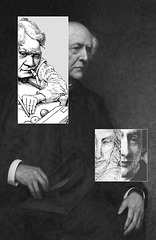
The Billiard Marker & Henry George Liddell
| 04 May 2014 |
|
|
upper inset:
Henry Holiday's depiction of the Billiard marker in Lewis Carroll's The Hunting of the Snark (1876).
background:
Henry George Liddell (painted by Sir Hubert von Herkomer in 1891) . Liddell was Carroll's (Dodgson's) superior in Christ Church, Oxford. As for the time line, of course Holiday could not have alluded to this painting.
lower inset:
The comparison shows Henry Holiday's first depiction (draft) of the Billiard marker in Lewis Carroll's The Hunting of the Snark . The face on the right side is Henry George Liddell's face at a youger age.
The image (right side; from a portrait by George Cruikshan) shows Liddell at age 28. Such a clear resemblance of Holiday's draft of the Billiard marker to Carroll's boss perhaps was a bit too risky for Carroll. The similarity wasn't sufficiently deniable. In the final illustration the resemblance is much weaker, but the asymmetry of the eyes and eyebrows still is there.
Wood Shavings turned Pope
| 16 Feb 2014 |
|
|
|
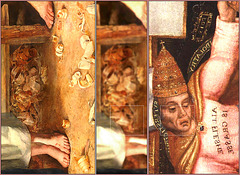
From Pope to Wood Shavings
[left]: Rotated segment from John Everett Millais : Christ in the House of His Parents (1850).
[center]: As above. Blurred.
[right]: Rotated segment from anonymous: Edward VI and the Pope, a Tudor anti-papal allegory of reformation, mirrored view (16th century).
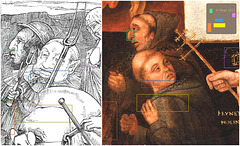
The Broker's and the Monk's Nose (with a little he…
| 16 Jan 2014 |
|
|
[left]: Segment from an illustration by Henry Holiday to Lewis Carroll's The Hunting of the Snark depicting the Broker (upper left corner). The object he is holding at his lips is the handle of a malacca walking cane, a gesture associated with dandies in the Victorian era.
[right]: Segment from anonymous: Edward VI and the Pope , a Tudor anti-papal allegory of reformation (16th century).
Holidays Snark illustrations are conundrums. And they were constructed as conundrums. The colored boxes are meant as a little help to you. There is not only a relation between the patterns marked by the same color, also the topological relation between the patterns on the left side and the right side show some similarity.
The pattern in the orange frame on the lower left side clearly is an allusion to a rather unobtrusive pattern on the right side. This shows that Holiday did not "copy" patterns just because of they would contribute to the impressiveness of his illustrations. Holiday is not a plagiarist.
·
In 1922 (46 years after The Hunting of the Snark was published), Henry Holiday (the illustrator) wrote to George Sutcliffe (Sangorski & Sutcliffe, bookbinders, London): "... you will notice that the Broker in [the proof of the illustration to The Crew on Board ] no. 5 is quite different to the one in [ the later proof ] no. 2. I had intended to give a caricature a the vulgar specimen of the profession, but Lewis Carroll took exception to this and asked me to treat the head in a less aggressive manner, and no. 2 is the result. I consider that no. 5 has much more character, but I understood L. Carroll's objection and agreed to tone him down. ..."
Charles Mitchel called the first design of the broker's face in the lower right corner of the print "conspiciously antisemitic". The change of the printing blocks must have been very important to Carroll, as it took the wood cutter Swain quite some effort to implement that change (see p. 102, Lewis Carroll's The Hunting of the Snark , 1981 William Kaufmann edition).
As shown in the image above, the broker's face also appears in the upper left section of Holiday's illustration to The Hunting . Rather than by a "Semitic" face, Holiday may have been inspired by what could be a cliché of the face of a roman catholic monk depicted in the 16th century anti-papal painting Edward VI and the Pope .
·
Links:
※ www.reddit.com/r/museum/comments/4lrs3o/anonymous_king_edward_vi_and_the_pope_estimates
※ www.reddit.com/r/TheHuntingOfTheSnark/comments/3ul02u/the_brokers_and_the_monks_nose
※ www.academia.edu/9890076/The_Broker_and_the_Monk
※ www.facebook.com/snark150/posts/1647429028620386
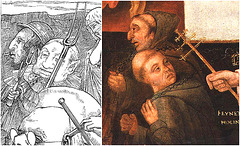
The Broker's and the Monk's Nose
| 02 Jun 2013 |
|
|
[left]: Segment from an illustration by Henry Holiday to Lewis Carroll's The Hunting of the Snark depicting the Broker (upper left corner). The object he is holding at his lips is the handle of a malacca walking cane, a gesture associated with dandies in the Victorian era.
[right]: Segment from anonymous: Edward VI and the Pope , a Tudor anti-papal allegory of reformation (16th century).
Holidays Snark illustrations are conundrums. And the were constructed as conundrums. The pattern in the frame (2) on the left side is an allusion to a rather unobstrusive pattern on the right side. This shows that Holiday did not "copy" patterns just because of they would contribute to the impressiveness of his illustrations.
·
In 1922 (46 years after The Hunting of the Snark was published), Henry Holiday (the illustrator) wrote to George Sutcliffe (Sangorski & Sutcliffe, bookbinders, London): "... you will notice that the Broker in [the proof of the illustration to The Crew on Board ] no. 5 is quite different to the one in [ the later proof ] no. 2. I had intended to give a caricature a the vulgar specimen of the profession, but Lewis Carroll took exception to this and asked me to treat the head in a less aggressive manner, and no. 2 is the result. I consider that no. 5 has much more character, but I understood L. Carroll's objection and agreed to tone him down. ..."
Charles Mitchel called the first design of the broker's face in the lower right corner of the print "conspiciously antisemitic". The change of the printing blocks must have been very important to Carroll, as it took the wood cutter Swain quite some effort to implement that change (see p. 102, Lewis Carroll's The Hunting of the Snark , 1981 William Kaufmann edition).
As shown in the image above, the broker's face also appears in the upper left section of Holiday's illustration to The Hunting . Rather than by a "Semitic" face, Holiday may have been inspired by what could be a cliché of the face of a roman catholic monk depicted in the 16th century anti-papal painting Edward VI and the Pope .
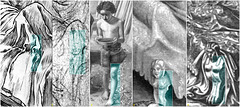
Holiday - Millais - Anonymous - Galle; detail
| 08 Aug 2014 |
|
|
|
#1, left - (allusion to the bedpost #3): 1876, Henry Holiday (engraver: Joseph Swain): The illustration detail on the very left side is a vectorized scan from Holiday's illustration to an 1910 edition of Lewis Carroll's The Hunting of the Snark .
#1, right: Additionally you see a segment from Holiday's preperatory draft.
#2 - (allusion to the bedpost #3 and to Philip Galle's print #4): 1850, the young John the Baptist in John Everett Millais : Christ in the House of His Parents (aka The Carpenter's Shop ). The left leg of the boy looks a bit deformed. This is no mistake. Probably Millais referred to #3 and to #4.
#3 - (Henry VIII's bedpost): 16th century, anonymous: Redrawn segment of Edward VI and the Pope, An Allegory of Reformation , (mirror view).
#4 - (bedpost #3 alludes to bedpost #4): 1564, Redrawn segment of a print Ahasuerus consulting the records by Philip Galle after Maarten van Heemskerck. The resemblance of #4 to the image #3 (the bedpost) was shown by the late Dr. Margaret Aston in 1994 in The King's Bedpost: Reformation and Iconography in a Tudor Group Portrait (p. 68). She also compared the bedpost to Heemskerck's Esther Crowned by Ahasuerus .
Victor in Your Dreams (2013)
| 28 Jul 2013 |
|
|
|
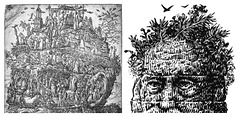
Mahendra Singh (Montréal) holds the copyright to the illustration (depicting Victor Hugo ) on the right side. Compare it to the 16th century etching The Image Breakers (1566-1568, mirror view, right side) by Marcus Gheraerts the Elder.
I added that comparison as shown above to my photostream with Mahendra's consent (2010-07-22).
Source of Mahendra Singh's illustration: justtheplaceforasnark (blog, 2009-12-03)
Mahendra knows the art of deniability very well.
Mahendra's "heads":
• justtheplaceforasnark.blogspot.de/2009/12/dream-books-nonsense-and-bourbon.html
• justtheplaceforasnark.blogspot.de/2013/09/the-heart-is-lonely-snark-hunter.html
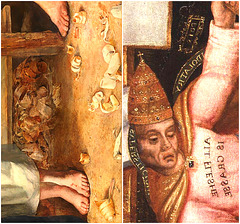
Wood Shavings turned Pope (1st version)
| 20 Jul 2013 |
|
|
From Pope to Wood Shavings
[left]: Rotated segment from John Everett Millais : Christ in the House of His Parents (1850).
[right]: Rotated segment from anonymous: Edward VI and the Pope, a Tudor anti-papal allegory of reformation, mirrored view (16th century).
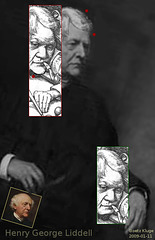
Henry George Liddell in "The Hunting of the Snark"
| 07 Jul 2013 |
|
|
This was my first image showing Henry Holiday's depiction of the Billiard marker in Lewis Carroll's The Hunting of the Snark (1876). The face in color and in the background is Henry George Liddell 's face (painted by Sir Hubert von Herkomer in 1891). Liddell was Carroll's (Dodgson's) superior in Christ Church, Oxford.
In this image, I had been fooling around a bit: I gave Liddell the Billiard marker's wig. And I gave Liddel's chin back to the Billiard marker. I am not hiding anything: The red dots indicate my manipulations, and in the lower part of the image you can see the unmanipulated elements.
Later I discovered, that the comparison between Liddell at age 28 and a draft by Holiday's of the Billiard marker yielded a much stronger resemblance:
Perhaps Carroll/Dodgson did not accept such an obvious resemblance. So Holiday finally showed an older Billiard marker with a wig (which slipped a bit out of position) . Holiday also chopped off the Billard marker's chin, but left its shadow in his illustration. That is no mistake. Thus, the real Liddell would not really be able to find himself depicted as the Billiard marker playing foul in the Snark .
However, the shadow just could be a bow tie. Who knows?
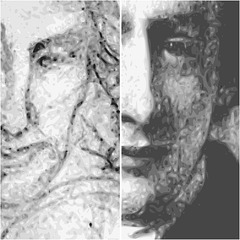
Snarked: Henry George Liddell
| 07 Jul 2013 |
|
|
The comparison shows (left side) a reproduction of Henry Holiday's draft of the Billiard marker for an illustration to Lewis Carroll's The Hunting of the Snark (1876) and a redrawn detail (right side) from a portrait by George Cruikshan of Henry George Liddell's face. Liddell was Carroll's (Dodgson's) superior in Christ Church, Oxford.
The portrait by George Cruikshan shows Liddell at age 28. The resemblance of Holiday's draft of the Billiard marker to Carroll's boss perhaps was a bit too risky for Carroll. The similarity wasn't sufficiently deniable. In the final illustration Holiday was more cautious: He gave an older Liddell a wig (which slipped a bit out of position) and chopped of his chin.
Holiday - Millais- Anonymous - Galle, detail
| 07 Jul 2013 |
|
|
|
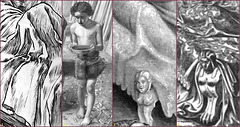
#1 - (allusion to the bedpost #3): 1876, Henry Holiday: Segment of an illustration to Lewis Carroll's The Hunting of the Snark (vectorized after a scan from an 1911 edition of the Snark )
#2 - (allusion to the bedpost #3 and to Philip Galle's print #4): 1850, the young John the Baptist in John Everett Millais : Christ in the House of His Parents (aka The Carpenter's Shop ). The left leg of the boy looks a bit deformed. This is no mistake. Probably Millais referred to #3 and to #4.
#3 - (Henry VIII's bedpost): 16th century, anonymous: Redrawn segment of Edward VI and the Pope, An Allegory of Reformation , (mirror view).
#4 - (bedpost #3 alludes to bedpost #4): 1564, Redrawn segment of a print Ahasuerus consulting the records by Philip Galle after Maarten van Heemskerck. The resemblance of #4 to the image #3 (the bedpost) was shown by the late Dr. Margaret Aston in 1994 in The King's Bedpost: Reformation and Iconography in a Tudor Group Portrait (p. 68). She also compared the bedpost to Heemskerck's Esther Crowned by Ahasuerus .
Billiard-Marker & Henry George Liddell
| 25 Jun 2013 |
|
|
|
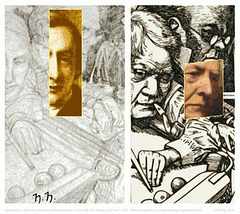
[right]: Henry Holiday's depiction of the Billiard marker in Lewis Carroll's The Hunting of the Snark . The face in color is Henry George Liddell's face (by Hubert von Herkomer) . Liddell was Carroll's (Dodgson's) superior in Christ Church, Oxford. (In the image I wrote "George Henry Liddell". But I am to lazy to correct that mistake now.)
[left]: The left image shows Holiday's draft for the right picture and an image depicting Liddell at age 28. That clear resemblance in Holiday's draft of the Billiard marker to Carroll's boss perhaps was a bit too much for Carroll. In the right picture the resemblance is weaker, but the asymmetry of the eyes and eyebrows still is there. In that final illustration Holiday was more cautious: He gave an older Liddell a wig (which slipped a bit out of position) and chopped of his chin.
42 Boxes, Sheep, Iconoclasm
| 08 Jun 2013 |
|
|
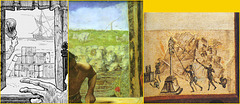
[left]: Segment from Henry Holiday's depiction of the Baker's visit to his uncle (1876) in Lewis Carroll's The Hunting of the Snark . Outside of the window are some of the Baker's 42 boxes.
[center]: Segment from John Everett Millais : Christ in the House of His Parents (1850).
[right]: segment from Edward VI and the Pope , An Allegory of Reformation , mirrored view (Anonymous, 16th century); depiction of iconoclasm. In The King's Bedpost: Reformation and Iconography in a Tudor Group Portrait (1994, p. 72), the late Margaret Aston compared the iconoclastic scene to prints depicting the destruction of the Tower of Babel (Philip Galle after Maarten van Heemskerck, 1567). From Margaret Aston's book I learned that the section showing the iconoclasm scene is an inset, not a window. Actually, I think, it is an inset which was meant to be perceived as a window as well.
·
Holiday quoted pictorial elements from both paintings [center, right]. I assume that he must have noticed, that Millais quoted from the 16th century painting.
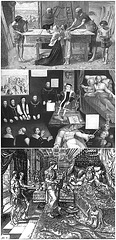
Millais, Anonymous, Galle
| 02 Jun 2013 |
|
|
[top]: John Everett Millais : Christ in the House of His Parents aka The Carpenter's Shop (1850).
Location: Tate Britain (N03584) , London.
Literature:
* Deborah Mary Kerr (1986): John Everett Millais's Christ in the house of his parents ( circle.ubc.ca/handle/2429/26546 )
p.34 in (01) Éva Péteri (2003): Victorian Approaches to Religion as Reflected in the Art of the Pre-Raphaelites, Budapest 2003, ISBN 978-9630580380 (shortlink: www.snrk.de/EvaPeteri.htm )
* Albert Boime (2008): Art in an Age of Civil Struggle, 1848-1871
p. 225-364: The Pre-Raphaelites and the 1848 Revolution ( en.wikipedia.org/wiki/Special:BookSources/0226063283 )
[center]: Anonymous : Edward VI and the Pope , An Allegory of Reformation, mirrored view (16th century, NPG 4165 ). Iconoclasm depicted in the window. Under the "window" 3rd from left is Thomas Cranmer who wrote the 42 Articles in 1552.
Edward VI and the Pope (NPG 4165) was, until 1874, the property of Thomas Green, Esq., of Ipswich and Upper Wimpole Street , a collection 'Formed by himself and his Family during the last Century and early Part of the present Century' (Roy C. Strong: Tudor and Jacobean Portraits , 1969, p.345). Thus, when Millais' Christ in the House of His Parents ('The Carpenter's Shop') was painted in 1849-1850, the 16th century painting was part of a private collection. It was sold by Christie's 20 March 1874 (lot 9) to a buyer unknown to me, that is, when Holiday started with his illustrations to The Hunting of the Snark .
Location: National Portrait Gallery, London
[bottom]: Philip Galle after Maarten van Heemskerck , Redrawn print Ahasuerus consulting the records (1564). The resemblance to the image above (middle) was shown by Dr. Margaret Aston in 1994 in The King's Bedpost: Reformation and Iconography in a Tudor Group Portrait (p. 68). She also compared the bedpost to Heemskerck's Esther Crowned by Ahasuerus .
Location: Rijksmuseum, Amsterdam
Detail:
The Carpenter and Ahasuerus:
Before I found Millais' allusions as a kind of bycatch of my Snark hunt,
I started with Henry Holiday's allusions to Millais:
An "allusion chain":
Album:
J. E. Millais
Holiday - Millais- Anonymous - Galle, detail
| 31 May 2013 |
|
|
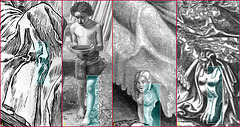
#1 - (allusion to the bedpost #3): 1876, Henry Holiday: Segment of an illustration to Lewis Carroll's The Hunting of the Snark (vectorized after a scan from an 1910 edition of the Snark )
#2 - (allusion to the bedpost #3 and to Philip Galle's print #4): 1850, the young John the Baptist in John Everett Millais : Christ in the House of His Parents (aka The Carpenter's Shop ). The left leg of the boy looks a bit deformed. This is no mistake. Probably Millais referred to #3 and to #4.
#3 - (Henry VIII's bedpost): 16th century, anonymous: Redrawn segment of Edward VI and the Pope, An Allegory of Reformation , (mirror view).
#4 - (bedpost #3 alludes to bedpost #4): 1564, Redrawn segment of a print Ahasuerus consulting the records by Philip Galle after Maarten van Heemskerck. The resemblance of #4 to the image #3 (the bedpost) was shown by the late Dr. Margaret Aston in 1994 in The King's Bedpost: Reformation and Iconography in a Tudor Group Portrait (p. 68). She also compared the bedpost to Heemskerck's Esther Crowned by Ahasuerus .
Jump to top
RSS feed- Götz Kluge's latest photos with "cryptomorph" - Photos
- ipernity © 2007-2026
- Help & Contact
|
Club news
|
About ipernity
|
History |
ipernity Club & Prices |
Guide of good conduct
Donate | Group guidelines | Privacy policy | Terms of use | Statutes | In memoria -
Facebook
X
