

Götz Kluge's photos with the keyword: deniability
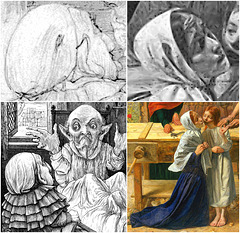
Mary's and the Baker's Kerchiefs
| 27 Dec 2014 |
|
|
[left]: Redrawn segment from one of Henry Holiday's pencil drafts for the depiction of the Baker's visit to his uncle (1876) in Lewis Carroll's The Hunting of the Snark . Below the draft you see a segment of the final – and less daring – illustration.
[right]: John Everett Millais : Redrawn Segment from Christ in the House of His Parents (1850) depicting Mary (and a part of Christ's face in the upper right corner). Below that segment you see a larger segment from Millais' painting.
This example shows how Holiday worked on the construction of his conundrums in his illustrations to Lewis Carroll's The Hunting of the Snark . Even though Holiday copied a face from a face, he reinterprated shapes of face elements from the source face in order to represent different face elements with a resembling shape in the target face. The baker's ear is based on a shape in the depiction of Marie's face which is no ear. The same partially applies to the Baker's nose and the baker's eye.
Such kind of pictorial obfuscation should not be a surprise as The Hunting of the Snark is a poem in which readers had been searching textual allusions since 1876. (Too obvuous allusions are too boring.) The focus on textual analysis of the Snark seems to lead us to underestimate Holiday's paralleling Carroll's wordplay with is own means as an graphical artist.
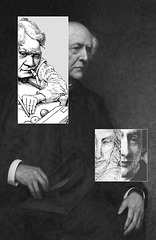
The Billiard Marker & Henry George Liddell
| 04 May 2014 |
|
|
upper inset:
Henry Holiday's depiction of the Billiard marker in Lewis Carroll's The Hunting of the Snark (1876).
background:
Henry George Liddell (painted by Sir Hubert von Herkomer in 1891) . Liddell was Carroll's (Dodgson's) superior in Christ Church, Oxford. As for the time line, of course Holiday could not have alluded to this painting.
lower inset:
The comparison shows Henry Holiday's first depiction (draft) of the Billiard marker in Lewis Carroll's The Hunting of the Snark . The face on the right side is Henry George Liddell's face at a youger age.
The image (right side; from a portrait by George Cruikshan) shows Liddell at age 28. Such a clear resemblance of Holiday's draft of the Billiard marker to Carroll's boss perhaps was a bit too risky for Carroll. The similarity wasn't sufficiently deniable. In the final illustration the resemblance is much weaker, but the asymmetry of the eyes and eyebrows still is there.
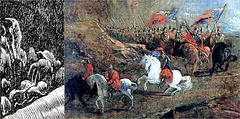
Herbs & Horses
| 15 Apr 2014 |
|
|
|
[left]: Henry Holiday: The Vanishing (detail from lower left side)
Illustration to Lewis Carroll's "The Hunting of the Snark" (1876)
[right]: John Martin: The Bard (retinex filtered and vectorized detail from lower left side)
commons.wikimedia.org/wiki/File:John_Martin_-_The_Bard_-_Google_Art_Project.jpg (ca. 1817)
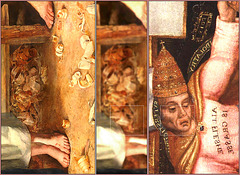
Wood Shavings turned Pope
| 16 Feb 2014 |
|
|
|
From Pope to Wood Shavings
[left]: Rotated segment from John Everett Millais : Christ in the House of His Parents (1850).
[center]: As above. Blurred.
[right]: Rotated segment from anonymous: Edward VI and the Pope, a Tudor anti-papal allegory of reformation, mirrored view (16th century).
Holiday - Millais - Anonymous - Galle; detail
| 08 Aug 2014 |
|
|
|
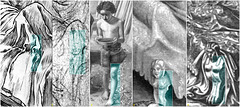
#1, left - (allusion to the bedpost #3): 1876, Henry Holiday (engraver: Joseph Swain): The illustration detail on the very left side is a vectorized scan from Holiday's illustration to an 1910 edition of Lewis Carroll's The Hunting of the Snark .
#1, right: Additionally you see a segment from Holiday's preperatory draft.
#2 - (allusion to the bedpost #3 and to Philip Galle's print #4): 1850, the young John the Baptist in John Everett Millais : Christ in the House of His Parents (aka The Carpenter's Shop ). The left leg of the boy looks a bit deformed. This is no mistake. Probably Millais referred to #3 and to #4.
#3 - (Henry VIII's bedpost): 16th century, anonymous: Redrawn segment of Edward VI and the Pope, An Allegory of Reformation , (mirror view).
#4 - (bedpost #3 alludes to bedpost #4): 1564, Redrawn segment of a print Ahasuerus consulting the records by Philip Galle after Maarten van Heemskerck. The resemblance of #4 to the image #3 (the bedpost) was shown by the late Dr. Margaret Aston in 1994 in The King's Bedpost: Reformation and Iconography in a Tudor Group Portrait (p. 68). She also compared the bedpost to Heemskerck's Esther Crowned by Ahasuerus .
Victor in Your Dreams (2013)
| 28 Jul 2013 |
|
|
|
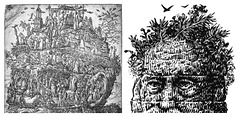
Mahendra Singh (Montréal) holds the copyright to the illustration (depicting Victor Hugo ) on the right side. Compare it to the 16th century etching The Image Breakers (1566-1568, mirror view, right side) by Marcus Gheraerts the Elder.
I added that comparison as shown above to my photostream with Mahendra's consent (2010-07-22).
Source of Mahendra Singh's illustration: justtheplaceforasnark (blog, 2009-12-03)
Mahendra knows the art of deniability very well.
Mahendra's "heads":
• justtheplaceforasnark.blogspot.de/2009/12/dream-books-nonsense-and-bourbon.html
• justtheplaceforasnark.blogspot.de/2013/09/the-heart-is-lonely-snark-hunter.html
Wood Shavings turned Pope (1st version)
| 20 Jul 2013 |
|
|
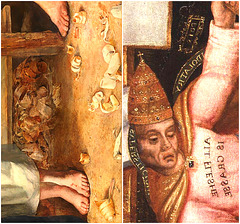
From Pope to Wood Shavings
[left]: Rotated segment from John Everett Millais : Christ in the House of His Parents (1850).
[right]: Rotated segment from anonymous: Edward VI and the Pope, a Tudor anti-papal allegory of reformation, mirrored view (16th century).
Henry George Liddell in "The Hunting of the Snark"
| 07 Jul 2013 |
|
|
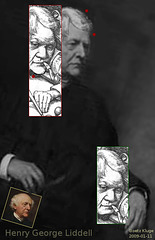
This was my first image showing Henry Holiday's depiction of the Billiard marker in Lewis Carroll's The Hunting of the Snark (1876). The face in color and in the background is Henry George Liddell 's face (painted by Sir Hubert von Herkomer in 1891). Liddell was Carroll's (Dodgson's) superior in Christ Church, Oxford.
In this image, I had been fooling around a bit: I gave Liddell the Billiard marker's wig. And I gave Liddel's chin back to the Billiard marker. I am not hiding anything: The red dots indicate my manipulations, and in the lower part of the image you can see the unmanipulated elements.
Later I discovered, that the comparison between Liddell at age 28 and a draft by Holiday's of the Billiard marker yielded a much stronger resemblance:
Perhaps Carroll/Dodgson did not accept such an obvious resemblance. So Holiday finally showed an older Billiard marker with a wig (which slipped a bit out of position) . Holiday also chopped off the Billard marker's chin, but left its shadow in his illustration. That is no mistake. Thus, the real Liddell would not really be able to find himself depicted as the Billiard marker playing foul in the Snark .
However, the shadow just could be a bow tie. Who knows?
Snarked: Henry George Liddell
| 07 Jul 2013 |
|
|
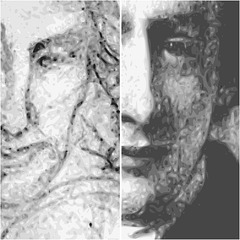
The comparison shows (left side) a reproduction of Henry Holiday's draft of the Billiard marker for an illustration to Lewis Carroll's The Hunting of the Snark (1876) and a redrawn detail (right side) from a portrait by George Cruikshan of Henry George Liddell's face. Liddell was Carroll's (Dodgson's) superior in Christ Church, Oxford.
The portrait by George Cruikshan shows Liddell at age 28. The resemblance of Holiday's draft of the Billiard marker to Carroll's boss perhaps was a bit too risky for Carroll. The similarity wasn't sufficiently deniable. In the final illustration Holiday was more cautious: He gave an older Liddell a wig (which slipped a bit out of position) and chopped of his chin.
Holiday - Millais- Anonymous - Galle, detail
| 07 Jul 2013 |
|
|
|
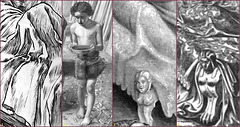
#1 - (allusion to the bedpost #3): 1876, Henry Holiday: Segment of an illustration to Lewis Carroll's The Hunting of the Snark (vectorized after a scan from an 1911 edition of the Snark )
#2 - (allusion to the bedpost #3 and to Philip Galle's print #4): 1850, the young John the Baptist in John Everett Millais : Christ in the House of His Parents (aka The Carpenter's Shop ). The left leg of the boy looks a bit deformed. This is no mistake. Probably Millais referred to #3 and to #4.
#3 - (Henry VIII's bedpost): 16th century, anonymous: Redrawn segment of Edward VI and the Pope, An Allegory of Reformation , (mirror view).
#4 - (bedpost #3 alludes to bedpost #4): 1564, Redrawn segment of a print Ahasuerus consulting the records by Philip Galle after Maarten van Heemskerck. The resemblance of #4 to the image #3 (the bedpost) was shown by the late Dr. Margaret Aston in 1994 in The King's Bedpost: Reformation and Iconography in a Tudor Group Portrait (p. 68). She also compared the bedpost to Heemskerck's Esther Crowned by Ahasuerus .
Billiard-Marker & Henry George Liddell
| 25 Jun 2013 |
|
|
|
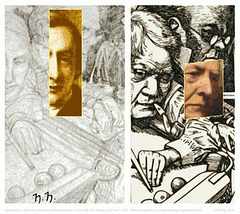
[right]: Henry Holiday's depiction of the Billiard marker in Lewis Carroll's The Hunting of the Snark . The face in color is Henry George Liddell's face (by Hubert von Herkomer) . Liddell was Carroll's (Dodgson's) superior in Christ Church, Oxford. (In the image I wrote "George Henry Liddell". But I am to lazy to correct that mistake now.)
[left]: The left image shows Holiday's draft for the right picture and an image depicting Liddell at age 28. That clear resemblance in Holiday's draft of the Billiard marker to Carroll's boss perhaps was a bit too much for Carroll. In the right picture the resemblance is weaker, but the asymmetry of the eyes and eyebrows still is there. In that final illustration Holiday was more cautious: He gave an older Liddell a wig (which slipped a bit out of position) and chopped of his chin.
Kerchiefs and other shapes
| 09 Jun 2013 |
|
|
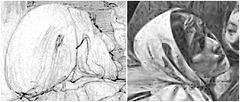
[left]: Redrawn segment from one of Henry Holiday's pencil drafts for the depiction of the Baker's visit to his uncle (1876) in Lewis Carroll's The Hunting of the Snark .
[right]: John Everett Millais : Redrawn Segment from Christ in the House of His Parents (1850) depicting Mary (and a part of Christ's face in the upper right corner).
This example shows how Holiday worked on the construction of his conundrums in his illustrations to Lewis Carroll's The Hunting of the Snark . Even though Holiday copied a face from a face, he reinterprated shapes of face elements from the source face in order to represent different face elements with a resembling shape in the target face. The baker's ear is based on a shape in the depiction of Marie's face which is no ear. The same partially applies to the Baker's nose and the baker's eye.
Such kind of pictorial obfuscation should not be a surprise as The Hunting of the Snark is a poem in which readers had been searching textual allusions since 1876. (Too obvuous allusions are too boring. The focus on textual analysis of the Snark seems to lead us to underestimate Holiday's paralleling Carroll's wordplay with is own means as an graphical artist.
By the way: In 1882, Alfred Parsons turned the Baker's ear into a part of a chair in Charles Darwin's study at Downe . Holiday quoted and was quoted. Artists like Parsons, Holiday and Millais (see below) do such things and have fun when playing their game. Today Mahendra Singh is maintaining the tradition , in the Snark and beyond the beast.
Extended version, Dec. 2014:
42 Boxes, Sheep, Iconoclasm
| 08 Jun 2013 |
|
|
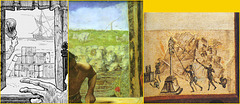
[left]: Segment from Henry Holiday's depiction of the Baker's visit to his uncle (1876) in Lewis Carroll's The Hunting of the Snark . Outside of the window are some of the Baker's 42 boxes.
[center]: Segment from John Everett Millais : Christ in the House of His Parents (1850).
[right]: segment from Edward VI and the Pope , An Allegory of Reformation , mirrored view (Anonymous, 16th century); depiction of iconoclasm. In The King's Bedpost: Reformation and Iconography in a Tudor Group Portrait (1994, p. 72), the late Margaret Aston compared the iconoclastic scene to prints depicting the destruction of the Tower of Babel (Philip Galle after Maarten van Heemskerck, 1567). From Margaret Aston's book I learned that the section showing the iconoclasm scene is an inset, not a window. Actually, I think, it is an inset which was meant to be perceived as a window as well.
·
Holiday quoted pictorial elements from both paintings [center, right]. I assume that he must have noticed, that Millais quoted from the 16th century painting.
Weeds turned Horses (detail)
| 01 Jun 2013 |
|
|
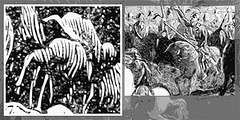
[left]: Henry Holiday: "The Vanishing" (detail)
Illustration to Lewis Carroll's "The Hunting of the Snark" (1876), lower left side
[right]: John Martin: "The Bard" (detail)
commons.wikimedia.org/wiki/File:John_Martin_-_The_Bard_-_Google_Art_Project.jpg (ca. 1817), lower left side
Thomas Cranmer's 42 Boxes
| 23 Jun 2013 |
|
|
|
"I personally don't look for secret messages hidden by Carroll in the text; rather, I look at themes and symbols as potential hints as to the sorts of things that were on Carroll's mind at the time."
Darien Graham-Smith , 2005-10-05
The image:
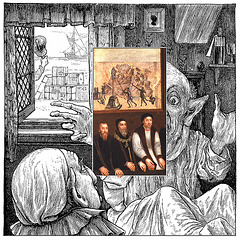
[B&W]: Upper part of Henry Holiday's illustration (1876) to The Baker's Tale in Lewis Carroll's The Hunting of the Snark depicting some of the Baker's 42 boxes piled up outside the window. In 1552, shortly before the early death of Edward VI, Thoma s Cran mer wrote down 42 articles , a protestant doctrine. In Henry Holiday's depiction of the staple of some of the Baker's 42 boxes piled up outside of the window of the Baker's uncle's room also the number 42 is visible.
[color]: Segment from a painting (c. 1570) by an unknown artist ( commons.wikimedia.org/wiki/File:Ed_and_pope.png ).The segment is displayed in a mirrored view. Thomas Cranmer is located on the right side in the mirrored image. (Among other persons in the painting not shown in this segment: Edward VI, Henry VIII).
There is a book about this painting where Thomas Cranmer is identified: Margaret Aston, The King's Bedpost: Reformation and Iconography in a Tudor Group Portrait , 1994.
·
42 and Thomas Cranmer:
How could the number 42 get into anyone's mind? Douglas Adams made that number popular as an answer to everything. (But what was the question?) In The Hitchhiker's Guide to the Galaxy he (similar to many other writers, e.g. Tom Stoppard) challenged his readers with allusions to the works of earlier writers. An earlier writer who had an obvious affinity to the number 42 is known as Lewis Carroll. And, as I learned from John Tufail , "before the 39 articles of Faith that Carroll [the Rev. Dodgson] declined to attest to, there were 42 articles [written by Thomas Cranmer]."
Of course, like Adams, Carroll wouldn't give any good reason for his affinity (not only in the Snark ) to the number 42 either, but he surely knew, that "Forty-Two" is an important number in the history of Anglicanism: In the mind of Charles Lutwidge Dodgson (aka Lewis Carroll) the Forty-Two Articles of Thomas Cranmer surely had their place.
· · · · 021 · · There was one who was famed for the number of things
· · · · 022 · · · · He forgot when he entered the ship:
· · · · 023 · · His umbrella, his watch, all his jewels and rings,
· · · · 024 · · · · And the clothes he had bought for the trip.
· · · · 025 · · He had forty-two boxes , all carefully packed,
· · · · 026 · · · · With his name painted clearly on each:
· · · · 027 · · But, since he omitted to mention the fact,
· · · · 028 · · · · They were all left behind on the beach.
· · · · 029 · · The loss of his clothes hardly mattered, because
· · · · 030 · · · · He had seven coats on when he came,
· · · · 031 · · With three pairs of boots --but the worst of it was,
· · · · 032 · · · · He had wholly forgotten his name.
· · · · 033 · · He would answer to "Hi!" or to any loud cry,
· · · · 034 · · · · Such as " Fry me! " or " Fritter my wig! "
· · · · 035 · · To "What-you-may-call-um!" or "What-was-his-name!"
· · · · 036 · · · · But especially "Thing-um-a-jig!"
· · · · 037 · · While, for those who preferred a more forcible word,
· · · · 038 · · · · He had different names from these:
· · · · 039 · · His intimate friends called him " Candle-ends ,"
· · · · 040 · · · · And his enemies " Toasted-cheese ."
· · · · 041 · · "His form is ungainly--his intellect small--"
· · · · 042 · · · · (So the Bellman would often remark)
· · · · 043 · · "But his courage is perfect! And that, after all,
· · · · 044 · · · · Is the thing that one needs with a Snark."
· · · · 045 · · He would joke with hyenas, returning their stare
· · · · 046 · · · · With an impudent wag of the head :
· · · · 047 · · And he once went a walk, paw-in-paw, with a bear ,
· · · · 048 · · · · "Just to keep up its spirits," he said.
· · · · 049 · · He came as a Baker: but owned, when too late--
· · · · 050 · · · · And it drove the poor Bellman half-mad--
· · · · 051 · · He could only bake Bridecake--for which, I may state,
· · · · 052 · · · · No materials were to be had.
·
·
Background:
The Baker in Lewis Carroll's The Hunting of the Snark has many features in common with Thomas Cramer. Many of his nick names are associated with heat or having been burnt : "Fry me!" or "Fritter my wig!", "Candle-ends" or "Toasted-cheese".
Cranmer later was accused of heresy and had to leave his articles behind him before he heroically recanted his recantations: "On 14 February 1556, he was degraded from his episcopal and sacerdotal offices in preparation for execution. Following his trial, Cranmer was put under intense pressure to recant. Desperately lonely and broken, Cranmer at last signed a series of six recantations, the last of which rejected his entire theological development. Although the more traditional practice was to impose a lesser sentence on recanted heretics, Mary maintained that Cranmer should burn . On 21 March 1556, Cranmer was to recant publicly, using a speech that had been endorsed by the government before suffering his punishment. Instead, he stunned the authorities and the gathered crowd by recanting not his earlier theological positions but the recantations themselves. He then ran to the stake and steadfastly held his right hand, the hand that had signed the recantations, in the fire . His heroic end undid much of the government's planned propaganda against him and his Protestant cause and earned him an honored place in Foxe's catalog of Protestant martyrs." ( Encyclopedia Britannica, 1911 )
"Mary Tudor suppressed the 42 Articles when she returned England to the Catholic faith; however, Cranmer's work became the source of the 39 Articles which Elizabeth I established as the doctrinal foundations of the Church of England. There are two editions of the 39 Articles: those of 1563 are in Latin and those of 1571 are in English." ( Victorian Web )
The Paranoiac-Critical Method serves the Art of De…
| 15 Nov 2014 |
|
|
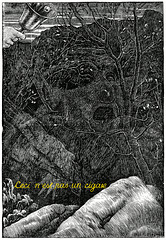
Ceci n'est pas un cigare.
Hendry Holiday was an underestimated artist.
In Lewis Carroll's The Hunting of the Snark , Holiday made sure that it is you who will be hold responsible for your perceptions. Both, Holiday and Carroll/Dodgson, were masters of the art of deniability. They applied the " paranoiac-critical method " a few years before Dalí invented it to pull our legs.
Holiday's illustration to the last Snark chapter:
See also: www.academia.edu/9907524/The_Art_of_Deniability
Millais, Anonymous, Galle
| 02 Jun 2013 |
|
|
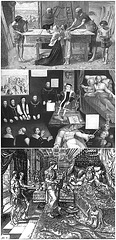
[top]: John Everett Millais : Christ in the House of His Parents aka The Carpenter's Shop (1850).
Location: Tate Britain (N03584) , London.
Literature:
* Deborah Mary Kerr (1986): John Everett Millais's Christ in the house of his parents ( circle.ubc.ca/handle/2429/26546 )
p.34 in (01) Éva Péteri (2003): Victorian Approaches to Religion as Reflected in the Art of the Pre-Raphaelites, Budapest 2003, ISBN 978-9630580380 (shortlink: www.snrk.de/EvaPeteri.htm )
* Albert Boime (2008): Art in an Age of Civil Struggle, 1848-1871
p. 225-364: The Pre-Raphaelites and the 1848 Revolution ( en.wikipedia.org/wiki/Special:BookSources/0226063283 )
[center]: Anonymous : Edward VI and the Pope , An Allegory of Reformation, mirrored view (16th century, NPG 4165 ). Iconoclasm depicted in the window. Under the "window" 3rd from left is Thomas Cranmer who wrote the 42 Articles in 1552.
Edward VI and the Pope (NPG 4165) was, until 1874, the property of Thomas Green, Esq., of Ipswich and Upper Wimpole Street , a collection 'Formed by himself and his Family during the last Century and early Part of the present Century' (Roy C. Strong: Tudor and Jacobean Portraits , 1969, p.345). Thus, when Millais' Christ in the House of His Parents ('The Carpenter's Shop') was painted in 1849-1850, the 16th century painting was part of a private collection. It was sold by Christie's 20 March 1874 (lot 9) to a buyer unknown to me, that is, when Holiday started with his illustrations to The Hunting of the Snark .
Location: National Portrait Gallery, London
[bottom]: Philip Galle after Maarten van Heemskerck , Redrawn print Ahasuerus consulting the records (1564). The resemblance to the image above (middle) was shown by Dr. Margaret Aston in 1994 in The King's Bedpost: Reformation and Iconography in a Tudor Group Portrait (p. 68). She also compared the bedpost to Heemskerck's Esther Crowned by Ahasuerus .
Location: Rijksmuseum, Amsterdam
Detail:
The Carpenter and Ahasuerus:
Before I found Millais' allusions as a kind of bycatch of my Snark hunt,
I started with Henry Holiday's allusions to Millais:
An "allusion chain":
Album:
J. E. Millais
Holiday - Millais- Anonymous - Galle, detail
| 31 May 2013 |
|
|
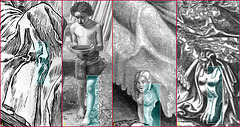
#1 - (allusion to the bedpost #3): 1876, Henry Holiday: Segment of an illustration to Lewis Carroll's The Hunting of the Snark (vectorized after a scan from an 1910 edition of the Snark )
#2 - (allusion to the bedpost #3 and to Philip Galle's print #4): 1850, the young John the Baptist in John Everett Millais : Christ in the House of His Parents (aka The Carpenter's Shop ). The left leg of the boy looks a bit deformed. This is no mistake. Probably Millais referred to #3 and to #4.
#3 - (Henry VIII's bedpost): 16th century, anonymous: Redrawn segment of Edward VI and the Pope, An Allegory of Reformation , (mirror view).
#4 - (bedpost #3 alludes to bedpost #4): 1564, Redrawn segment of a print Ahasuerus consulting the records by Philip Galle after Maarten van Heemskerck. The resemblance of #4 to the image #3 (the bedpost) was shown by the late Dr. Margaret Aston in 1994 in The King's Bedpost: Reformation and Iconography in a Tudor Group Portrait (p. 68). She also compared the bedpost to Heemskerck's Esther Crowned by Ahasuerus .
Jump to top
RSS feed- Götz Kluge's latest photos with "deniability" - Photos
- ipernity © 2007-2026
- Help & Contact
|
Club news
|
About ipernity
|
History |
ipernity Club & Prices |
Guide of good conduct
Donate | Group guidelines | Privacy policy | Terms of use | Statutes | In memoria -
Facebook
X
