

Götz Kluge's photos with the keyword: John Everett Millais
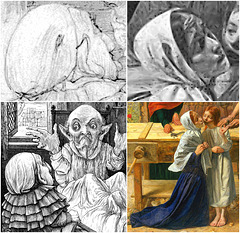
Mary's and the Baker's Kerchiefs
| 27 Dec 2014 |
|
|
[left]: Redrawn segment from one of Henry Holiday's pencil drafts for the depiction of the Baker's visit to his uncle (1876) in Lewis Carroll's The Hunting of the Snark . Below the draft you see a segment of the final – and less daring – illustration.
[right]: John Everett Millais : Redrawn Segment from Christ in the House of His Parents (1850) depicting Mary (and a part of Christ's face in the upper right corner). Below that segment you see a larger segment from Millais' painting.
This example shows how Holiday worked on the construction of his conundrums in his illustrations to Lewis Carroll's The Hunting of the Snark . Even though Holiday copied a face from a face, he reinterprated shapes of face elements from the source face in order to represent different face elements with a resembling shape in the target face. The baker's ear is based on a shape in the depiction of Marie's face which is no ear. The same partially applies to the Baker's nose and the baker's eye.
Such kind of pictorial obfuscation should not be a surprise as The Hunting of the Snark is a poem in which readers had been searching textual allusions since 1876. (Too obvuous allusions are too boring.) The focus on textual analysis of the Snark seems to lead us to underestimate Holiday's paralleling Carroll's wordplay with is own means as an graphical artist.
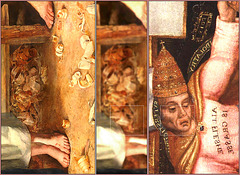
Wood Shavings turned Pope
| 16 Feb 2014 |
|
|
|
From Pope to Wood Shavings
[left]: Rotated segment from John Everett Millais : Christ in the House of His Parents (1850).
[center]: As above. Blurred.
[right]: Rotated segment from anonymous: Edward VI and the Pope, a Tudor anti-papal allegory of reformation, mirrored view (16th century).
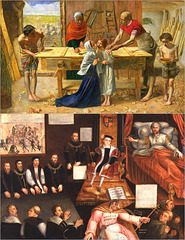
Carpenters Shop and Millais' Allusions
| 15 Feb 2014 |
|
|
Finding Millais' allusions to an anonymous painter is a "bycatch" of my Snark hunt.
[top]: John Everett Millais : Christ in the House of His Parents aka The Carpenter's Shop (1850).
Location: Tate Britain (N03584) , London.
Literature:
* Deborah Mary Kerr (1986): John Everett Millais's Christ in the house of his parents ( circle.ubc.ca/handle/2429/26546 )
p.34 in (01) Éva Péteri (2003): Victorian Approaches to Religion as Reflected in the Art of the Pre-Raphaelites, Budapest 2003, ISBN 978-9630580380 (shortlink: www.snrk.de/EvaPeteri.htm )
* Albert Boime (2008): Art in an Age of Civil Struggle, 1848-1871
p. 225-364: The Pre-Raphaelites and the 1848 Revolution ( en.wikipedia.org/wiki/Special:BookSources/0226063283 )
[bottom]: Anonymous : Edward VI and the Pope , An Allegory of Reformation, mirrored view (16th century, NPG 4165 ). Iconoclasm depicted in the window. Under the "window" 3rd from left is Thomas Cranmer who wrote the 42 Articles in 1552.
Edward VI and the Pope (NPG 4165) was, until 1874, the property of Thomas Green, Esq., of Ipswich and Upper Wimpole Street , a collection 'Formed by himself and his Family during the last Century and early Part of the present Century' (Roy C. Strong: Tudor and Jacobean Portraits , 1969, p.345). Thus, when Millais' Christ in the House of His Parents ('The Carpenter's Shop') was painted in 1849-1850, the 16th century painting was part of a private collection. It was sold by Christie's 20 March 1874 (lot 9) to a buyer unknown to me, that is, when Holiday started with his illustrations to The Hunting of the Snark .
Location: National Portrait Gallery, London
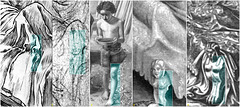
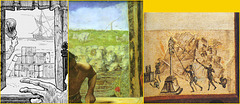
Holiday - Millais - Anonymous - Galle; detail
| 08 Aug 2014 |
|
|
|
#1, left - (allusion to the bedpost #3): 1876, Henry Holiday (engraver: Joseph Swain): The illustration detail on the very left side is a vectorized scan from Holiday's illustration to an 1910 edition of Lewis Carroll's The Hunting of the Snark .
#1, right: Additionally you see a segment from Holiday's preperatory draft.
#2 - (allusion to the bedpost #3 and to Philip Galle's print #4): 1850, the young John the Baptist in John Everett Millais : Christ in the House of His Parents (aka The Carpenter's Shop ). The left leg of the boy looks a bit deformed. This is no mistake. Probably Millais referred to #3 and to #4.
#3 - (Henry VIII's bedpost): 16th century, anonymous: Redrawn segment of Edward VI and the Pope, An Allegory of Reformation , (mirror view).
#4 - (bedpost #3 alludes to bedpost #4): 1564, Redrawn segment of a print Ahasuerus consulting the records by Philip Galle after Maarten van Heemskerck. The resemblance of #4 to the image #3 (the bedpost) was shown by the late Dr. Margaret Aston in 1994 in The King's Bedpost: Reformation and Iconography in a Tudor Group Portrait (p. 68). She also compared the bedpost to Heemskerck's Esther Crowned by Ahasuerus .
The Butcher & the young Raleigh (details)
| 18 Nov 2013 |
|
|
Two details:
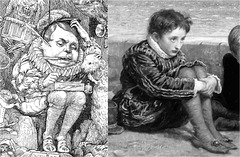
[left]: Depiction of the Butcher in an illustration by Henry Holiday to the 5th fit in Lewis Carroll's The Hunting of the Snark (1876)
[right]: The Boyhood of Raleigh by J. E. Millais (1869)
The comparison is based on Louise Schweitzer 's assumption in One Wild Flower (2012, page 223): "But perhaps Holiday's ruff - and the pose of the Fit Five drawing - was inspired by the Elizabethan drama inherent in Millais' Boyhood of Raleigh , (1869)." (As for the young Raleigh, a son of Millais was the model for the boy.)
Wood Shavings turned Pope (1st version)
| 20 Jul 2013 |
|
|
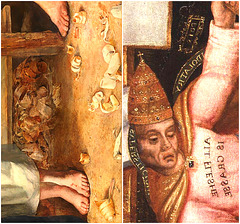
From Pope to Wood Shavings
[left]: Rotated segment from John Everett Millais : Christ in the House of His Parents (1850).
[right]: Rotated segment from anonymous: Edward VI and the Pope, a Tudor anti-papal allegory of reformation, mirrored view (16th century).
Holiday - Millais- Anonymous - Galle, detail
| 07 Jul 2013 |
|
|
|
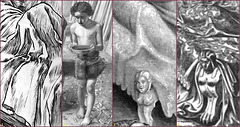
#1 - (allusion to the bedpost #3): 1876, Henry Holiday: Segment of an illustration to Lewis Carroll's The Hunting of the Snark (vectorized after a scan from an 1911 edition of the Snark )
#2 - (allusion to the bedpost #3 and to Philip Galle's print #4): 1850, the young John the Baptist in John Everett Millais : Christ in the House of His Parents (aka The Carpenter's Shop ). The left leg of the boy looks a bit deformed. This is no mistake. Probably Millais referred to #3 and to #4.
#3 - (Henry VIII's bedpost): 16th century, anonymous: Redrawn segment of Edward VI and the Pope, An Allegory of Reformation , (mirror view).
#4 - (bedpost #3 alludes to bedpost #4): 1564, Redrawn segment of a print Ahasuerus consulting the records by Philip Galle after Maarten van Heemskerck. The resemblance of #4 to the image #3 (the bedpost) was shown by the late Dr. Margaret Aston in 1994 in The King's Bedpost: Reformation and Iconography in a Tudor Group Portrait (p. 68). She also compared the bedpost to Heemskerck's Esther Crowned by Ahasuerus .
John Everett Millais: Lorenzo and Isabella (detail…
| 01 Jul 2013 |
|
|
|
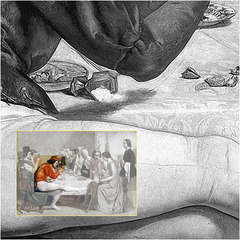
John Everett Millais' painting Lorenzo and Isabella (National Museums Liverpool, Walker Art Gallery) was inspired by John Keats poem Isabella .
The reproduction displayed above shows a detail from the depiction of one of Lorenzo's brothers. Here young Millais left quite visible traces when he re-positioned the elbow of that thug.
In November 2012 the Liverpool museums page said (but doesn't say ist anymore): "[...] On the table there is spilled salt, symbolic of the blood which will later be spilled. The shadow of the arm of the foremost brother is cast across this salt, thus linking him directly with the future bloodshed. [...]"
In June 2013 I noticed that the "shadow of the arm" and all that is gone. Another page says: "[...] salt, symbol of life, is spilt on the table; [...]"
By the way, did you notice that the white salt partially covers the "shadow of the arm"? What a miraculous shadow that is! Has this already been discussed in the past 164 years?
See also: www.academia.edu/10907558/More_salt_To_see_or_not_to_see
Some quotes, which may be related to this image:
“peindre n’est pas affirmer"
Michel Foucault. This is Not a Pipe , Chapter 6 ( excerpt ), 1968
"An anti-subject painting might effectly conceal its subject, hiding it from everyone except the painter; or it might tease viewers with clues; or it might be so arcane that few people can see its subject: What counts is the retreat from the obvious, unambiguous primary meaning."
James Elkins (The School of the Art Institute of Chicago): Why are our Pictures Puzzles? , p. 129, 1999 (see also book review )
"To say it fully, a cryptomorph is an image that is hidden at its making, remains invisible for some period, and then is revealed so that it becomes an image that once was hidden (and the can no longer be hidden again)."
James Elkins ..., p. 184
"The act of revealing fully hidden cryptomorphs is an act of terrorism against pictorial sense."
James Elkins ..., p. 203
"Only those questions that are in principle undecidable, we can decide."
Heinz von Foerster: Ethics and Second-Order Cybernetics , 1990-10-04 (Système et thérapie familiale, Paris)
Honi soit qui mal y pense
The Carpenter and Ahasuerus
| 30 Jun 2013 |
|
|
|
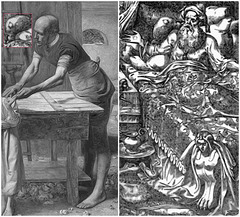
[left]: Vectorized segment from John Everett Millais : Christ in the House of His Parents aka The Carpenter's Shop (1850).
Location: Tate Britain (N03584) , London.
[right]: Vectorized segment from Philip Galle after Maarten van Heemskerck , Redrawn print Ahasuerus consulting the records (1564).
Location: Rijksmuseum, Amsterdam
Thumb & Lappet
| 29 Jun 2013 |
|
|
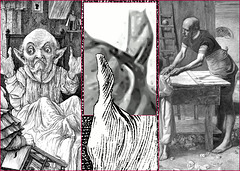
[left]: Henry Holiday : Segment from a depictionof the Baker's visit to his uncle (1876) in Lewis Carroll's The Hunting of the Snark (engraved by Joseph Swain).
[center]: Doesn't this thumb look more like a piece of cloth rather than like a thumb?
[right]: John Everett Millais : Redrawn Segment from Christ in the House of His Parents aka The Carpenter's Shop (1850), presently on display at Tate Britain (N03584) .
Kerchiefs and other shapes
| 09 Jun 2013 |
|
|
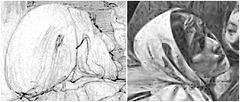
[left]: Redrawn segment from one of Henry Holiday's pencil drafts for the depiction of the Baker's visit to his uncle (1876) in Lewis Carroll's The Hunting of the Snark .
[right]: John Everett Millais : Redrawn Segment from Christ in the House of His Parents (1850) depicting Mary (and a part of Christ's face in the upper right corner).
This example shows how Holiday worked on the construction of his conundrums in his illustrations to Lewis Carroll's The Hunting of the Snark . Even though Holiday copied a face from a face, he reinterprated shapes of face elements from the source face in order to represent different face elements with a resembling shape in the target face. The baker's ear is based on a shape in the depiction of Marie's face which is no ear. The same partially applies to the Baker's nose and the baker's eye.
Such kind of pictorial obfuscation should not be a surprise as The Hunting of the Snark is a poem in which readers had been searching textual allusions since 1876. (Too obvuous allusions are too boring. The focus on textual analysis of the Snark seems to lead us to underestimate Holiday's paralleling Carroll's wordplay with is own means as an graphical artist.
By the way: In 1882, Alfred Parsons turned the Baker's ear into a part of a chair in Charles Darwin's study at Downe . Holiday quoted and was quoted. Artists like Parsons, Holiday and Millais (see below) do such things and have fun when playing their game. Today Mahendra Singh is maintaining the tradition , in the Snark and beyond the beast.
Extended version, Dec. 2014:
Holiday - Millais - Anonymous - Galle
| 08 Jun 2013 |
|
|
|
See also: www.academia.edu/9856486/Henry_Holiday_-_and_Millais_Christ_in_the_House_of_His_Parents_
.
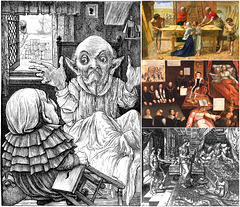
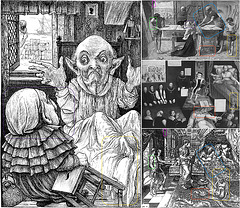
The discovery here is the allusion by Henry Holiday to the painting by J.E. Millais. Finding Millais' allusions to an anonymous painter and to Galle's print is a "bycatch" of my Snark hunt. The relation between the anonymous painting and Galle's print already has been explained by Margaret Aston in 1994. That relation brobably has been discovered even earlier by Millais.
.
[left]: Henry Holiday: Depiction (1876) of the Baker 's visit to his uncle in Lewis Carroll's " The Hunting of the Snark " (engraved by Joseph Swain). Outside of the window are some of the Baker's 42 boxes.
[right top]: John Everett Millais : Christ in the House of His Parents aka The Carpenter's Shop (1850).
Location: Tate Britain (N03584) , London.
Literature:
* Deborah Mary Kerr (1986): John Everett Millais's Christ in the house of his parents ( circle.ubc.ca/handle/2429/26546 )
p.34 in (01) Éva Péteri (2003): Victorian Approaches to Religion as Reflected in the Art of the Pre-Raphaelites, Budapest 2003, ISBN 978-9630580380 (shortlink: www.snrk.de/EvaPeteri.htm )
* Albert Boime (2008): Art in an Age of Civil Struggle, 1848-1871
p. 225-364: The Pre-Raphaelites and the 1848 Revolution ( en.wikipedia.org/wiki/Special:BookSources/0226063283 )
[right middle]: Anonymous : Edward VI and the Pope , An Allegory of Reformation, mirrored view (16th century, NPG 4165 ). Iconoclasm depicted in the window. Under the "window" 3rd from left is Thomas Cranmer who wrote the 42 Articles in 1552.
Edward VI and the Pope (NPG 4165) was, until 1874, the property of Thomas Green, Esq., of Ipswich and Upper Wimpole Street , a collection 'Formed by himself and his Family during the last Century and early Part of the present Century' (Roy C. Strong: Tudor and Jacobean Portraits , 1969, p.345). Thus, when Millais' Christ in the House of His Parents ('The Carpenter's Shop') was painted in 1849-1850, the 16th century painting was part of a private collection. It was sold by Christie's 20 March 1874 (lot 9) to a buyer unknown to me, that is, when Holiday started with his illustrations to The Hunting of the Snark .
Location: National Portrait Gallery, London
[right bottom]: Philip Galle after Maarten van Heemskerck , Redrawn print Ahasuerus consulting the records (1564). The resemblance to the image above (right middle) was shown by Dr. Margaret Aston in 1994 in The King's Bedpost: Reformation and Iconography in a Tudor Group Portrait (p. 68). She also compared the bedpost to Heemskerck's Esther Crowned by Ahasuerus .
Location: Rijksmuseum, Amsterdam
42 Boxes, Sheep, Iconoclasm
| 08 Jun 2013 |
|
|
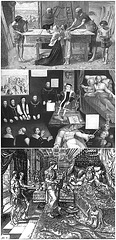
[left]: Segment from Henry Holiday's depiction of the Baker's visit to his uncle (1876) in Lewis Carroll's The Hunting of the Snark . Outside of the window are some of the Baker's 42 boxes.
[center]: Segment from John Everett Millais : Christ in the House of His Parents (1850).
[right]: segment from Edward VI and the Pope , An Allegory of Reformation , mirrored view (Anonymous, 16th century); depiction of iconoclasm. In The King's Bedpost: Reformation and Iconography in a Tudor Group Portrait (1994, p. 72), the late Margaret Aston compared the iconoclastic scene to prints depicting the destruction of the Tower of Babel (Philip Galle after Maarten van Heemskerck, 1567). From Margaret Aston's book I learned that the section showing the iconoclasm scene is an inset, not a window. Actually, I think, it is an inset which was meant to be perceived as a window as well.
·
Holiday quoted pictorial elements from both paintings [center, right]. I assume that he must have noticed, that Millais quoted from the 16th century painting.
Millais, Anonymous, Galle
| 02 Jun 2013 |
|
|
[top]: John Everett Millais : Christ in the House of His Parents aka The Carpenter's Shop (1850).
Location: Tate Britain (N03584) , London.
Literature:
* Deborah Mary Kerr (1986): John Everett Millais's Christ in the house of his parents ( circle.ubc.ca/handle/2429/26546 )
p.34 in (01) Éva Péteri (2003): Victorian Approaches to Religion as Reflected in the Art of the Pre-Raphaelites, Budapest 2003, ISBN 978-9630580380 (shortlink: www.snrk.de/EvaPeteri.htm )
* Albert Boime (2008): Art in an Age of Civil Struggle, 1848-1871
p. 225-364: The Pre-Raphaelites and the 1848 Revolution ( en.wikipedia.org/wiki/Special:BookSources/0226063283 )
[center]: Anonymous : Edward VI and the Pope , An Allegory of Reformation, mirrored view (16th century, NPG 4165 ). Iconoclasm depicted in the window. Under the "window" 3rd from left is Thomas Cranmer who wrote the 42 Articles in 1552.
Edward VI and the Pope (NPG 4165) was, until 1874, the property of Thomas Green, Esq., of Ipswich and Upper Wimpole Street , a collection 'Formed by himself and his Family during the last Century and early Part of the present Century' (Roy C. Strong: Tudor and Jacobean Portraits , 1969, p.345). Thus, when Millais' Christ in the House of His Parents ('The Carpenter's Shop') was painted in 1849-1850, the 16th century painting was part of a private collection. It was sold by Christie's 20 March 1874 (lot 9) to a buyer unknown to me, that is, when Holiday started with his illustrations to The Hunting of the Snark .
Location: National Portrait Gallery, London
[bottom]: Philip Galle after Maarten van Heemskerck , Redrawn print Ahasuerus consulting the records (1564). The resemblance to the image above (middle) was shown by Dr. Margaret Aston in 1994 in The King's Bedpost: Reformation and Iconography in a Tudor Group Portrait (p. 68). She also compared the bedpost to Heemskerck's Esther Crowned by Ahasuerus .
Location: Rijksmuseum, Amsterdam
Detail:
The Carpenter and Ahasuerus:
Before I found Millais' allusions as a kind of bycatch of my Snark hunt,
I started with Henry Holiday's allusions to Millais:
An "allusion chain":
Album:
J. E. Millais
Holiday - Millais - Anonymous - Galle
| 08 Jun 2013 |
|
|
|
See also: www.academia.edu/9856486/Henry_Holiday_-_and_Millais_Christ_in_the_House_of_His_Parents_
.
The discovery here is the allusion by Henry Holiday to the painting by J.E. Millais. Finding Millais' allusions to an anonymous painter and to Galle's print is a "bycatch" of my Snark hunt. The relation between the anonymous painting and Galle's print already has been explained by Margaret Aston in 1994. That relation brobably has been discovered even earlier by Millais.
.
[left]: Henry Holiday: Depiction (1876) of the Baker's visit to his uncle in Lewis Carroll's " The Hunting of the Snark " (engraved by Joseph Swain). Outside of the window are some of the Baker's 42 boxes.
[right top]: John Everett Millais : Christ in the House of His Parents aka The Carpenter's Shop (1850).
Location: Tate Britain (N03584) , London.
Literature:
* Deborah Mary Kerr (1986): John Everett Millais's Christ in the house of his parents ( circle.ubc.ca/handle/2429/26546 )
* p.34 in (01) Éva Péteri (2003): Victorian Approaches to Religion as Reflected in the Art of the Pre-Raphaelites, Budapest 2003, ISBN 978-9630580380 (shortlink: www.snrk.de/EvaPeteri.htm )
* Albert Boime (2008): Art in an Age of Civil Struggle, 1848-1871
p. 225-364: The Pre-Raphaelites and the 1848 Revolution ( en.wikipedia.org/wiki/Special:BookSources/0226063283 )
[right middle]: Anonymous : Edward VI and the Pope , An Allegory of Reformation, mirrored view (16th century, NPG 4165 ). Iconoclasm depicted in the window. Under the "window" 3rd from left is Thomas Cranmer who wrote the 42 Articles in 1552.
Edward VI and the Pope (NPG 4165) was, until 1874, the property of Thomas Green, Esq., of Ipswich and Upper Wimpole Street , a collection 'Formed by himself and his Family during the last Century and early Part of the present Century' (Roy C. Strong: Tudor and Jacobean Portraits , 1969, p.345). Thus, when Millais' Christ in the House of His Parents ('The Carpenter's Shop') was painted in 1849-1850, the 16th century painting was part of a private collection. It was sold by Christie's 20 March 1874 (lot 9) to a buyer unknown to me, that is, when Holiday started with his illustrations to The Hunting of the Snark .
Location: National Portrait Gallery, London
[right bottom]: Philip Galle after Maarten van Heemskerck , Redrawn print Ahasuerus consulting the records (1564). The resemblance to the image above (right middle) was shown by Dr. Margaret Aston in 1994 in The King's Bedpost: Reformation and Iconography in a Tudor Group Portrait (p. 68). She also compared the bedpost to Heemskerck's Esther Crowned by Ahasuerus .
Location: Rijksmuseum, Amsterdam
Holiday - Millais- Anonymous - Galle, detail
| 31 May 2013 |
|
|
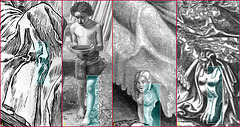
#1 - (allusion to the bedpost #3): 1876, Henry Holiday: Segment of an illustration to Lewis Carroll's The Hunting of the Snark (vectorized after a scan from an 1910 edition of the Snark )
#2 - (allusion to the bedpost #3 and to Philip Galle's print #4): 1850, the young John the Baptist in John Everett Millais : Christ in the House of His Parents (aka The Carpenter's Shop ). The left leg of the boy looks a bit deformed. This is no mistake. Probably Millais referred to #3 and to #4.
#3 - (Henry VIII's bedpost): 16th century, anonymous: Redrawn segment of Edward VI and the Pope, An Allegory of Reformation , (mirror view).
#4 - (bedpost #3 alludes to bedpost #4): 1564, Redrawn segment of a print Ahasuerus consulting the records by Philip Galle after Maarten van Heemskerck. The resemblance of #4 to the image #3 (the bedpost) was shown by the late Dr. Margaret Aston in 1994 in The King's Bedpost: Reformation and Iconography in a Tudor Group Portrait (p. 68). She also compared the bedpost to Heemskerck's Esther Crowned by Ahasuerus .
Jump to top
RSS feed- Götz Kluge's latest photos with "John Everett Millais" - Photos
- ipernity © 2007-2026
- Help & Contact
|
Club news
|
About ipernity
|
History |
ipernity Club & Prices |
Guide of good conduct
Donate | Group guidelines | Privacy policy | Terms of use | Statutes | In memoria -
Facebook
X
