

Earthwatcher's photos with the keyword: suevite
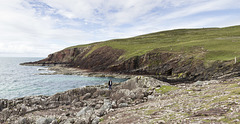
Staca Fada - view west
| 14 Aug 2016 |
|
Stac Fada at the northern end of the Bay of Stoer, north west Scotland, is the type locality for the Stac Fada Formation , recently interpreted as a meteorite impact debris horizon, comparable with suevite from the much younger (Miocene, 15 Ma) Ries meteorite impact event in south Germany. The Stac Fada Formation lies within the Bay of Stoer Formation, mostly fluviatile sandstones and siltstones (Mesoproterozoic, c. 1200 Ma).
The Stac Fada Formation is about 12 metres thick at this location. This photo gives a general view of the deposit, showing its massive, rather poorly bedded nature where the person is standing, in contrast with the Bay of Stoer Formation above and below.
The site of the meteorite impact is now correlated with a well-defined, roughly circular, low-gravity anomaly some 50 km to the east, near the village of Lairg, although any impact crater is now buried beneath younger rocks. SEE UPDATE BELOW.
For more details see:
Simms, M. J., 2015. The Stac Fada impact ejecta deposit and the Lairg Gravity Low: evidence for a buried Precambrian impact crater in Scotland?, Proceedings of the Geologists Association , 126 (2015), 742 - 761.
UPDATE June 2019:
Latest research based on detailed field observations, geochemical and geomagnetic work now seems to indicate that the impact site is located in the present day Minch, about 15 - 20 km WNW of Enard Bay. See:
Amor, K. et al, 2019. The Mesoproterozoic Stac Fada proximal ejecta blanket, NW Scotland: constraints on crater location from field observations, anisotropy of magnetic susceptibility, petrography and geochemistry. Journal of the Geological Society 176/4 (2019).
dx.doi.org/10.1144/jgs2018-093
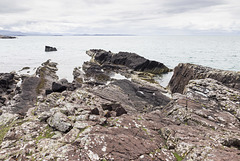
Staca Fada - view south
| 14 Aug 2016 |
|
|
|
Stac Fada at the northern end of the Bay of Stoer, north west Scotland, is the type locality for the Stac Fada Formation , recently interpreted as a meteorite impact debris horizon, comparable with suevite from the much younger (Miocene, 15 Ma) Ries meteorite impact event in south Germany. The Stac Fada Formation lies within the Bay of Stoer Formation, mostly fluviatile sandstones and siltstones (Mesoproterozoic, c. 1200 Ma).
The Stac Fada Formation is about 12 metres thick at this location. This photo gives a general view of the deposit, showing its massive, rather poorly bedded nature, in contrast with the Bay of Stoer Formation above and below.
The site of the meteorite impact is now correlated with a well-defined, roughly circular, low-gravity anomaly some 50 km to the east, near the village of Lairg, although any impact crater is now buried beneath younger rocks. SEE UPDATE BELOW.
For more details see:
Simms, M. J., 2015. The Stac Fada impact ejecta deposit and the Lairg Gravity Low: evidence for a buried Precambrian impact crater in Scotland?, Proceedings of the Geologists Association , 126 (2015), 742 - 761.
UPDATE June 2019:
Latest research based on detailed field observations, geochemical and geomagnetic work now seems to indicate that the impact site is located in the present day Minch, about 15 - 20 km WNW of Enard Bay. See:
Amor, K. et al, 2019. The Mesoproterozoic Stac Fada proximal ejecta blanket, NW Scotland: constraints on crater location from field observations, anisotropy of magnetic susceptibility, petrography and geochemistry. Journal of the Geological Society 176/4 (2019).
dx.doi.org/10.1144/jgs2018-093
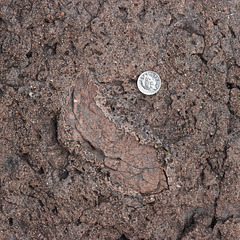
Staca Fada Formation - close up 2
| 14 Aug 2016 |
|
Stac Fada at the northern end of the Bay of Stoer, north west Scotland, is the type locality for the Stac Fada Formation , recently interpreted as a meteorite impact debris horizon, comparable with suevite from the much younger (Miocene, 15 Ma) Ries meteorite impact event in south Germany. The Stac Fada Formation lies within the Bay of Stoer Formation, mostly fluviatile sandstones and siltstones (Mesoproterozoic, c. 1200 Ma).
The Stac Fada Formation is about 12 metres thick at this location. The photo shows a close-up view of part of the middle section. The red-brown arkosic sand matrix contains darker grey-green chloritised clasts and fragments representing formerly molten debris blasted into the air from the original impact, together with un-melted rock fragments.
The prominent clast in the centre appears to be a somewhat deformed rock fragment which may have been near-molten during its passage through the air following the impact. Rounded edges and fish-tailed ends may indicate ablation by hot gasses whilst in motion.
Small cavities lined with pale pink feldspar crystals, especially on around the margin of the clast are interpreted as elutriation channels where steam and other volatiles escaped as the ejecta deposit cooled.
The coin shown for scale is a UK 5p piece, 1.8 cm in diameter.
The site of the meteorite impact is now correlated with a well-defined, roughly circular, low-gravity anomaly some 50 km to the east, near the village of Lairg, although any impact crater is now buried beneath younger rocks. SEE UPDATE BELOW.
For more details see:
Simms, M. J., 2015. The Stac Fada impact ejecta deposit and the Lairg Gravity Low: evidence for a buried Precambrian impact crater in Scotland?, Proceedings of the Geologists Association , 126 (2015), 742 - 761.
UPDATE June 2019:
Latest research based on detailed field observations, geochemical and geomagnetic work now seems to indicate that the impact site is located in the present day Minch, about 15 - 20 km WNW of Enard Bay. See:
Amor, K. et al, 2019. The Mesoproterozoic Stac Fada proximal ejecta blanket, NW Scotland: constraints on crater location from field observations, anisotropy of magnetic susceptibility, petrography and geochemistry. Journal of the Geological Society 176/4 (2019).
dx.doi.org/10.1144/jgs2018-093
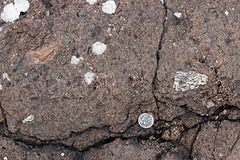
Staca Fada Formation - close up 1
| 14 Aug 2016 |
|
Stac Fada at the northern end of the Bay of Stoer, north west Scotland, is the type locality for the Stac Fada Formation , recently interpreted as a meteorite impact debris horizon, comparable with suevite from the much younger (Miocene, 15 Ma) Ries meteorite impact event in south Germany. The Stac Fada Formation lies within the Bay of Stoer Formation, mostly fluviatile sandstones and siltstones (Mesoproterozoic, c. 1200 Ma).
The Stac Fada Formation is about 12 metres thick at this location. The photo shows a close-up view of part of the middle section. The red-brown arkosic sand matrix contains darker grey-green chloritised clasts and fragments representing formerly molten debris blasted into the air from the original impact, together with un-melted rock fragments. The pale irregular clast to the right of centre appears to be a fragment of Lewisian Gneiss. Small cavities lined with pale pink feldspar crystals are interpreted as elutriation channels where steam and other volatiles escaped as the ejecta deposit cooled.
The coin shown for scale is a UK 5p piece, 1.8 cm in diameter.
The site of the meteorite impact is now correlated with a well-defined, roughly circular, low-gravity anomaly some 50 km to the east, near the village of Lairg, although any impact crater is now buried beneath younger rocks. SEE UPDATE BELOW.
For more details see:
Simms, M. J., 2015. The Stac Fada impact ejecta deposit and the Lairg Gravity Low: evidence for a buried Precambrian impact crater in Scotland?, Proceedings of the Geologists Association , 126 (2015), 742 - 761.
UPDATE June 2019:
Latest research based on detailed field observations, geochemical and geomagnetic work now seems to indicate that the impact site is located in the present day Minch, about 15 - 20 km WNW of Enard Bay. See:
Amor, K. et al, 2019. The Mesoproterozoic Stac Fada proximal ejecta blanket, NW Scotland: constraints on crater location from field observations, anisotropy of magnetic susceptibility, petrography and geochemistry. Journal of the Geological Society 176/4 (2019).
dx.doi.org/10.1144/jgs2018-093
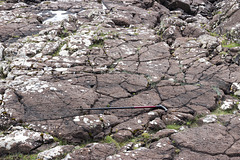
Stac Fada Formation - possible cooling joints? 2
| 14 Aug 2016 |
|
Stac Fada at the northern end of the Bay of Stoer, north west Scotland, is the type locality for the Stac Fada Formation , recently interpreted as a meteorite impact debris horizon, comparable with suevite from the much younger (Miocene, 15 Ma) Ries meteorite impact event in south Germany. The Stac Fada Formation lies within the Bay of Stoer Formation, mostly fluviatile sandstones and siltstones (Mesoproterozoic, c. 1200 Ma).
The Stac Fada Formation is about 12 metres thick at this location. The photo shows a part of the middle section and consists of a poorly bedded arkosic sand matrix within which there are dark green chloritised clasts and fragments which represent formerly molten debris blasted into the air from the original impact. There is a network of polygonal cracks visible on this 'bedding' surface and I theorise that these may be cooling joints formed as the presumably hot ejecta deposit cooled and contracted. (I have seen no reference to this particular feature in the literature).
The site of the meteorite impact is now correlated with a well-defined, roughly circular, low-gravity anomaly some 50 km to the east, near the village of Lairg, although any impact crater is now buried beneath younger rocks. SEE UPDATE BELOW.
For more details see:
Simms, M. J., 2015. The Stac Fada impact ejecta deposit and the Lairg Gravity Low: evidence for a buried Precambrian impact crater in Scotland?, Proceedings of the Geologists Association , 126 (2015), 742 - 761.
UPDATE June 2019:
Latest research based on detailed field observations, geochemical and geomagnetic work now seems to indicate that the impact site is located in the present day Minch, about 15 - 20 km WNW of Enard Bay. See:
Amor, K. et al, 2019. The Mesoproterozoic Stac Fada proximal ejecta blanket, NW Scotland: constraints on crater location from field observations, anisotropy of magnetic susceptibility, petrography and geochemistry. Journal of the Geological Society 176/4 (2019).
dx.doi.org/10.1144/jgs2018-093
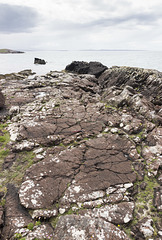
Stac Fada Formation - possible cooling joints? 1
| 14 Aug 2016 |
|
Stac Fada at the northern end of the Bay of Stoer, north west Scotland, is the type locality for the Stac Fada Formation , recently interpreted as a meteorite impact debris horizon, comparable with suevite from the much younger (Miocene, 15 Ma) Ries meteorite impact event in south Germany. The Stac Fada Formation lies within the Bay of Stoer Formation, mostly fluviatile sandstones and siltstones (Mesoproterozoic, c. 1200 Ma).
The Stac Fada Formation is about 12 metres thick at this location. The photo shows a part of the middle section and consists of a poorly bedded arkosic sand matrix within which there are dark green chloritised clasts and fragments which represent formerly molten debris blasted into the air from the original impact. There is a network of polygonal cracks visible on this 'bedding' surface and I theorise that these may be cooling joints formed as the presumably hot ejecta deposit cooled and contracted. (I have seen no reference to this particular feature in the literature).
The site of the meteorite impact is now correlated with a well-defined, roughly circular, low-gravity anomaly some 50 km to the east, near the village of Lairg, although any impact crater is now buried beneath younger rocks. SEE UPDATE BELOW.
For more details see:
Simms, M. J., 2015. The Stac Fada impact ejecta deposit and the Lairg Gravity Low: evidence for a buried Precambrian impact crater in Scotland?, Proceedings of the Geologists Association , 126 (2015), 742 - 761.
UPDATE June 2019:
Latest research based on detailed field observations, geochemical and geomagnetic work now seems to indicate that the impact site is located in the present day Minch, about 15 - 20 km WNW of Enard Bay. See:
Amor, K. et al, 2019. The Mesoproterozoic Stac Fada proximal ejecta blanket, NW Scotland: constraints on crater location from field observations, anisotropy of magnetic susceptibility, petrography and geochemistry. Journal of the Geological Society 176/4 (2019).
dx.doi.org/10.1144/jgs2018-093
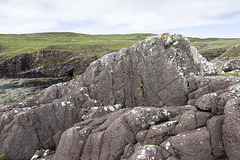
Stac Fada Formation
| 14 Aug 2016 |
|
Stac Fada at the northern end of the Bay of Stoer, north west Scotland, is the type locality for the Stac Fada Formation , recently interpreted as a meteorite impact debris horizon, comparable with suevite from the much younger (Miocene, 15 Ma) Ries meteorite impact event in south Germany. The Stac Fada Formation lies within the Bay of Stoer Formation, mostly fluviatile sandstones and siltstones (Mesoproterozoic, c. 1200 Ma).
The Stac Fada Formation is about 12 metres thick at this location. The photo shows a part of the middle section and consists of a poorly bedded arkosic sand matrix within which there are dark green chloritised clasts and fragments which represent formerly molten debris blasted into the air from the original impact.
The site of the meteorite impact is now correlated with a well-defined, roughly circular, low-gravity anomaly some 50 km to the east, near the village of Lairg, although any impact crater is now buried beneath younger rocks. SEE UPDATE BELOW.
For more details see:
Simms, M. J., 2015. The Stac Fada impact ejecta deposit and the Lairg Gravity Low: evidence for a buried Precambrian impact crater in Scotland?, Proceedings of the Geologists Association , 126 (2015), 742 - 761.
UPDATE June 2019:
Latest research based on detailed field observations, geochemical and geomagnetic work now seems to indicate that the impact site is located in the present day Minch, about 15 - 20 km WNW of Enard Bay. See:
Amor, K. et al, 2019. The Mesoproterozoic Stac Fada proximal ejecta blanket, NW Scotland: constraints on crater location from field observations, anisotropy of magnetic susceptibility, petrography and geochemistry. Journal of the Geological Society 176/4 (2019).
dx.doi.org/10.1144/jgs2018-093
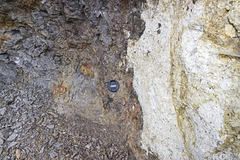
Aumühle quarry: Bunte Breccia and Suevite - close…
| 05 Jan 2016 |
|
Ries Meteorite Crater Geopark.
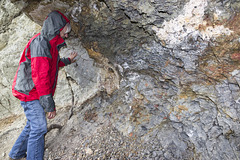
Exposure of Bunte Breccia (purple-grey) and Suevite (pale grey) in the Aumühle quarry near Oettingen located near the centre of the crater.
Suevite is formed from the fallout of the partially melted and vaporised ejecta debris shot high into the atmosphere as a result of the meteorite impact when temperatures and pressures almost instantaneously reached 20,000°C and several million bar.
Bunte Breccia is formed from discrete rock masses deposited as a coherent ejecta blanket following the meteorite impact.
Torrential rain at the time of taking this photo!
Aumühle quarry: Bunte Breccia and Suevite 2
| 05 Jan 2016 |
|
Ries Meteorite Crater Geopark.
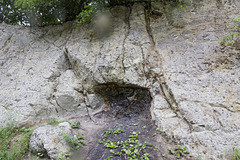
Exposure of Bunte Breccia (purple-grey) and Suevite (pale grey) in the Aumühle quarry near Oettingen located near the centre of the crater.
Suevite is formed from the fallout of the partially melted and vaporised ejecta debris shot high into the atmosphere as a result of the meteorite impact when temperatures and pressures almost instantaneously reached 20,000°C and several million bar.
Bunte Breccia is formed from discrete rock masses deposited as a coherent ejecta blanket following the meteorite impact.
Torrential rain at the time of taking this photo!
Aumühle quarry: Bunte Breccia and Suevite 1
| 05 Jan 2016 |
|
Ries Meteorite Crater Geopark.
Exposure of Bunte Breccia (purple-grey) and Suevite (pale grey) in the Aumühle quarry near Oettingen located near the centre of the crater.
Suevite is formed from the fallout of the partially melted and vaporised ejecta debris shot high into the atmosphere as a result of the meteorite impact when temperatures and pressures almost instantaneously reached 20,000°C and several million bar.
Bunte Breccia is formed from discrete rock masses deposited as a coherent ejecta blanket following the meteorite impact.
Torrential rain at the time of taking this photo!
Altenbürg quarry panorama
| 05 Jan 2016 |
|
Ries Meteorite Crater Geopark.
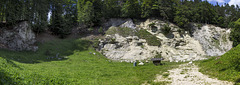
General view of the Altenbürg quarry located on the southwest crater rim. Suevite (pale buff) is in near vertical contact with disturbed Jurassic limestones (Malm - light grey).
Suevite is formed from the fallout of the partially melted and vaporised ejecta debris shot high into the atmosphere as a result of the meteorite impact when temperatures and pressures almost instantaneously reached 20,000°C and several million bar.
This quarry was crucial in the development of the correct understanding and interpretation of the Ries crater. The identification of coesite, stishovite (high temperature and pressure varieties of quartz) and diamond in the suevite enabled the latter to be identified as a meteorite impact ejecta blanket rather than of volcanic origin.
Altenbürg quarry 1a
| 05 Jan 2016 |
|
Ries Meteorite Crater Geopark.
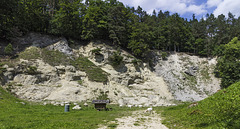
General view of the Altenbürg quarry located on the southwest crater rim. Suevite (pale buff) is in near vertical contact with disturbed Jurassic limestones (Malm - light grey).
Suevite is formed from the fallout of the partially melted and vaporised ejecta debris shot high into the atmosphere as a result of the meteorite impact when temperatures and pressures almost instantaneously reached 20,000°C and several million bar.
This quarry was crucial in the development of the correct understanding and interpretation of the Ries crater. The identification of coesite, stishovite (high temperature and pressure varieties of quartz) and diamond in the suevite enabled the latter to be identified as a meteorite impact ejecta blanket rather than of volcanic origin.
Suevite in Altenbürg quarry: close-up view
| 05 Jan 2016 |
|
Ries Meteorite Crater Geopark.
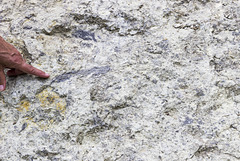
Close-up view of suevite in the Altenbürg quarry located on the southwest crater rim.
Suevite is formed from the fallout of the partially melted and vaporised ejecta debris shot high into the atmosphere as a result of the meteorite impact when temperatures and pressures almost instantaneously reached 20,000°C and several million bar. The darker blue-grey fragments are partly devitrified glass with many small spherules formed from condensed liquid melt.
This quarry was crucial in the development of the correct understanding and interpretation of the Ries crater. The identification of coesite, stishovite (high temperature and pressure varieties of quartz) and diamond in the suevite enabled the latter to be identified as a meteorite impact ejecta blanket rather than of volcanic origin.
Suevite in Altenbürg quarry
| 05 Jan 2016 |
|
Ries Meteorite Crater Geopark.
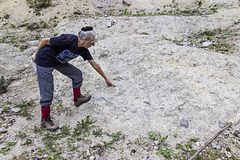
Suevite exposure in the Altenbürg quarry located on the southwest crater rim. Suevite is formed from the fallout of the partially melted and vaporised ejecta debris shot high into the atmosphere as a result of the meteorite impact when temperatures and pressures almost instantaneously reached 20,000°C and several million bar.
This quarry was crucial in the development of the correct understanding and interpretation of the Ries crater. The identification of coesite, stishovite (high temperature and pressure varieties of quartz) and diamond in the suevite enabled the latter to be identified as a meteorite impact ejecta blanket rather than of volcanic origin.
Altenbürg quarry 1
| 05 Jan 2016 |
|
Ries Meteorite Crater Geopark.
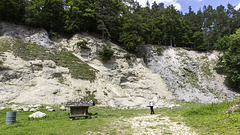
General view of the Altenbürg quarry located on the southwest crater rim. Suevite (pale buff) is in near vertical contact with disturbed Jurassic limestones (Malm - light grey).
Suevite is formed from the fallout of the partially melted and vaporised ejecta debris shot high into the atmosphere as a result of the meteorite impact when temperatures and pressures almost instantaneously reached 20,000°C and several million bar.
This quarry was crucial in the development of the correct understanding and interpretation of the Ries crater. The identification of coesite, stishovite (high temperature and pressure varieties of quartz) and diamond in the suevite enabled the latter to be identified as a meteorite impact ejecta blanket rather than of volcanic origin.
Jump to top
RSS feed- Earthwatcher's latest photos with "suevite" - Photos
- ipernity © 2007-2026
- Help & Contact
|
Club news
|
About ipernity
|
History |
ipernity Club & Prices |
Guide of good conduct
Donate | Group guidelines | Privacy policy | Terms of use | Statutes | In memoria -
Facebook
X
