

Earthwatcher's photos with the keyword: turbidite
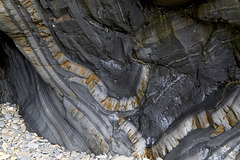
Syncline axis (detail), Wrangle Point, near Bude,…
| 06 May 2012 |
|
|
|
A closer view of the hinge zone of the fold in the previous photo. The 'space problem' of accommodating the beds in the hinge zone of the fold is well illustrated here. The thickened hinge zone contains several small-scale thrusts which have disrupted the thin sandstone bands.
I should have included an object for scale in this view but forgot, sorry! The pale sandstone band in the central portion of the photo is about 4 cm thick.
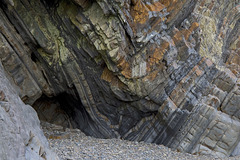
Syncline axis, Wrangle Point, near Bude, Cornwall.
| 06 May 2012 |
|
|
|
A view of the axis of the right-hand syncline shown in the previous photo at beach level. The Bude Formation here consists of alternating thin beds of turbidite sandstones (pale grey/brown) and fine-grained shaly siltstones/mudstones (darker grey). These chevron folds are 'similar' in style, rather than concentric. This means that material (mostly the weaker shaly beds) has had to 'flow' into the hinge zones - notice how it is thicker in the hinge, compared with the limbs of the fold.
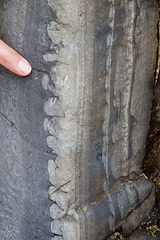
Load structures on turbidite sandstones, Crooklets…
| 17 May 2012 |
|
|
|
On the limb of an anticline, near-vertically bedded turbidite sandstones in the Bude Formation (upper Carboniferous) display sedimentary structures which can be used to determine the 'way up' of the bedding. Here, the sandstones display small-scale slump or load structures on the basal surfaces, and some beds show 'fining up' on the grain size (indicated by gradual darkening of the bed).
These structures demonstrate that the vertical beds here get younger to the right.
Here's structure in its proper setting and orientation:
www.ipernity.com/doc/earthwatcher/39024212
and here:
www.ipernity.com/doc/earthwatcher/39024214
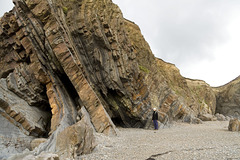
Syncline, Wrangle Point, near Bude, Cornwall
| 17 May 2012 |
|
|
|
A broader view of the syncline shown in the previous photos. The Bude Formation here consists of alternating thin beds of turbidite sandstones (pale grey/brown) and fine-grained shaly siltstones/mudstones (darker grey).
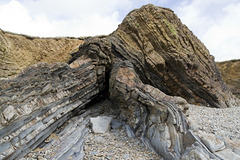
Anticline, Crooklets, near Bude, Cornwall
| 17 May 2012 |
|
|
An anticline in the Bude Formation (upper Carboniferous) at Crooklets, near Bude, Cornwall. The Bude Formation here consists of alternating thin beds of turbidite sandstones (pale grey/brown) and fine-grained shaly siltstones/mudstones (darker grey).
Minor crumpling on the south (right-hand) limb of the fold has resulted in near vertical or slightly overturned bedding. The sandstones display sedimentary structures which can be used to determine the 'way up' of the bedding. Here, the sedimentary structures are mostly rippled upper surfaces and small-scale slump or load structures on the basal surfaces. The latter can be seen in detail in the next two photos:
www.ipernity.com/doc/earthwatcher/39024212
www.ipernity.com/doc/earthwatcher/39024210
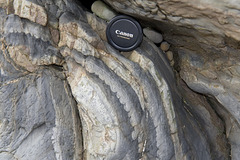
Load structures on turbidite sandstones, Crooklets…
| 17 May 2012 |
|
Turbidite sandstones in the Bude Formation (upper Carboniferous) display sedimentary structures which can be used to determine the 'way up' of the bedding. Here, the sandstones display small-scale slump or load structures on the basal surfaces, and some beds show 'fining up' on the grain size (indicated by gradual darkening of the bed).
These structures demonstrate that the beds here are the right way up, i.e. have not been completely inverted by the strong folding this area has undergone. The sequence shown here gets younger upwards and to the right.
Jump to top
RSS feed- Earthwatcher's latest photos with "turbidite" - Photos
- ipernity © 2007-2026
- Help & Contact
|
Club news
|
About ipernity
|
History |
ipernity Club & Prices |
Guide of good conduct
Donate | Group guidelines | Privacy policy | Terms of use | Statutes | In memoria -
Facebook
X
