

Earthwatcher's photos with the keyword: Pencannow Point
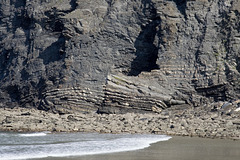
Crackington Haven recumbent folds
| 04 Nov 2009 |
|
A zoomed-in view of the base of the cliff on the north side of Crackington Haven, north Cornwall.
Grey shales and thin turbidite sandstones, (pale grey-brown) of the Crackington Formation (upper Carboniferous) have been strongly deformed into isoclinal recumbent folds by the Variscan earth movements at the end of the Carboniferous.
For an interpretation and further details, see this photo:
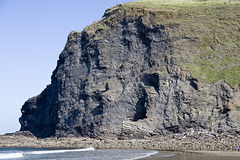
Pencannow Point cliff at Crackington Haven
| 04 Nov 2009 |
|
The 80 metre high cliff of Pencannow Point towers over the northern side of Crackington Haven, north Cornwall. A figure in the lower right corner helps give a sense of scale (see note).
Grey shales and thin turbidite sandstones, (pale grey-brown) of the Crackington Formation (upper Carboniferous) have been strongly deformed into isoclinal recumbent folds by the Variscan earth movements at the end of the Carboniferous.
A zoomed-in view of the lower part with a geological interpretation is here:
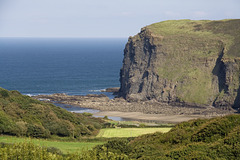
Crackington Haven low tide
| 04 Nov 2009 |
|
The 80 metre high cliff of Pencannow Point towers above the northern side of Crackington Haven, north Cornwall.
Photo taken from near Hallagather.
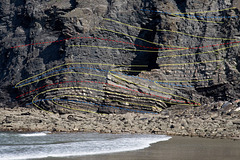
Crackington Haven recumbent folds interpretation
| 04 Nov 2009 |
|
By special request: an interpretation of the zoomed-in view of the base of the cliff on the north side of Crackington Haven, north Cornwall.
Original photo here:
Grey shales and thin turbidite sandstones, (pale grey-brown) of the Crackington Formation (upper Carboniferous) have been strongly deformed into isoclinal recumbent folds by the Variscan earth movements at the end of the Carboniferous.
This is an attempt to interpret the main geological structures, as seen on the more-or-less 2-D vertical cliff face:
Yellow lines are arbitrary bedding traces
Blue dashed lines are synclinal axes
Red dashed lines are anticlinal axes
Sedimentary features (ripples, sole structures, etc) in the sandstones enable us to determine the 'way-up' of the beds and hence classify the folds into anticlines and synclines. In this photo, the general 'younging' direction is to the south east (right). The folds were probably initially upright as the Variscan compression developed but continuing deformation and complex thrusting rotated the whole stack of folds in a clockwise sense so that the fold axes became approximately horizontal.
The deformation is more intense here compared with Millook Haven 3.5 miles to the NE:
This probably reflects (a) more shales (weaker rocks which deform more readily) in the Crackington Haven section and (b) the more southerly location is slightly closer to the 'source' of the deformation. As a general rule, in Cornwall the most intensely deformed rocks are towards the south.
Jump to top
RSS feed- Earthwatcher's latest photos with "Pencannow Point" - Photos
- ipernity © 2007-2026
- Help & Contact
|
Club news
|
About ipernity
|
History |
ipernity Club & Prices |
Guide of good conduct
Donate | Group guidelines | Privacy policy | Terms of use | Statutes | In memoria -
Facebook
X
