

Don Barrett (aka DBs travels)'s photos with the keyword: Indiana University
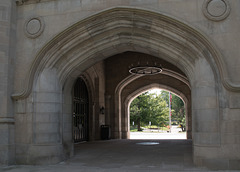
Bloomington Indiana University Memorial Hall (#026…
| 05 Apr 2020 |
|
What was always to me one of most impressive pieces of academic architecture at IU, the main entrance at Memorial Hall (not the same as Memorial Union). Memorial Hall opened in 1924 as a women’s dormitory (I didn’t know that) but for many years was used as offices and classroom space and has now returned to being a residence hall. It’s directly across from ISR (earlier picture), and if my memory is correct, I attended Women’s Studies (now Gender Studies) events in this building when I was there in the 1980’s.
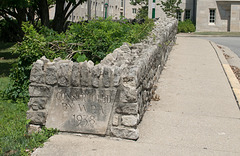
Bloomington Indiana University New Deal (#0267)
| 05 Apr 2020 |
|
Quite a bit of construction at IU occurred in the 1930’s with New Deal funding, including six complete (and large) buildings, and quite a bit of the landscaping, including this prominently marked wall.
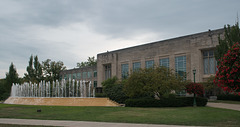
Bloomington Indiana University Jacobs School of Mu…
| 05 Apr 2020 |
|
|
The Jacobs School of Music at IU. When I applied to IU, I had no idea that it had a highly-respected, world renown school of music, which meant very high quality performances at very affordable prices. I basically discovered opera there --more on that with the next picture.
The building here was surprisingly difficult to identify, but I believe it to be Merrill Hall which was dedicated in 1937. Despite that it was built during the Depression and the New Deal, I can find no reference that New Deal funds were used in its construction.
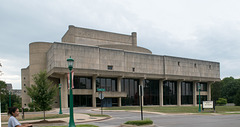
Bloomington Indiana University Musical Arts Center…
| 05 Apr 2020 |
|
|
A surprisingly ugly building for IU, the Musical Arts Center which opened in 1972 and is very appropriately considered to be an example of Brutalist architecture. Despite the horrors of the exterior (or maybe because of them), it has a very spacious auditorium, with excellent acoustics and a large back stage.
It was here that I discovered opera, a taste I never expected. I enjoyed the opera itself, but I expect part of what was special was the whole event of an entire evening with breaks every hour or so where you go out in the lobby, have a drink, and chat with people – a community experience. When I lived in SF I continued going to the opera because the SF opera sold very affordable tickets for standing room, which was fine with me. Elsewhere it has been too expensive, though I’ve been to the opera in Europe where it’s more affordable.
….
Using this to wrap up my thoughts on the years in Bloomington, it really was a remarkable time. While the intellectual development through the school and fellow students was important, I think that there was more value in finding the various channels available for being free and open about my politics and sexuality in an environment that was generally much more conservative and considered by many to be unwelcoming. The connection to IU has been a good reminder in recent years to not be as judging as many are of life in the ‘fly over’ states.
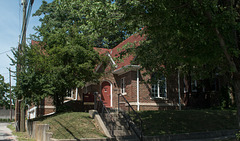
Bloomington home/gay center 2... (#0255)
| 28 Mar 2020 |
|
|
One of the many places I lived in Bloomington, this with some of the more interesting background. I had a friend who always managed to somehow make good connections with various bureaucrats, and so he managed to rent this from the university. It was a large and rather elegant house that had been some administrators home but, at that time, was simply being held by the university for later use. We shared the entire house, with my friend and his girl friend having a bedroom on the first floor and me on the top floor. Since it was owned by the university, we didn’t have to worry about much of the upkeep other than snow removal.
It’s size worked perfectly – I was a leader of the small gay group and we could have meetings in the living room along with potlucks in the dining room. My friend who rented the place usually left town with his girlfriend over the holidays, so another friend and I organized Christmas and Thanksgiving dinner for other gays who had nowhere else to go. Besides being an easy one block walk to the student union, it was also an easy walk to the gay bar and back through the cruising area around the library, so an ideal location...
One fun point – it was also the location for the letter writing campaign we would do, which led to Indiana Governor Bowen claiming that, as far as he knew, there were only ‘13 homosexuals in Indiana and they all live in Bloomington’.
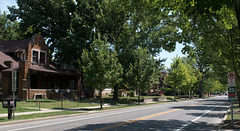
Bloomington street scene / real LGBT center (#0257…
| 28 Mar 2020 |
|
What looks to be a typical street scene, and sort of is. It’s actually reflective of nearby residential streets, but this is directly across the street from the student union and what you see here are homes that have been converted into the offices of various organizations, plus there’s a few churches scattered in here. The building on the left side of the picture with two white flower pots on the steps is now the official LGBTQ center.
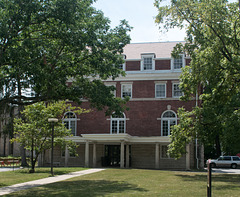
Bloomington Sociology / ISR / grad life (#0265)
| 28 Mar 2020 |
|
|
On the south side of campus, in the middle of fraternity/sorority row, the Institute for Social Research. I believe the building started out as a fraternity or sorority but had been converted into office and classroom space long before I arrived at IU. It was the site for the research and other scholarship activities of many of the faculty, as well as the site for the offices of graduate students who either worked on those projects or taught (I did both).
As an older building, it had steam heat with the old-fashioned radiators that were either way too hot or cold. I taught a couple of classes in the building and the old steam heat was a problem – I’m allergic to strong odors and the heat would get so excessive that I’d have to ask students wearing strong perfumes or colognes to move to the back of the room, which is an awkward request!
There were two other unforgettable experiences in that building, one particularly sad, one just remarkable. First the sad one – I was working one night on writing a paper on the computer when the electricity suddenly shut down. Of course I was angry at what I had lost (early computer, not as secure at backing up as now days), and I blamed the outage on some fraternity party creating some overload (that happened). Later, though, we found out that the power outage was due to a suicide.
Re the remarkable event. I was one of the regular ‘hotline operators’ for the gay and lesbian hotline for south central Indiana (I don’t remember the official name of the hotline). The line could be called for free from anywhere in a broad area that went from Bloomington south to the Ohio River. We could transfer the hotline to some convenient location, so the evenings that I worked it, I’d go to my office to work while waiting for calls. The calls we got were a mix of frustrating. Rewarding, and just interesting. Somehow people (both men and women) in rural areas 60 to 100 miles away would find our number and call with questions that would now sound silly (“what’s a gay”) or impossible to answer (“I’m on a farm, nobody in my family knows I’m questioning, how I can I figure out if I’m gay”) – surprisingly, we got very few harassment calls. We did, though, get a surprising number of calls from rural folk who had figured most everything out and just wanted some detail or just to talk. The calls I remember most clearly were from a man who called repeatedly to talk about opera gloves – where he could get some, what they felt like when he wore them. Many of us who worked the lines got the calls (though he mainly wanted to talk with the men who worked the lines) and the conversations could go up to our 15 minute limit for calls. We talked about his calls in our monthly meetings and decided that he probably just needed to talk, since none of us could provide any answers. His calls, and many similar calls, were good lessons in the value of simple listening.
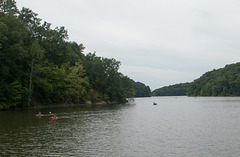
Bloomington Griffy Lake (#0272)
| 28 Mar 2020 |
|
|
Jumping away from town and campus, there were basically two ‘swimming holes’ relatively near town – Griffy Lake (this picture) and the abandoned quarries. Griffy Lake (actually a reservoir) was for many years the main source of drinking water for Bloomington, though it was replaced by two larger lakes south of town in the 60’s. Griffy is surrounded by a nature preserve that was there in the early 80’s, but largely untended. Back in those days it was a relatively wide open space, with people wandering along the lake and setting up to swim anywhere – and nude sun bathing in some of the more distant areas. Luckily, because the campus was largely empty in the summer, it was never crowded. I don’t know when the city started exerting more control over the lake, but now they have a canoe rental and I didn’t see people along the shores.
More interesting, though far more dangerous, was various flooded abandoned limestone quarries around town. These were informal swimming places, often past worn out ‘no trespassing’ signs, where there was nothing to tell you what dangers you were diving into or how far down the bottom was. I enjoyed them, but having always been wary of swimming in places where I couldn’t touch bottom, I spent less time swimming and more time watching. My hesitancy turned out to be fortunate – around the time I left Bloomington was when it was discovered that many of the quarries had old electrical transformers dumped in them, leaking mercury into the water. I tried to photograph one of the quarries we had used on this trip, but couldn’t get near one. I suspect they’re all fenced now, and with people no longer driving up to their edges, you can’t see them due to surrounding trees.
Bloomington bar / hang out (#0264)
| 28 Mar 2020 |
|
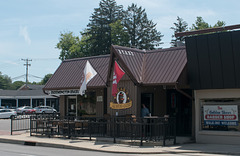
Of course there was a favorite bar/restaurant for Sociology grad students (and the younger faculty) – Bear’s Place, only a short walk from ISR (previous picture). I was surprised to see it was still there (it originally opened in 1972) and pretty much looked like it did when I was there in the early 80’s. Thinking back, I can’t believe the amount we drank and the number of burgers we ate while mixing arguments about Marx or Goffman with discussions of Dallas (the TV show) or some other show, complaints about faculty expectations, and tales of personal romantic woes…..
Bloomington Sociology / Ballentine Hall / grad lif…
| 28 Mar 2020 |
|
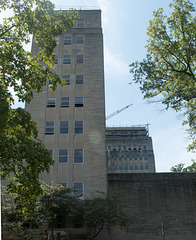
Back to campus, and my main ‘home’ as a graduate student. There were basically two on-campus ‘homes’ for Sociology graduate students, Ballantine Hall and the Institute for Social Research (later picture). Ballantine Hall was the location of the Sociology department, the site of all of the faculty offices, and the site for very many of the classes (both that we took and that we taught).
Ballentine Hall, compared to many other buildings on campus, was relatively dreadful. At 10 stories it is the tallest building on campus and, when it was completed in 1959, the largest academic building in the world. It was just classrooms and offices, so there weren’t any open spaces to break up the sense of dull repetition. Despite its size and interior blandness, its layout was such that it was easy to navigate – except when the elevators didn’t work. Like much of campus, it’s hard to get a good picture of the building, and that was made worse on this trip by some major refurbishing that was happening. The picture link below has a good winter picture of it.
Putting aside the comments on the building, now’s a good time to say a few things about my time in Sociology there. The first thing to address is how I, an openly gay man living in what was then the ‘gay mecca’ of San Francisco, ended up at IU. For very many years I had a love/hate relationship to gay life in SF, I liked the ability to be quite open, but was frustrated by both the economics of trying to afford to live in SF and by a gay culture that had no interest in areas outside their neighborhood. In the late 70’s it was very hard to get a good job in SF, and so I decided to explore graduate school again (after an earlier attempt.)
IU was the home of some of the faculty who did some of the earliest, positive, work on gay life, and was also a well-respected school with a diverse faculty that provided multiple angles for attacking the issues I was interested in – how class prejudice had an impact on the lives of working-class gays and lesbians. Though IU fit with much of what I was concerned with academically, I was worried about moving to a small Midwestern town after having been out and spending long periods in large coastal cities (Manhattan, Boston and SF) for a number of years. I was already in my early 30’s, and not willing to go back to hiding my sexuality. So, I wrote a personal letter to the department, they gave it to a grad student (non-gay) who had moved to IU from the LA area (he became a long-term friend), and he responded with an invitation to visit. I went, felt very welcomed, and decided on IU.
Life there, as both an older graduate student and as an openly gay man, was generally good. I went to Bloomington with a friend and we were quickly welcomed into the community of sociology graduate students, and I was treated no differently by faculty (with a couple of exceptions). Surprisingly, though it felt like my relationships with the department were smooth and welcoming, many years after I left I learned that many following students characterized me as a ground-breaker in terms of making the department comfortable for gay students. Since I never felt like I was blazing new territory, I’m not quite sure how that reputation came to be.
Like in Sociology, Bloomington itself was a surprisingly welcoming community of lesbians and gay men. Though it was quickly clear that Bloomington was something special in a state that was more conservative, it also became clear over time that, though the state was conservative and even often disapproving, there was a history of tolerance that meant that we seldom felt a sense of physical danger.
As I said with the first Bloomington photo, it was an interesting experience being there. Given the divides that are happening in the country now (in 2019), it might be helpful if we got out of our enclaves more often, to see that we’re not as different as we often believe.
…..
One more important note about IU and Bloomington. I left Bloomington early, after almost all of my Sociology graduate course work was completed, but nowhere near the point of completing my PhD. Why? Part of the reason was the future job market. From what I could see in the mid-80’s, if I finished my PhD in the next couple of years, I would end up having to apply for jobs in parts of the country that were far away from the urban centers where gay life was easier (e.g., in South Dakota). Also, we were at that time at the height of the AIDS crisis AND in the middle of the Reagan presidency, a time when anti-gay fever (due to both AIDS and Reagan’s politics) was sharply increasing across the country (there were even some national discussions of quarantining gays.) It was before gay men could know who would be next with AIDS, so the value of a PhD was questionable when live expectancy was uncertain – that uncertainty, combined with the risk of having to move to a potentially unwelcoming small town in a rural state, was not favorable. I hoped that my new skills could be of some use re AIDS, so I moved back to a town I knew, Boston and then later back to SF. When the prospects of early death became less likely, I decided to finish my PhD. With strong help from faculty at IU and support from my work environment in SF, I finished my PhD in ‘92.
History: bloomingpedia.org/wiki/Ballantine_Hall
Picture: bloomingpedia.org/w/images/6/65/Ballantine.jpg
Bloomington Kirkwood St (#0279)
| 27 Mar 2020 |
|
|
COVID-19 update: Given concerns over the coronavirus, I debated whether to keep posting pictures that are, themselves, documentations of a place that I knew 35+ years ago. But, Bloomington was a place that I knew best during the period of another deadly virus that was particularly important to me (HIV) and the pictures thus, in various small ways, indicate how we survive strong fears of infection.
The descriptions on these pictures were written some month ago, long before the coronavirus became such a concern. I'll do some minor editing, but mostly the reflect thoughts before the new virus scare.
********
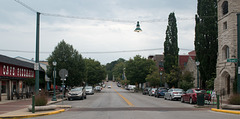
One comparison to the newness of the other campuses that I had attended in the past was that there were no commercial student-centered business zones near those campuses. IU has dominated the culture/economy of Bloomington for quite some time and the key ‘student’ commercial strip is Kirkwood (this street) coming east from the historic main gate of campus. I was surprised on this visit that the street looks basically unchanged, with very many of the same businesses, from when I was a student there in the early 80’s. Looks, though, are slightly deceptive – both here and in other areas Bloomington has somehow managed to integrate new buildings and new businesses in with the old in a way that doesn’t hurt the charm of the old. If you look on the right side of the picture you see a fairly new building – there’s a Chipotle and a chain sandwich shop in there, and across the street there’s a new building with a Panda Express.
….
The church on the corner to my right, Trinity Episcopal, was important for gay culture in Bloomington since the minister had created a chapter of Integrity, an Episcopal gay group popular in larger cities – the one in Bloomington usually has something like 10-12 attendees for its meetings. More important for me (I didn’t attend the group), the minister was also a good source for insights whenever some local gay or HIV issue arose.
Bloomington Runcible Spoon (#0281)
| 27 Mar 2020 |
|
|
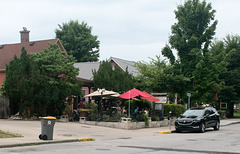
From the days before chain coffee houses, a dependable coffee house and cafe, that’s been in the same location (just off Kirkwood) since 1976. Back when I was there, it was mostly a gathering place for older students and younger faculty (and politically left gays) – I don’t know if it’s still the same.
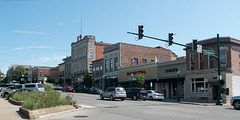
Bloomington Courthouse Square (#0251)
| 27 Mar 2020 |
|
Maybe because it’s a college town, the central downtown was thriving when I was there in the 80’s, and still seemed to be in 2019 – though it looked like the small number of stores that had sold office supplies and ordinary merchandise in the 80's have been replaced by restaurants.
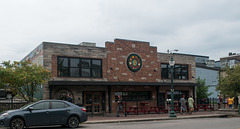
Bloomington Kirkwood Kilroy’s (#0282)
| 27 Mar 2020 |
|
Now this really amazed me that it was still there. Kilroy’s was a party space for undergraduate frat boys and sorority sisters when I was there – not a place that gays went. Considering the youth of its clientele, I didn’t expect it to hold on.
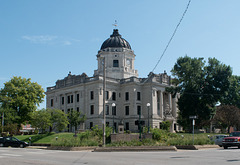
Bloomington Monroe County Courthouse (#0254)
| 27 Mar 2020 |
|
|
Very much the physical center of town when I was there, and apparently still the center, the Monroe County Courthouse. Built in 1908 and, like all older governmental buildings in the area, constructed of Indiana limestone. Though it forms a good historical marker for the town, I only vaguely recall going in there. I seem to recall paying a parking ticket there, but it’s not City Hall, so I doubt I did.
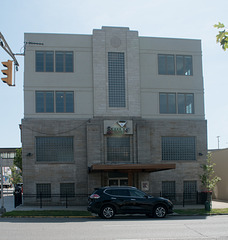
Bloomington gay bar history (#0253)
| 21 Mar 2020 |
|
In the 80’s the main gay bar in Bloomington was in this building, with a bar and dance floor on the lower level (a few steps down), and a large stage on the upper level where there were drag shows every weekend. Per Google, the main gay bar is now in the building to its right, with an entrance in the back and is actually called “The Back Door”. From the descriptions I’ve seen, the current gay bar in the adjacent building sounds very much like the gay bar that was in this building in the 80’s. The building in this picture is now a ‘martini bar’ without any specification as gay.
The gay bar in Bloomington, in the 1980’s, was pretty much like gay bars around the country at that time – a place to relax and socialize, dance (they had good music), find a partner, and sometimes a place to meet for political stuff. My very weak effort at bartending happened there – when our political group had events there, we got a percent of the proceeds if we provided the bar staffing.
The drag show upstairs on the weekend was a new experience for me since I’d never been a fan of drag shows when I lived in cities. Bloomington was small enough that you often knew the men who routinely performed in the drag shows, but the highlight for me was the amateur nights that they had about once a month. ‘Amateur’ isn’t quite the right word. It was not unusual for the men who performed to be closeted men from rural areas, often 50 to 100 miles away, who came for their monthly chance to be ‘gay’. For some their ability to do drag, and the quality of their lip-syncing, indicated they must have spent a surprising amount of time practicing in the privacy of their rural homes. I often found watching those ‘amateur’ shows to be a positive experience of their celebration, while at the same time a poignantly sad commentary on the status of gay life for many who were away from the more positive resources in cities and college towns.
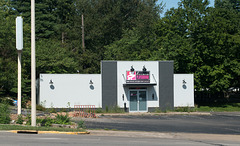
Bloomington adult bookstore (#0247)
| 21 Mar 2020 |
|
One of the other locations for gay men’s lives, at least it was back in the 1980’s – the local adult bookstore. I was surprised to see it still in the same location (and remodeled, it used to look like a dump), and still the same business 35+ years later. Back in the 80’s a number of the clerks were gay men – all were discrete about mentioning any specific customers, but their stories were a good source about closeted gay men on the faculty.
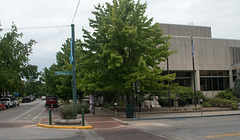
Bloomington / Monroe County Public Library / cruis…
| 21 Mar 2020 |
|
Monroe County public library, which was surprisingly good considering how many residents had access to the libraries at the university that was only 4 blocks away.
But, the story here, is not about the library but a story of 80’s gay culture and the police. One of the ways for gay men to easily meet other gay men (plus some closeted men) in those days, was cruising the block around the library in the evening. What was interesting was that when the local police drove around the library, the cruisers didn’t scurry into hiding. Why? Because the police were open about being there to protect gays from the occasional incidence of straights showing up to harass the men that were cruising – a relationship between police and gays that’s very rare.
Jump to top
RSS feed- Don Barrett (aka DBs travels)'s latest photos with "Indiana University" - Photos
- ipernity © 2007-2026
- Help & Contact
|
Club news
|
About ipernity
|
History |
ipernity Club & Prices |
Guide of good conduct
Donate | Group guidelines | Privacy policy | Terms of use | Statutes | In memoria -
Facebook
X
