

Don Barrett (aka DBs travels)'s photos with the keyword: Newcastle
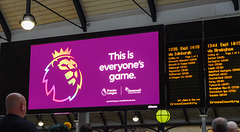
Newcastle Football / Rainbow Laces ad (#1216)
| 06 Apr 2019 |
|
Quite a surprise, at least to me. Considering the reputation of hooliganism at football games in the UK, and considering that standing just in front of me below that sign was a group of male fans with the sorts of 'stand your ground' posture that makes many of us gays feel threatened, I was startled to see a gay affirmative ad from the Premier (football) League on a very central monitor in the train station. Due to being in a fairly dark area, this didn't come out well in terms of colors, but the lion's head is in rainbow colors -- and there is the 'Stonewall' reference on the sign. Well worth reading is the Premier League's strong and very positive campaign (see the link below) about making both the fields and the stands a comfortable place for LGBT players and fans.
Source: www.premierleague.com/rainbowLaces
(Part of a documentation of 2018 exploration/reflection on Brexit and populist movements in Europe, keyword Europe2018)
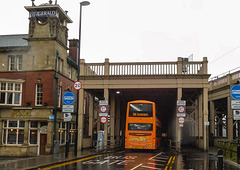
Newcastle High Level bridge / Brexit reflection (#…
| 04 Apr 2019 |
|
|
Intercity bus to Sunderland (about 30 minutes southeast of Newcastle) entering the single lane roadway on the High Level bridge.
This particular bus provides a good opportunity to reflect, again, on the Brexit vote. Sunderland was a supporter of the Leave campaign (61%); Newcastle voted to Remain, but by a very slim margin (50.7%). Based on my limited observations and a conversation on the train, I'm actually surprised that Newcastle voted to Remain..
On the way to Newcastle, I had a very long conversation with a college student who talked about the end of the coal industry in the area and how that had created an overall depressed economy in the general area, and that government seemed to be unconcerned about the fate of those areas -- thus the Leave vote (he was a Remain voter). In Newcastle itself, while the quayside areas along the Tyne looked prosperous (typically associated with Remain voting), the inner city parts that I stumbled upon looked much less successful (typically associated with Leave voting).
Though the Sunderland vote was apparently influenced towards Leave by the actions of a Nissan plant that is there, it's surprising that Newcastle didn't end up on the Leave vote as well. Based just on very rough impressions, one hypothesis would be that the inner-city redevelopment along the Tyne played a part in Newcastle voters having a more positive perspective regarding the EU. Somehow, though, that didn't extend just across the river where Gateshead voted even more strongly than Sunderland to leave (70.6%). It would be interesting to know whether Newcastle alone was benefited by the redevelopment.
Source: www.chroniclelive.co.uk/news/local-news/gateshead-eu-referendum-results-your-11504693
(Part of a documentation of 2018 exploration/reflection on Brexit and populist movements in Europe, keyword Europe2018)
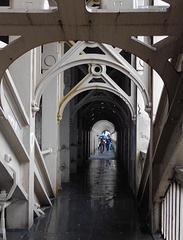
Newcastle High Level bridge (#1210)
| 04 Apr 2019 |
|
|
Sidewalk on the High Level bridge.
(Part of a documentation of 2018 exploration/reflection on Brexit and populist movements in Europe, keyword Europe2018)

Newcastle Gateshead Millennium Bridge (#1201)
| 02 Apr 2019 |
|
|
|
A little past the furthest I could go in the time I had, the Gateshead Millennium Bridge, a pedestrian/bicycle bridge opened to the public in 2001 in celebration of the Millenium. The bridge was built to provide an attractive link of the redeveloped waterfronts of Gateshead (opposite shore) and Newcastle. The bridge opens for taller boats by tilting (which should be interesting to see). In the sources below is a YouTube of it opening.
Sources:
www.bridgesonthetyne.co.uk/gmb.html
www.youtube.com/watch?v=jeYxtFa3YsQ
(Part of a documentation of 2018 exploration/reflection on Brexit and populist movements in Europe, keyword Europe2018)
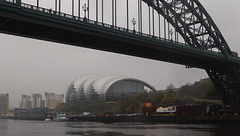
Newcastle Sage Gateshead (#1199)
| 02 Apr 2019 |
|
|
Past the Tyne Bridge, the Sage Gateshead concert venue. Due to the grayness of the day, it was hard to get a good picture of it, but I liked the design overall (though apparently some refer to it as a 'giant slug’). It opened in 2004.
Source: en.wikipedia.org/wiki/Sage_Gateshead
(Part of a documentation of 2018 exploration/reflection on Brexit and populist movements in Europe, keyword Europe2018)
Newcastle historic luxury (#1196)
| 02 Apr 2019 |
|
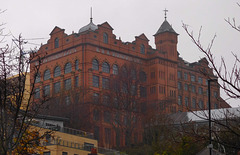
The E & F Turnbull building, overlooking the High Level Bridge on the Newcastle side. The building, built in the 1890's, was originally used by a printing company but in 1963 was taken over by the ironmongers, E & F Turnbull. In 2002 it was redeveloped as luxury condominiums; when I wrote this, there were two 2-bedroom units for sale (£450,000 and £385,000).
Source: www.geograph.org.uk/photo/1159766
(Part of a documentation of 2018 exploration/reflection on Brexit and populist movements in Europe, keyword Europe2018)

Newcastle Tyne bridge (#1202)
| 31 Mar 2019 |
|
|
For some reason this is described as the most celebrated bridge, though there was nothing from this angle that would suggest that. Maybe part of it being cherished is because it links Newcastle (where I am) with Gateshead, the opposite side of the river -- and it is attractive from an aerial perspective (see the link).
Not visible from this angle (see later picture), there are large granite towers on each end which house lifts which were once used for moving pedestrians and goods from the bridge level down to quayside level.
Source: www.bridgesonthetyne.co.uk/tynebri.html
(Part of a documentation of 2018 exploration/reflection on Brexit and populist movements in Europe, keyword Europe2018)
Newcastle harbor Brett's Oil (#1194)
| 31 Mar 2019 |
|
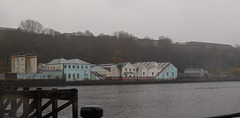
Piecing together information from various sites, including a picture of the other side from Google Streetview, here's what I figured out. The buildings on the Gateshead side of the river are the former Brett's Oils that had been suppliers of lubricants to Newcastle industry since 1877. The company was sold in 2006 and then closed, and there have been various plans to develop the site ever since, but apparently none of them came to fruition. The buildings provide an interesting view from here, hopefully then can be incorporated into whatever ends up over there.
Source: www.chroniclelive.co.uk/news/north-east-news/firm-bids-old-site-1522195
(Part of a documentation of 2018 exploration/reflection on Brexit and populist movements in Europe, keyword Europe2018)
Newcastle Swing Bridge (#1191)
| 31 Mar 2019 |
|
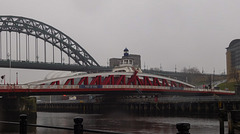
Not a spring chicken.... the Swing Bridge opened in 1876, it replaced a bridge that hampered traffic up river, including the product that made Newcastle famous - coal. The Swing bridge still swings -- the cupola over the center is the housing for the control, the hydraulics are on the center pier. With the end of coal mining in the area, and then a decline in manufacturing, the bridge is opened much less often now, but still is opened. Interestingly, the white trim is to reduce the effects of very hot days. The metal expands enough on hot days that, before the painting had happened, the bridge would become immovable.
Good history and pictures on the following:
Source: www.bridgesonthetyne.co.uk/swingbr.html
(Part of a documentation of 2018 exploration/reflection on Brexit and populist movements in Europe, keyword Europe2018)

Newcastle High Level Bridge (#1189)
| 30 Mar 2019 |
|
|
From the walks along the north bank, two views (this and adjacent picture) of the "High Level Bridge", opened in 1849 and built as it is still used, rail bridge on top and road bridge below. Obviously it was built to alleviate the steep descents and climbs for trains that would have been necessary with a more modest bridge closer to Tyne river level. Due to its design and the significant increase in road traffic (and weight of road traffic) over the years, the bridge now only has buses and taxis on one lane (south bound) on the road level.
The link below provides quite a bit of detail, and interesting pictures of the bridge from other angles.
Source: www.bridgesonthetyne.co.uk/highlev.html
(Part of a documentation of 2018 exploration/reflection on Brexit and populist movements in Europe, keyword Europe2018)

Newcastle ‘memories’ (#1188)
| 30 Mar 2019 |
|
Own Memories Not Possessions
Getting close to the river, a fairly large but undescribed plaza with a fairly radical expression. I suspect it is just very well done graffiti.
(Part of a documentation of 2018 exploration/reflection on Brexit and populist movements in Europe, keyword Europe2018)
Newcastle castle walls? (#1190)
| 29 Mar 2019 |
|
|
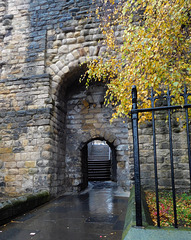
One thing I could not figure out was the age of the walls and stairs as I walked down to the river. These look to be related to the Castle that was part of the Castle Keep and Black Gate of the 1200’s or earlier, but I didn’t see any documentation. If I’d had time to visit longer, I might have found material about this.
(Part of a documentation of 2018 exploration/reflection on Brexit and populist movements in Europe, keyword Europe2018)

Newcastle historic wall (#1181)
| 28 Mar 2019 |
|
Durham Tower (turret) described as the most complete turrett of the remaining wall.
See nearby photo for the history (# 1178) of the wall.
Source: co-curate.ncl.ac.uk/durham-tower
(Part of a documentation of 2018 exploration/reflection on Brexit and populist movements in Europe, keyword Europe2018)

Newcastle mystery (#1183)
| 28 Mar 2019 |
|
|
Despite the detail in the architecture and the gold clock statue (see adjacent), I could find no information on this building/statue.
(Part of a documentation of 2018 exploration/reflection on Brexit and populist movements in Europe, keyword Europe2018)

Newcastle mystery closeup (#1183b)
| 28 Mar 2019 |
|
|
A closer view of the history-less clock and statue in the adjacent picture.
(Part of a documentation of 2018 exploration/reflection on Brexit and populist movements in Europe, keyword Europe2018)

Newcastle historic wall (#1182)
| 28 Mar 2019 |
|
|
Opposite side of the wall shown in the adjacent photo, with gate to Chinatown in the distance. The tower (turret) with windows is Morden Tower. In the 1700’s the towers were used by crafts guilds, this one having been the hall of the Glaziers, Plumbers, Pewterers, and Painters; more recently the turret has become a location for poetry readings.
See nearby photo for the history (# 1178) of the wall.
Source: co-curate.ncl.ac.uk/morden-tower
(Part of a documentation of 2018 exploration/reflection on Brexit and populist movements in Europe, keyword Europe2018)

Newcastle historic wall (#1180)
| 28 Mar 2019 |
|
One of the longer stretches of the ancient wall – there’s a park on the opposite side of the wall, but this side didn’t look inviting for exploring :) The shops backing up to the wall are in Newcastle’s Chinatown.
See nearby photo for the history (# 1178) of the wall.
(Part of a documentation of 2018 exploration/reflection on Brexit and populist movements in Europe, keyword Europe2018)

Newcastle historic wall (#1178)
| 28 Mar 2019 |
|
Remains of the Newcastle Town wall, construction of which apparently began in about 1265, initially to keep out invading Scots. The wall successfully kept the Scots out in 1342 and 1388 but as border wars with Scotland lessened, the wall was allowed to deteriorate. It was strengthened again in the 1700’s in response to the Jacobite rebellions, but then declined after that with sections being demolished to allow for growth – though there were repairs during the Napoleonic wars. (See the Wikipedia for more detail)
The section in this and nearby pictures is the longest remaining section and is described as the West Wall. Pictured here is the Herber tower, the opening in the wall for the road is a later remodeling.
Source: en.wikipedia.org/wiki/Newcastle_town_wall
(Part of a documentation of 2018 exploration/reflection on Brexit and populist movements in Europe, keyword Europe2018)
Jump to top
RSS feed- Don Barrett (aka DBs travels)'s latest photos with "Newcastle" - Photos
- ipernity © 2007-2026
- Help & Contact
|
Club news
|
About ipernity
|
History |
ipernity Club & Prices |
Guide of good conduct
Donate | Group guidelines | Privacy policy | Terms of use | Statutes | In memoria -
Facebook
X
