

David Slater (Spoddendale)'s photos with the keyword: Spoddendale Coachways
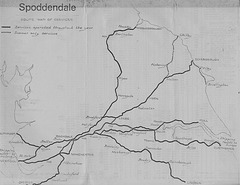
Spoddendale route map late 1970s
| 31 Dec 2013 |
|
A map showing the Spoddendale network in the late 1970s which appeared in the timetable leaflets created at the time. A3 photocopiers were relatively unknown back then so my work was on two A4 sheets that had to be taped together. Forty odd years later the effectiveness of the tape had deteriorated and the two sheets are again separate! Plus it had left a brown mark where it had once been.
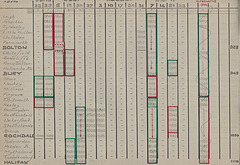
Spoddendale holiday feeder services 1974
| 31 Dec 2013 |
|
The ‘Cotton Towns’ of Lancashire each had an annual close down for two weeks in the main summer months with an additional one week in September. These dedicated weeks generated quite a demand for transport to the holiday resorts. In order to capitalise on this extra traffic, from the towns within a company’s catchment area where regular services did not exist, holiday feeder services were often provided. (Some companies held Road Service Licences merely to operate on three particular Saturdays a year to specific coastal destinations often referred to as ‘long date excursions’).
So much so I created a schedule to provide a number of holiday feeder services from a number of extra towns which fed into the main Spoddendale services. This list covers those for the summer of 1974 and shows all the extra points from where such feeders would have run that linked into the timings at the key towns served by the regular services (shown in bold).
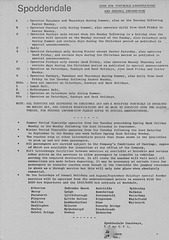
Spoddendale timetable codes 24 May 1977 - Page 5 o…
| 31 Dec 2013 |
|
The full Spoddendale timetable effective 24 May 1977 spread over four pages (two eastbound and two westbound) plus a fifth page containing general information and the codes used within the timetables themselves.
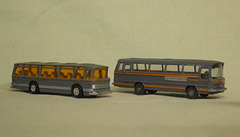
Models in the Spoddendale fleet
| 31 Dec 2013 |
|
|
For a quick fix during the late 1960s/very early 1970s I resorted to using the (hideous) Dinky Toy Duple Viceroy coach for the Spoddendale fleet – quite literally a true toy rather than a model. It was useful that the orange windows complemented my grey and orange livery extremely well! From 1973 to 1978 I turned to the German made Wiking model of the Mercedes-Benz integral O 302 with two per year entering the fleet (fleet numbers 78-89).
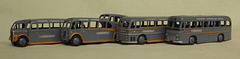
Dinky Toy models in the Spoddendale fleet
| 31 Dec 2013 |
|
|
Four early Spoddendale vehicles manufactured by Dinky Toys, the two underfloor engine examples were bought as gifts for me by my Grandad and I still consider these most treasured possessions.
Left to right they represent a Duple bodied Leyland PS1 (fleet number 12); a James Whitsun ‘deck and a half’ bodied Maudslay (19); a Duple Roadmaster bodied Leyland Royal Tiger (23); and a Harrington bodied Leyland Royal Tiger (32).
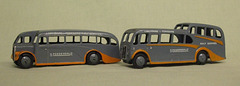
Dinky Toy models in the Spoddendale fleet
| 31 Dec 2013 |
|
|
These two Dinky Toy models represent early Spoddendale vehicles.
Left is a Duple bodied Leyland PS1 (fleet number 12) and right a James Whitsun ‘deck and a half’ bodied Maudslay (19).
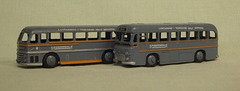
Dinky Toy models in the Spoddendale fleet
| 31 Dec 2013 |
|
|
|
These two Dinky Toy models were bought as childhood gifts for me by my Grandad so have a very special meaning to me. I well remember running the Duple Roadmaster bodied Leyland Royal Tiger (left) along the wall at Oakenrod Primary School circa 1959/1960. It became Spoddendale’s fleet number 23. The Harrington bodied coach represents fleet number 32.
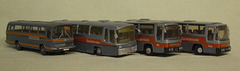
Models in the Spoddendale fleet
| 31 Dec 2013 |
|
A line up of the different types of models that featured in the Spoddendale fleet.
Left to right: Wiking Mercedes-Benz integral O 302 (Between 1973 and 1978 fleet numbers 78-89); Majorette Neoplan Jetliner (1979/1980 fleet numbers 90-94); EFSI Mercedes-Benz/Jonckheere Bermuda (1981 fleet numbers 95/96); and EFSI Volvo B10M/Jonckheere Bermuda (1982-1986 fleet numbers 97-107). Representing the four styles are coaches are 81, 92, 96 and 103.
Whilst the Majorette and EFSI models were basically toys they didn't look too bad when refined with wing mirrors and a little additional detail. Note the circular red 'No smoking' signs on the windows by the first eight or so rows of seats on these two types. The original 'whizz wheels' on the Majorette Neoplans were replaced with decent wheels like those on the Wiking Mercedes-Benz O 302.
Models in the Spoddendale fleet
| 31 Dec 2013 |
|
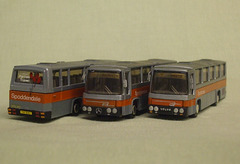
Thirteen examples of the Jonckheere Bermuda model manufactured by the Dutch company EFSI were added to the Spoddendale fleet between 1981 and 1986, two with Mercedes-Benz grilles in 1981 and the rest with Volvo grilles. This photograph shows coach 95 one of the Mercedes-Benz examples parked between two of the Volvos (Left is 99 and right is 98). Inspired by the song ’99 red balloons’ coach 99 carries a promotional message for ‘Private Parties Travel’ with four red balloons tied to the fleetname.
Models in the Spoddendale fleet
| 31 Dec 2013 |
|
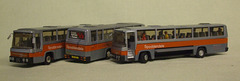
Three of the thirteen examples of the Jonckheere Bermuda model manufactured by the Dutch company EFSI from the Spoddendale fleet. Whilst these were basically toys they didn't look too bad when refined with wing mirrors and a little additional detail. Note the circular red 'No smoking' signs on the windows by the first eight rows of seats.
Coach 96, one of the two which had Mercedes-Benz grilles, is on the left. The other two are Volvos.
Centre is coach 99 which carries a promotional message for ‘Private Parties Travel’ with four red balloons tied to the fleetname - 99 and red balloons inspired by a certain song.
Coach 103 features opening door detail and steps (although the door couldn’t be found for the photograph). It has a small contingent of passengers on board including a young couple cuddling on the back seat. This model has another feature not noticeable in this photograph. The front and rear lights have fibre optics brought from the mid position of the chassis where a 10mm hole was drilled through the chassis base. When the model is placed over an illuminated torch bulb light is carried to the front and tail light fittings.
Models in the Spoddendale fleet
| 31 Dec 2013 |
|
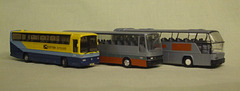
Three different German manufactured models from the Spoddendale fleet are seen in this shot.
Coach 108, as with sister vehicle 109, carried the Scottish Citylink livery to work a Cambridge to Aberdeen integrated/joint service. It is Wiking model of a Mercedes-Benz O 303 integral.
Coach 110 is a Kässbohrer-Setra S215HD manufactured by Herpa numbered but unlettered. The livery layout was different on these coaches and featured the cloud shaped orange relief.
Coach 119 was the first of Rietze Neoplan Cityliners (in both two axle and three axle form) and another experimental livery.
A model Setra in the Spoddendale fleet
| 31 Dec 2013 |
|
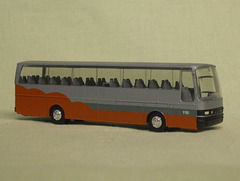
Coach 110 is a Kässbohrer-Setra S215HD manufactured by Herpa numbered but unlettered. The livery layout was different on these coaches and featured the cloud shaped orange relief.
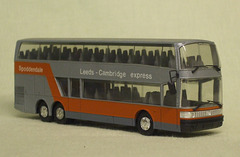
A model Setra in Spoddendale livery
| 31 Dec 2013 |
|
A Kässbohrer-Setra S228DT manufactured by Herpa lettered for Spoddendale’s Cambridge to Leeds Express. Strangely, after going to the trouble of creating the model it was never actually numbered nor considered part of the mainstream fleet! (Perhaps we could say it was a gamble on the part of the coach manufacturer to cajole Spoddendale into buying their product by painting it in the company livery?)
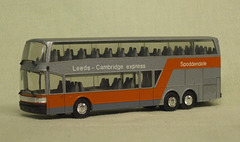
A model Setra in Spoddendale livery
| 31 Dec 2013 |
|
A Kässbohrer-Setra S228DT manufactured by Herpa lettered for Spoddendale’s Cambridge to Leeds Express. Strangely, after going to the trouble of creating the model it was never actually numbered nor considered part of the mainstream fleet! (Perhaps we could say it was a gamble on the part of the coach manufacturer to cajole Spoddendale into buying their product by painting it in the company livery?)
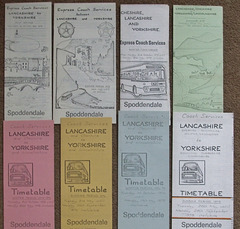
A selection of Spoddendale timetable leaflets 1972…
| 31 Dec 2013 |
|
A selection of Spoddendale timetable leaflets produced between 1972 and 1975. Most of the handwritten written content was made using a very sharp pencil. I was very fortunate to have access to a photocopier at work to create the literature but had to take into account that the copies it produced were slightly smaller than the originals. When preparing an original I did so on a piece of paper that was a few millimetres larger so the end result came out neatly without featuring any borders.
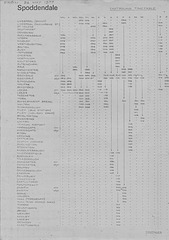
Spoddendale timetable 24 May 1977 - Page 1 of 5
| 31 Dec 2013 |
|
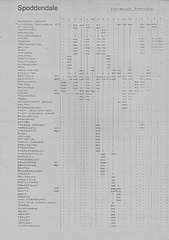
The full Spoddendale timetable effective 24 May 1977 spread over four pages (two eastbound and two westbound) plus a fifth page containing general information and the codes used within the timetables themselves. All the handwritten written content was made using a very sharp pencil. I was very fortunate to have access to a photocopier at work to create the literature but had to take into account that the copies it produced were slightly smaller than the originals. When preparing an original I did so on a piece of paper that was a few millimetres larger so the end result came out neatly without featuring any borders.
Spoddendale timetable 24 May 1977 - Page 2 of 5
| 31 Dec 2013 |
|
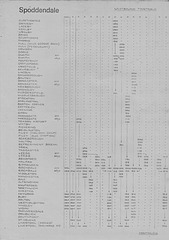
The full Spoddendale timetable effective 24 May 1977 spread over four pages (two eastbound and two westbound) plus a fifth page containing general information and the codes used within the timetables themselves. All the handwritten written content was made using a very sharp pencil. I was very fortunate to have access to a photocopier at work to create the literature but had to take into account that the copies it produced were slightly smaller than the originals. When preparing an original I did so on a piece of paper that was a few millimetres larger so the end result came out neatly without featuring any borders.
Spoddendale timetable 24 May 1977 - Page 3 of 5
| 31 Dec 2013 |
|
The full Spoddendale timetable effective 24 May 1977 spread over four pages (two eastbound and two westbound) plus a fifth page containing general information and the codes used within the timetables themselves. All the handwritten written content was made using a very sharp pencil. I was very fortunate to have access to a photocopier at work to create the literature but had to take into account that the copies it produced were slightly smaller than the originals. When preparing an original I did so on a piece of paper that was a few millimetres larger so the end result came out neatly without featuring any borders.
Jump to top
RSS feed- David Slater (Spoddendale)'s latest photos with "Spoddendale Coachways" - Photos
- ipernity © 2007-2026
- Help & Contact
|
Club news
|
About ipernity
|
History |
ipernity Club & Prices |
Guide of good conduct
Donate | Group guidelines | Privacy policy | Terms of use | Statutes | In memoria -
Facebook
X
