

Tony James' photos with the keyword: Macroglossinae
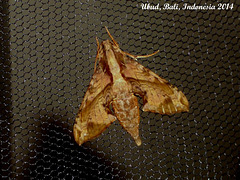
IBa022 Eupanacra elegantulus
| 01 Jan 2015 |
|
Sphingidae, Macroglossinae - Wingspan: 54mm.
A single specimen of this small Hawkmoth was discovered at rest on the wall of the Foyer under a light on the 3rd.
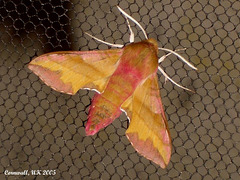
1992 Deilephila porcellus (Small Elephant Hawkmoth…
| 30 Mar 2014 |
|
|
Sphingidae, Macroglossinae Wingspan: 50mm.
The "baby brother" of the previous species, but no less colourful. In Cornwall, it occurs mainly in coastal regions on Sand Dunes or short-grass moorland, where the foodplants, various Bedstraws (Galium sps.) can grow. In good locations, it can occur in sizable numbers.
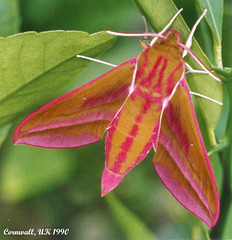
1991 Deilephila elpenor (Elephant Hawkmoth)
| 30 Mar 2014 |
|
|
|
Sphingidae, Macroglossinae Wingspan: 74mm.
This is one of the commonest UK Hawkmoths, and the above specimen had just emerged from the pupa, so it's colours were fresh and pristine. The colours mimic the flowers of the Rosebay Willowherb (Chamerion angustifolium), a large wild plant which grows in swathes on wild or disused ground. It is also one of the food plants for the caterpillars.
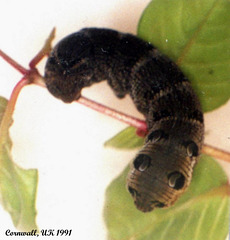
1991 Deilephila elpenor (Elephant Hawkmoth)
| 31 Mar 2014 |
|
Sphingidae Macroglossinae Final Length: ~70mm
Another view of the caterpillar, with the head retracted, showing the defensive posture. If disturbed, the head is pulled back into the third segment, causing the eye-spots to swell and looking somewhat like the head of a small snake.This specimen was found feeding on a garden Fuscia.
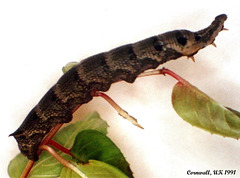
1991 Deilephila elpenor (Elephant Hawkmoth)
| 30 Mar 2014 |
|
Sphingidae Macroglossinae Final Length: ~70mm
The caterpillar of this species gives the source of its common name, as the shape, colour, and motion of it is reminiscent of an Elephant including the trunk, when it is searching for new food to eat (as in this picture).

KS049 Macroglossum glaucoptera
| 17 Nov 2013 |
|
Sphingidae Macroglossinae. Wingspan: 52mm.
This moth, together with a number of others were seen feeding around a bed of Lantana australis outside our friend, Madeline's chalet at dawn and dusk. However, they were always fast moving and very difficult to get near. One morning, Madeline called in with one that she had managed to capture using a large plastic jar alone, a triumph of patience.
Jump to top
RSS feed- Tony James' latest photos with "Macroglossinae" - Photos
- ipernity © 2007-2026
- Help & Contact
|
Club news
|
About ipernity
|
History |
ipernity Club & Prices |
Guide of good conduct
Donate | Group guidelines | Privacy policy | Terms of use | Statutes | In memoria -
Facebook
X
