

Martin M. Miles' photos with the keyword: Alfonso X
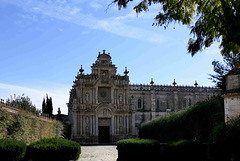
Cartuja de Jerez de la Frontera
| 17 Jul 2024 |
|
|
|
The Cartuja de Jerez de la Frontera (Charterhouse of Jerez de la Frontera) is a monastery, dating back to the knight Alvaro Obertos de Valeto, appointed during the Reconquista by Alfonso X of Castile to defend the city in 1264. Lacking descendants, he left his fortune to establish a Carthusian monastery. It was not until 1475 that this location, that had been the site of a victorious battle, was chosen,
The architecture is of a Late Gothic style, corresponding to the start of construction in the 15th century, with Baroque aspects dating from the 17th century. The building, completed in the 17th century.
Alcobaça - Mosteiro de Alcobaça
| 22 Feb 2024 |
|
|
Alcobaça is home to the "Mosteiro de Alcobaça", one of the largest, most famous and oldest monasteries in Portugal. It was the seat of the Real Abadia de Alcobaça (Royal Abbey of Alcobaça), which from 1567 also presided over all Portuguese Cistercian monasteries. The complex dates back to 1153, when Portugal's first king, Afonso Henriques, gave the Cistercian order the 500 km² area that would later become the monastery, which had been reclaimed from the Moors. Bernard of Clairvaux (1090-1153) one of the most influential clerics of his time, had helped him in his disputes with Alfonso VII. of Leao and Castile over Portugal's unilaterally declared independence and the self-coronation of Alfonso Henriques as King of Portugal in 1139, especially as Eugene III was the first Cistercian to sit on the papal throne from 1145 to 1153. However, the papal bull recognizing Portugal, now issued by Alexander III, was delayed until 1179.
Construction of the monastery began in 1178 and was completed in 1240 with the first section (church and first cloister). As a result of the initial large influx of friars, particularly from Burgundy, the complex was constantly expanded, including the addition of three further cloisters and a church.
The economic success caused a considerable influx, which is why the monastery facilities were constantly expanded. By the beginning of the 15th century, the monks developed a great deal of activity, cultivating the land and developing and expanding agriculture, fishing, extracting salt and iron, promoting crafts and educating the settlers. In 1269 they founded one of the first public schools in the West, and its relocation to Coimbra in 1290 gave rise to the University of Coimbra. The communities belonging to the monastery prospered so well that even in the Alcobaça Abbey, some affluent living began to displace the strict Cistercian rules, a development to which many monasteries succumbed. That's why Pope Benedict XII ordered. In 1335 a reform of the Cistercian orders was announced. King Afonso IV (1291–1357) took advantage of this to curtail the abbey's power. and placed a large number of the towns belonging to Alcobaça under his rule on the grounds that the deed of foundation of King Afonso Henriques did not include the towns.
In view of their wealth and power, the monks distanced themselves from the strict teachings of their founders. In 1475, Abbot Nicolau Vieira secretly ceded his rights to the Archbishop of Lisbon in exchange for an annual pension of 150,000 réis. The monks only found out about this when a delegation from the archbishop took possession of his new rights. The monastery, whose general assembly had always elected its own abbots, thus came under the influence of the commandant abbots (appointed by the king).
In 1531, Afonso de Portugal (1509-1540), the fourth son of King Manuel I (1469-1521) and brother of the later King João III (1502-1557), became Abbot of Alcobaça, who was also Bishop of Lisbon and a cardinal. After his death, King João III appointed his other brother Henrique (1512-1580) as Abbot, who was also Archbishop of Lisbon and Inquisitor General of Portugal and was later appointed Cardinal.
As a result of the Lisbon earthquake of 1755, the southern part of the monastery in particular was damaged and the sacristy destroyed. The monastery's own college was completely destroyed and relocated to the rebuilt parts of the southern monastery complex. In two large processions to the Santuário de Nossa Senhora de Nazaré, 10 km away, the monks gave thanks for being largely spared despite this damage. In 1774, Alcobaça was hit by a flood when the river Alcoa overflowed its banks. It once again damaged the southern monastery complex and also caused large areas of the monastery to sink into the muddy masses of the receding water. It took years for the masses of earth to be moved to the south side of the adjoining grounds, where they buried most of the monastery wall. Finally, as part of the Napoleonic Wars on the Iberian Peninsula in 1810, French troops invaded Alcobaça and pillaged the monastery.
At the end of the 19th century the historian, archaeologist and agronomist Manuel Vieira de Natividade published his work on the monastery of Alcobaça. It was not until 1901 that the president of the district submitted a request to the government to repair and clean the monastery façade. In 1907, parts of the monastery were placed under protection for the first time by government decree. From 1929, the state began to repair the church and the medieval monastery and restore them to their original condition.
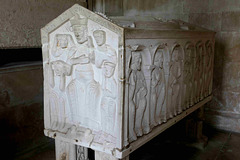
The tomb of Beatrice of Castile (1242-1303)
She was an illegitimate daughter of Alfonso X of Castile and Mayor Guillén de Guzmán and became the second queen consort of Afonso III of Portugal after he had repudiated his first wife, Matilda of Dammartin
Stralsund - Nikolaikirche
| 02 Nov 2021 |
|
|
Slavic Ranen lived on the island of Ruegen and the mainland opposite the island. They were independent heathens up to the middle of the 12th century, and so maybe the last non-Christian people in Central Europe.
In 1168 Danish King Valdemar I defeated the Ranen and destroyed "Jaromarsburg" their main sanctuary. After the Danish victory, the Slavic princes became feudatories of the Danish crown and accepted the Christian faith.
They founded Strale, which prospered because of the rich herring stocks in the waters, many merchants settled here who saw this as their basis for trade. Already in 1234 Slavic Prince Wizlaw I granted the village the town charter (Lübsches Stadtrecht). Stralsund now became an important trading town in the Baltic region, mainly due to settlers from Westphalia. The German settlers clearly outnumbered the Slavic population already around 1300. From 1325 on Stralsund belonged to Pomerania-Wolgast. In the 14th century, it was the most important Hanseatic city in the southern Baltic region after Lübeck.
The 15th century was Stralsund's heyday. Long-distance trade was the most important economic factor. Around 1450, 350 merchants were involved in such trade. In 1488, 50 skippers founded the "St. Marienbruderschaft der Schiffer", the forerunner of the still existing "Stralsund Schiffercompagnie".
As early as 1525, the majority of Stralsund's citizens converted to the Protestant faith. After the Thirty Years' War Stralsund belonged to the Kingdom of Sweden for almost 200 years. In 1815 Stralsund came to Prussia.
-
The town hall and the Nikolaikirche form an impressive architectural ensemble. The planning and construction of the church went hand in hand with the planning of the town hall. The city council was even the trustee for the construction of the new church. The church was initially built as a hall church but following the example of Lübeck's Marienkirche, the unfinished Nikolaikirche was rebuilt into a basilica around 1270.
From the beginning, the church was built with brick produces in the region. Around 1308, the enclosing wall of the choir was closed. This is the result of dendrochronological investigations.
With the start of construction work on the new choir pillars, the eastern part of the predecessor church, which had still been used until then, was finally demolished. An invoice from 1314 for the ridge turret of the choir indicates the date of completion of this section.
Construction of the tower to the west began as early as 1300. Around 1314, when the tower had reached the height of the choir enclosure at 13 metres, the council decided to have two towers built.
Around 1350, the construction of the nave between the two towers was completed.
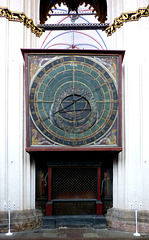
Astronomical clocks were marvels of technology in the Middle Ages. Very expensive high-tech devices that only a few communities could afford.
The astronomical clock of the Nikolaikirche is an astrolabe clock. It is the oldest mechanical clock in the world to have been preserved in its original state. According to an inscription on it, the clock was completed by Nikolaus Lilienfeld on St. Nicholas' Day 1394. It was probably damaged in 1525, when the Protestants raided the church, and has not worked since then. So it has been preserved almost entirely in its original condition. The clockwork and the indications have never been restored.
The clock's case is square is about 16m³. The dial is round. In the four corners, four men are depicted.
Top left: Ptolemy, Greek mathematician, geographer, astronomer and astrologer. His banner reads "Inferiora reguntur a superioribus" (Lower things are ruled by higher things.)
Top right: Alfonso X, King of Castile, Léon and Galicia and sponsor of the Alfonsine tables of astronomical data. His banner: "Motus solis et planetarum in obliquo circulo est" (The motion of the sun and the planets is in an oblique circle.)
Bottom left: Ali ibn Ridwan (labelled Hali), the Islamic physician and astrologer. His banner: "Dies est elevacio solis super orizontem" (The day is the elevation of the sun above the horizon.)
Bottom right: Abu Ma'shar (labelled Albumazar), the Persian mathematician, astronomer and astrologer. His banner: "Sapiens vir dominabitur astris" (The wise man will rule over the stars.)
The small portrait of Master Nikolaus Lilienfeld, the clockmaker, is not visible from here.
Jump to top
RSS feed- Martin M. Miles' latest photos with "Alfonso X" - Photos
- ipernity © 2007-2026
- Help & Contact
|
Club news
|
About ipernity
|
History |
ipernity Club & Prices |
Guide of good conduct
Donate | Group guidelines | Privacy policy | Terms of use | Statutes | In memoria -
Facebook
X
