

Martin M. Miles' photos with the keyword: Hospital de Santiago
Úbeda - Hospital de Santiago
| 13 Dec 2023 |
|
|
During the Reconquista, in 1233, King Ferdinand III conquered Ubeda to the Kingdom of Castile. In 1368, the city was damaged during the Castilian Civil War between Peter I of Castile and Henry II of Castile. This, combined with other circumstances, caused the worsening of the rivalry between the nobel families de Trapera and de Aranda at first, and the families de la Cueva and de Molina after. This political instability was solved when the "Catholic Monarchs" ruled as they ordered the Alcázar, used by the nobility as a fortress, to be destroyed.
During the 16th century, these important Castilian aristocratic families from Úbeda reached top positions in the Spanish Monarchy administration. Notably, Francisco de los Cobos and Juan Vazquez de Molina became Secretaries of State for Emperor Charles V and Philip II respectively. Due to the patronage of arts of these competing families, Úbeda became a Renaissance focus in Spain.
Ubeda and neighboring Baeza benefited from this patronage resulting in the construction of a series of Renaissance style palaces and churches, which have been preserved ever since. In 2003, UNESCO declared the historic centres and landmarks of these two towns a World Heritage Site.
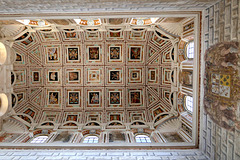
The "Hospital de Santiago" was designed by Andrés de Vandelvira in 1562 and completed in 1575. Don Diego de los Cobos, Bishop of Jaén, ordered its construction as a hospital for the sick poor as well as a church-pantheon and palace. It is now used as a cultural center, exhibition and conference center.
It is an austere work with a great volume. It features two towers at the ends of the facade and two further towers framing the large central chapel. The complex is organized around a large central courtyard.
The ceiling of the hospital´s chapel.
Úbeda - Hospital de Santiago
| 13 Dec 2023 |
|
|
During the Reconquista, in 1233, King Ferdinand III conquered Ubeda to the Kingdom of Castile. In 1368, the city was damaged during the Castilian Civil War between Peter I of Castile and Henry II of Castile. This, combined with other circumstances, caused the worsening of the rivalry between the nobel families de Trapera and de Aranda at first, and the families de la Cueva and de Molina after. This political instability was solved when the "Catholic Monarchs" ruled as they ordered the Alcázar, used by the nobility as a fortress, to be destroyed.
During the 16th century, these important Castilian aristocratic families from Úbeda reached top positions in the Spanish Monarchy administration. Notably, Francisco de los Cobos and Juan Vazquez de Molina became Secretaries of State for Emperor Charles V and Philip II respectively. Due to the patronage of arts of these competing families, Úbeda became a Renaissance focus in Spain.
Ubeda and neighboring Baeza benefited from this patronage resulting in the construction of a series of Renaissance style palaces and churches, which have been preserved ever since. In 2003, UNESCO declared the historic centres and landmarks of these two towns a World Heritage Site.
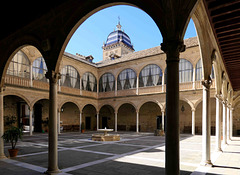
The "Hospital de Santiago" was designed by Andrés de Vandelvira in 1562 and completed in 1575. Don Diego de los Cobos, Bishop of Jaén, ordered its construction as a hospital for the sick poor as well as a church-pantheon and palace. It is now used as a cultural center, exhibition and conference center.
It is an austere work with a great volume. It features two towers at the ends of the facade and two further towers framing the large central chapel. The complex is organized around a large central courtyard
Andalusia, Andalucía,
Spain,
España
Úbeda - Hospital de Santiago
| 13 Dec 2023 |
|
|
During the Reconquista, in 1233, King Ferdinand III conquered Ubeda to the Kingdom of Castile. In 1368, the city was damaged during the Castilian Civil War between Peter I of Castile and Henry II of Castile. This, combined with other circumstances, caused the worsening of the rivalry between the nobel families de Trapera and de Aranda at first, and the families de la Cueva and de Molina after. This political instability was solved when the "Catholic Monarchs" ruled as they ordered the Alcázar, used by the nobility as a fortress, to be destroyed.
During the 16th century, these important Castilian aristocratic families from Úbeda reached top positions in the Spanish Monarchy administration. Notably, Francisco de los Cobos and Juan Vazquez de Molina became Secretaries of State for Emperor Charles V and Philip II respectively. Due to the patronage of arts of these competing families, Úbeda became a Renaissance focus in Spain.
Ubeda and neighboring Baeza benefited from this patronage resulting in the construction of a series of Renaissance style palaces and churches, which have been preserved ever since. In 2003, UNESCO declared the historic centres and landmarks of these two towns a World Heritage Site.
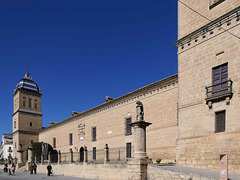
The "Hospital de Santiago" was designed by Andrés de Vandelvira in 1562 and completed in 1575. Don Diego de los Cobos, Bishop of Jaén, ordered its construction as a hospital for the sick poor as well as a church-pantheon and palace. It is now used as a cultural center, exhibition and conference center.
It is an austere work with a great volume. It features two towers at the ends of the facade and two further towers framing the large central chapel.
Úbeda - Hospital de Santiago
| 13 Dec 2023 |
|
|
During the Reconquista, in 1233, King Ferdinand III conquered Ubeda to the Kingdom of Castile. In 1368, the city was damaged during the Castilian Civil War between Peter I of Castile and Henry II of Castile. This, combined with other circumstances, caused the worsening of the rivalry between the nobel families de Trapera and de Aranda at first, and the families de la Cueva and de Molina after. This political instability was solved when the "Catholic Monarchs" ruled as they ordered the Alcázar, used by the nobility as a fortress, to be destroyed.
During the 16th century, these important Castilian aristocratic families from Úbeda reached top positions in the Spanish Monarchy administration. Notably, Francisco de los Cobos and Juan Vazquez de Molina became Secretaries of State for Emperor Charles V and Philip II respectively. Due to the patronage of arts of these competing families, Úbeda became a Renaissance focus in Spain.
Ubeda and neighboring Baeza benefited from this patronage resulting in the construction of a series of Renaissance style palaces and churches, which have been preserved ever since. In 2003, UNESCO declared the historic centres and landmarks of these two towns a World Heritage Site.
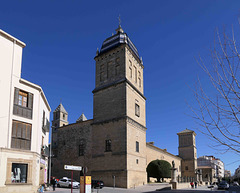
The "Hospital de Santiago" was designed by Andrés de Vandelvira in 1562 and completed in 1575. Don Diego de los Cobos, Bishop of Jaén, ordered its construction as a hospital for the sick poor as well as a church-pantheon and palace. It is now used as a cultural center, exhibition and conference center.
It is an austere work with a great volume. It features two towers at the ends of the facade and two further towers framing the large central chapel.
Jump to top
RSS feed- Martin M. Miles' latest photos with "Hospital de Santiago" - Photos
- ipernity © 2007-2026
- Help & Contact
|
Club news
|
About ipernity
|
History |
ipernity Club & Prices |
Guide of good conduct
Donate | Group guidelines | Privacy policy | Terms of use | Statutes | In memoria -
Facebook
X
