

Martin M. Miles' photos with the keyword: jewelery

Pylos - Archaeological Museum
| 04 Aug 2026 |
|
|
Pylos has been inhabited since Neolithic times. It was a significant kingdom in Mycenaean Greece, with the remains of the so-called "Palace of Nestor" excavated nearby, named after Nestor, the king of Pylos in Homer's Iliad. During the Peloponnesian War, the Bay of Pylos was the site of the Battle of Sphacteria in 425 BC.
In the Middle Ages, during the time of the Crusades, Pylos fell to the Principality of Achaia, founded in 1205. In the 1280s the Franks built the Old Navarino castle. Pylos came under the control of the Republic of Venice from 1417 until 1500, when it was conquered by the Ottoman Empire.
The Ottomans used Pylos and its bay as a naval base, and built the New Navarino / Niokastro fortress there. The area remained under Ottoman control, with the exception of a brief period of renewed Venetian rule from 1685–1715 and a Russian occupation from 1770–71, until the outbreak of the Greek War of Independence in 1821.
The Niokastro covers an area of approximately 70,000 square meters (about 7 hectares). The fortress is strategically located on a hill at the southern entrance to Pylos Bay. There is a lower-lying, sprawling lower castle and a heavily fortified, hexagonal upper castle at the highest point of the complex.
The Archaeological Museum of Pylos is housed in the "Maizonos building" located in the archaeological site of Niokastro Fortress.
Necklace beads
grave gift
Semiprecious stones, 1680 - 1180 BC
Pylos - Archaeological Museum
| 04 Aug 2026 |
|
|
Pylos has been inhabited since Neolithic times. It was a significant kingdom in Mycenaean Greece, with the remains of the so-called "Palace of Nestor" excavated nearby, named after Nestor, the king of Pylos in Homer's Iliad. During the Peloponnesian War, the Bay of Pylos was the site of the Battle of Sphacteria in 425 BC.
In the Middle Ages, during the time of the Crusades, Pylos fell to the Principality of Achaia, founded in 1205. In the 1280s the Franks built the Old Navarino castle. Pylos came under the control of the Republic of Venice from 1417 until 1500, when it was conquered by the Ottoman Empire.
The Ottomans used Pylos and its bay as a naval base, and built the New Navarino / Niokastro fortress there. The area remained under Ottoman control, with the exception of a brief period of renewed Venetian rule from 1685–1715 and a Russian occupation from 1770–71, until the outbreak of the Greek War of Independence in 1821.
The Niokastro covers an area of approximately 70,000 square meters (about 7 hectares). The fortress is strategically located on a hill at the southern entrance to Pylos Bay. There is a lower-lying, sprawling lower castle and a heavily fortified, hexagonal upper castle at the highest point of the complex.
The Archaeological Museum of Pylos is housed in the "Maizonos building" located in the archaeological site of Niokastro Fortress.
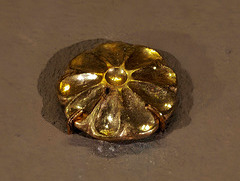
Rosette / Papyrus flower
grave gift
Gold, 1680 - 1180 BC

Pylos - Archaeological Museum
| 04 Aug 2026 |
|
|
Pylos has been inhabited since Neolithic times. It was a significant kingdom in Mycenaean Greece, with the remains of the so-called "Palace of Nestor" excavated nearby, named after Nestor, the king of Pylos in Homer's Iliad. During the Peloponnesian War, the Bay of Pylos was the site of the Battle of Sphacteria in 425 BC.
In the Middle Ages, during the time of the Crusades, Pylos fell to the Principality of Achaia, founded in 1205. In the 1280s the Franks built the Old Navarino castle. Pylos came under the control of the Republic of Venice from 1417 until 1500, when it was conquered by the Ottoman Empire.
The Ottomans used Pylos and its bay as a naval base, and built the New Navarino / Niokastro fortress there. The area remained under Ottoman control, with the exception of a brief period of renewed Venetian rule from 1685–1715 and a Russian occupation from 1770–71, until the outbreak of the Greek War of Independence in 1821.
The Niokastro covers an area of approximately 70,000 square meters (about 7 hectares). The fortress is strategically located on a hill at the southern entrance to Pylos Bay. There is a lower-lying, sprawling lower castle and a heavily fortified, hexagonal upper castle at the highest point of the complex.
The Archaeological Museum of Pylos is housed in the "Maizonos building" located in the archaeological site of Niokastro Fortress.
Bands and a tassel
a flower decorates the center of the two wreaths
Grave gifts
Gold, 1600 - 1300 BC

Kalamata - Archaeological Museum of Messenia
| 25 Jul 2026 |
|
|
With a population of over 70,000, Kalamata is the capital and main port of of Messenia. Today Kalamata is known as the home of the Kalamata olives and Kalamata olive oil.
Kalamata occupies the site of an ancient city, probably that of ancient Pharae, a city already mentioned by Homer.
In medieval times, Kalamata is first mentioned in the 10th-century and got following the Fourth Crusade was conquered by Frankish feudal lords William of Champlitte and Geoffrey of Villehardouin in 1205. Kalamata remained in Frankish hands until , coming under the control of the Byzantine Despotate of the Morea in 1428.
Kalamata was occupied by the Ottomans in 1481. In 1659, during the war between Ottomans and Venetians over Crete, the Venetians captured Kalamata. The town and its castle were plundered and destroyed, and all able-bodied men were carried off to serve as rowers in the Venetian galleys.
The Ottomans reoccupied Kalamata in the war of 1715 and controlled it until the Greek War of Independence, when Kalamata was the first city to be liberated as the Greeks rose in the War of Independence in 1821.
The Archaeological Museum of Messenia, built on the site of the city's old market hall, antiquities from Messenia from prehistoric and Mycenaean times to the Byzantine and Latin eras
Figurine of greenish steatite
portraying a seated naked female
It has a hanging hole and was probably worn as a pendant
Late neolithic period
5th - 4th millenium BC

Larnaca - Archaeological Museum
| 06 Mar 2026 |
|
|
With a population of over 50,000, Larnaca is one of the largest cities in Cyprus.
The Larnaca District Archaeological Museum displays the development of the city of Kition up to Roman times, as well as finds from the Neolithic settlement of Chirokitia. It is one of two archaeological museums in Larnaca.
Plaque/brooch in form of a lion
12th c BC

Larnaca - Archaeological Museum
| 06 Mar 2026 |
|
|
With a population of over 50,000, Larnaca is one of the largest cities in Cyprus.
The Larnaca District Archaeological Museum displays the development of the city of Kition up to Roman times, as well as finds from the Neolithic settlement of Chirokitia. It is one of two archaeological museums in Larnaca.
Gold Egypt-style pendant in form of a lotus flower
Ivory and carnelian inlays / 14th c BC

Larnaca - Archaeological Museum
| 02 Mar 2026 |
|
|
With a population of over 50,000, Larnaca is one of the largest cities in Cyprus.
The Larnaca District Archaeological Museum displays that show the development of the city of Kition and the District of Larnaka, and finds from the Neolithic settlement of Chirokitia. It is one of two archeological museums in Larnaca.
Necklaces from Chirokitia / 7000 - 6000 BC

Heraklion - Archaeological Museum
| 21 May 2025 |
|
Crete is the largest and most populous of the Greek islands, is located about 100 km south of the Peloponnese. Crete was the center of Europe's first advanced civilization, the Minoans, from 3000 to 1400 BC. The Minoan civilization was overrun by the Mycenaean civilization from mainland Greece. Crete was later ruled by Rome, then successively by the Byzantine Empire, Andalusian Arabs, the Byzantine Empire again, the Venetian Republic, and the Ottoman Empire. In 1898 Crete, whose people had for some time wanted to join the Greek state, achieved independence from the Ottomans, formally becoming the Cretan State. Crete became part of Greece in December 1913.
Heraklion is the largest city and the administrative capital of the island of Crete. With a municipal population of about 180.000 it is the fourth largest city in Greece. The greater area of Heraklion has been continuously inhabited since at least 7000 BCE, making it one of the oldest inhabited regions in Europe. As a major center of the Minoan civilization it often considered Europe's oldest city.
The Heraklion Archaeological Museum is one of the largest museums in Greeceand the best in the world for Minoan art, as it contains by far the most important and complete collection of artefacts of the Minoan civilization of Crete.
The museum began in 1883 as a simple collection of antiquities; it was about the time when the Minoan civilization was beginning to be rediscovered, and shortly before the first excavations using proper scientific methods. It was also during the period when Crete was a virtually autonomous part of the Ottoman Empire, after the Pact of Halepa of 1878, later followed by the independent Cretan State (1898-1913). The political situation helped to keep Cretan finds on the island during a crucial period of discoveries.
The museum is located in the town centre. It was built between 1937 and 1940 on a site previously occupied by the Roman Catholic monastery of Saint-Francis which was destroyed by earthquake in 1856.
Gold pectoral ornament with two helmeted heads
Late 8th - early 7th c BC

Agios Nikolaos - Archaeological Museum
| 14 May 2025 |
|
Agios Nikolaos was settled in the late Bronze Age by Dorian occupants of Lato under the name Lato pros Kamara, often simply Kamara. It was the port of Lato for a long time. In the 2nd century BC, Lato was abandoned, and many citizens settled in Kamara. The name of the present-day town comes from the church of Agios Nikolaos, which dates back to the 9th or 10th century and is one of the oldest intact churches in Crete.
In 1970, the Archaeological Museum was opened to house finds from Eastern Crete that had previously been housed in Heraklion
Necklaces, beads of glass paste, fayence and gold. Postpalatial period (1400 – 1150 BCE)
Heraklion - Archaeological Museum
| 02 Apr 2025 |
|
Crete is the largest and most populous of the Greek islands, is located about 100 km south of the Peloponnese. Crete was the center of Europe's first advanced civilization, the Minoans, from 3000 to 1400 BC. The Minoan civilization was overrun by the Mycenaean civilization from mainland Greece. Crete was later ruled by Rome, then successively by the Byzantine Empire, Andalusian Arabs, the Byzantine Empire again, the Venetian Republic, and the Ottoman Empire. In 1898 Crete, whose people had for some time wanted to join the Greek state, achieved independence from the Ottomans, formally becoming the Cretan State. Crete became part of Greece in December 1913.
Heraklion is the largest city and the administrative capital of the island of Crete. With a municipal population of about 180.000 it is the fourth largest city in Greece. The greater area of Heraklion has been continuously inhabited since at least 7000 BCE, making it one of the oldest inhabited regions in Europe. As a major center of the Minoan civilization it often considered Europe's oldest city.
The Heraklion Archaeological Museum is one of the largest museums in Greeceand the best in the world for Minoan art, as it contains by far the most important and complete collection of artefacts of the Minoan civilization of Crete.
The museum began in 1883 as a simple collection of antiquities; it was about the time when the Minoan civilization was beginning to be rediscovered, and shortly before the first excavations using proper scientific methods. It was also during the period when Crete was a virtually autonomous part of the Ottoman Empire, after the Pact of Halepa of 1878, later followed by the independent Cretan State (1898-1913). The political situation helped to keep Cretan finds on the island during a crucial period of discoveries.
The museum is located in the town centre. It was built between 1937 and 1940 on a site previously occupied by the Roman Catholic monastery of Saint-Francis which was destroyed by earthquake in 1856.
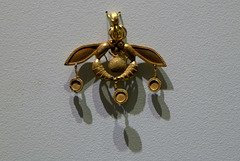
The Bee Pendant / The Malia Pendant / The Bees of Malia
The gold pendant was found in a tomb in 1930 at Chrysolakkos, Malia. It dates to the Minoan civilization, 1800-1650 BC.
The pendant measures 4.9 cm wide and 4.6 cm high. It depicts two bees or wasps sucking on a drop of honey. Another interpretation is that they are depositing the honey in a honeycomb between them. The insects' bodies are curled around the honeycomb, forming a circle. Above the bees' heads is a gold ball in a wire cage. From each of their wings and where their stingers touch, hangs a disc with a granulated edge.
Chaves - Museu da Região Flaviense
| 17 Sep 2024 |
|
People have lived in this area since the Neolithic period, but it has been continuously inhabited since the conquest by Roman legions, who established an outpost and took over the existing castros in the area. It developed into a military centre known for its baths. The Romans built defensive walls, spanned the river with a bridge, and exploited the local mines. The importance of the town led to it being elevated to the status of a city in 79 AD, during the reign of the first Flavian Caesar, which was also reflected in its name, Aquae Flaviae.
Rome's hegemony lasted until the 3rd century, when, successively, the Suebi and Visigoths as well as the Alani colonized the settlements of Chaves. The area surrendered to Islamic forces at around 714-716. The city was conquered by Alfonso I of Asturias in 773 and repopulated in 868 by Alfonso III of Asturias. Battles between Christian and Muslim forces then continued until the 11th century, when Alfonso V of León permanently reconquered Coimbra, establishing a firm buffer-zone to the south. He reconstructed, settled and encircled the settlement of Chaves with walls, in addition to establishing a Jewish quarter in the community. It was in the reign of Afonso I of Portugal that it was taken from León and firmly integrated into the Kingdom of Portugal domain (1160). Owing to its geographic location King Denis, ordered the construction of a castle to protect the kingdom's border.
The regional archaeological-ethnographic Museu da Região Flaviense is small, but has lots of Roman artefacts, plus a collection of pre-Roman jewellery, bronze tools, and megaliths.
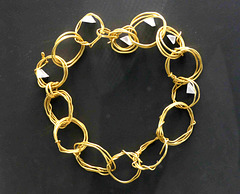
The golden necklace is dated to the end of the Bronze Age - around 1000 BC
Jump to top
RSS feed- Martin M. Miles' latest photos with "jewelery" - Photos
- ipernity © 2007-2026
- Help & Contact
|
Club news
|
About ipernity
|
History |
ipernity Club & Prices |
Guide of good conduct
Donate | Group guidelines | Privacy policy | Terms of use | Statutes | In memoria -
Facebook
X
