

Martin M. Miles' photos with the keyword: Trajan
Athens - Agora
| 25 May 2025 |
|
Athens, the southernmost capital on the European mainland, is one of the world's oldest cities, with its recorded history spanning over 3,400 years. According to Greek mythology the city was named after Athena, the ancient Greek goddess of wisdom. Classical Athens was one of the most powerful city-states in ancient Greece. It was a centre for democracy, the arts, education and philosophy, and was highly influential throughout the European continent, particularly in Ancient Rome. For this reason it is often regarded as the cradle of Western civilisation and the birthplace of democracy.
The ancient Agora of Athens was a meeting place of the polis, used for military, judicial, and popular assemblies of free citizens. It has existed since around the 5th century BC and contrasts with the cultic and political center of power of the archaic fortress (the Acropolis up in the knoll). Therefore, the agora represents a significant step in the development of Athenian democracy.
In 480 BC, the Persians conquered Athens, destroying much of the city and the agora. Sooin after the reconstruction began. Therefore, many new buildings were built during this period.
In the 2nd century BC, Athens increasingly became the spiritual center of the Mediterranean world. Rulers of various countries began to demonstrate their power and culture by constructing buildings in Athens. As a result, construction activity in the agora increased enormously. It was during this time that the large, imposing stoa were built. It wasn't until the second half of the 2nd century that the agora was completely surrounded by buildings.
In 146 BC Greece was declared a Roman province. At the beginning of the 1st century BC, Athens turned against Rome, leading to a siege of the city in 86 BC, during which, the Agora was partly damaged. By the middle of the century, the Romans were showing greater interest in Athens. This again led to increased construction activity. A new marketplace, the Roman Agora, was built about 150 meters east of the Agora, largely depriving the Agora of this function.
The reign of Trajan (98–117) and Hadrian (117–138) ushered in a final period of prosperity for the Agora. After the Heruli stormed Athens in 267, destroying most of the Agora's buildings, the Agora never again became the important center it had been in previous centuries.
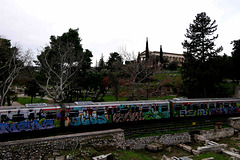
Railway tracks cut through the area and sometimes you can see a rather colorful train passing by in front of the Temple of Hephaestus.

Athens - Agora
| 25 May 2025 |
|
Athens, the southernmost capital on the European mainland, is one of the world's oldest cities, with its recorded history spanning over 3,400 years. According to Greek mythology the city was named after Athena, the ancient Greek goddess of wisdom. Classical Athens was one of the most powerful city-states in ancient Greece. It was a centre for democracy, the arts, education and philosophy, and was highly influential throughout the European continent, particularly in Ancient Rome. For this reason it is often regarded as the cradle of Western civilisation and the birthplace of democracy.
The ancient Agora of Athens was a meeting place of the polis, used for military, judicial, and popular assemblies of free citizens. It has existed since around the 5th century BC and contrasts with the cultic and political center of power of the archaic fortress (the Acropolis up in the knoll). Therefore, the agora represents a significant step in the development of Athenian democracy.
In 480 BC, the Persians conquered Athens, destroying much of the city and the agora. Sooin after the reconstruction began. Therefore, many new buildings were built during this period.
In the 2nd century BC, Athens increasingly became the spiritual center of the Mediterranean world. Rulers of various countries began to demonstrate their power and culture by constructing buildings in Athens. As a result, construction activity in the agora increased enormously. It was during this time that the large, imposing stoa were built. It wasn't until the second half of the 2nd century that the agora was completely surrounded by buildings.
In 146 BC Greece was declared a Roman province. At the beginning of the 1st century BC, Athens turned against Rome, leading to a siege of the city in 86 BC, during which, the Agora was partly damaged. By the middle of the century, the Romans were showing greater interest in Athens. This again led to increased construction activity. A new marketplace, the Roman Agora, was built about 150 meters east of the Agora, largely depriving the Agora of this function.
The reign of Trajan (98–117) and Hadrian (117–138) ushered in a final period of prosperity for the Agora. After the Heruli stormed Athens in 267, destroying most of the Agora's buildings, the Agora never again became the important center it had been in previous centuries.
The Church of the Holy Apostles
(aka Holy Apostles of Solaki) is located next to the Stoa of Attalos, and can be dated to around the late 10th century. The church is significant as the only monument in the Agora, other than the Temple of Hephaestus, to survive intact since its foundation. It was the first significant church of the Middle Byzantine period in Athens, and marks the beginning of the so-called "Athenian type", successfully combining the simple four-pier with the cross-in-square forms. The church was built partly over a 2nd-century nymphaion, and was restored to its original form between 1954 and 1957.
This may well be lintel of the early church depicting a cross flanked by lions.

Athens - Agora
| 25 May 2025 |
|
|
|
Athens, the southernmost capital on the European mainland, is one of the world's oldest cities, with its recorded history spanning over 3,400 years. According to Greek mythology the city was named after Athena, the ancient Greek goddess of wisdom. Classical Athens was one of the most powerful city-states in ancient Greece. It was a centre for democracy, the arts, education and philosophy, and was highly influential throughout the European continent, particularly in Ancient Rome. For this reason it is often regarded as the cradle of Western civilisation and the birthplace of democracy.
The ancient Agora of Athens was a meeting place of the polis, used for military, judicial, and popular assemblies of free citizens. It has existed since around the 5th century BC and contrasts with the cultic and political center of power of the archaic fortress (the Acropolis up in the knoll). Therefore, the agora represents a significant step in the development of Athenian democracy.
In 480 BC, the Persians conquered Athens, destroying much of the city and the agora. Sooin after the reconstruction began. Therefore, many new buildings were built during this period.
In the 2nd century BC, Athens increasingly became the spiritual center of the Mediterranean world. Rulers of various countries began to demonstrate their power and culture by constructing buildings in Athens. As a result, construction activity in the agora increased enormously. It was during this time that the large, imposing stoa were built. It wasn't until the second half of the 2nd century that the agora was completely surrounded by buildings.
In 146 BC Greece was declared a Roman province. At the beginning of the 1st century BC, Athens turned against Rome, leading to a siege of the city in 86 BC, during which, the Agora was partly damaged. By the middle of the century, the Romans were showing greater interest in Athens. This again led to increased construction activity. A new marketplace, the Roman Agora, was built about 150 meters east of the Agora, largely depriving the Agora of this function.
The reign of Trajan (98–117) and Hadrian (117–138) ushered in a final period of prosperity for the Agora. After the Heruli stormed Athens in 267, destroying most of the Agora's buildings, the Agora never again became the important center it had been in previous centuries.
The Church of the Holy Apostles
(aka Holy Apostles of Solaki) is located next to the Stoa of Attalos, and can be dated to around the late 10th century. The church is significant as the only monument in the Agora, other than the Temple of Hephaestus, to survive intact since its foundation. It was the first significant church of the Middle Byzantine period in Athens, and marks the beginning of the so-called "Athenian type", successfully combining the simple four-pier with the cross-in-square forms. The church was built partly over a 2nd-century nymphaion, and was restored to its original form between 1954 and 1957.

Athens - Agora
| 25 May 2025 |
|
Athens, the southernmost capital on the European mainland, is one of the world's oldest cities, with its recorded history spanning over 3,400 years. According to Greek mythology the city was named after Athena, the ancient Greek goddess of wisdom. Classical Athens was one of the most powerful city-states in ancient Greece. It was a centre for democracy, the arts, education and philosophy, and was highly influential throughout the European continent, particularly in Ancient Rome. For this reason it is often regarded as the cradle of Western civilisation and the birthplace of democracy.
The ancient Agora of Athens was a meeting place of the polis, used for military, judicial, and popular assemblies of free citizens. It has existed since around the 5th century BC and contrasts with the cultic and political center of power of the archaic fortress (the Acropolis up in the knoll). Therefore, the agora represents a significant step in the development of Athenian democracy.
In 480 BC, the Persians conquered Athens, destroying much of the city and the agora. Sooin after the reconstruction began. Therefore, many new buildings were built during this period.
In the 2nd century BC, Athens increasingly became the spiritual center of the Mediterranean world. Rulers of various countries began to demonstrate their power and culture by constructing buildings in Athens. As a result, construction activity in the agora increased enormously. It was during this time that the large, imposing stoa were built. It wasn't until the second half of the 2nd century that the agora was completely surrounded by buildings.
In 146 BC Greece was declared a Roman province. At the beginning of the 1st century BC, Athens turned against Rome, leading to a siege of the city in 86 BC, during which, the Agora was partly damaged. By the middle of the century, the Romans were showing greater interest in Athens. This again led to increased construction activity. A new marketplace, the Roman Agora, was built about 150 meters east of the Agora, largely depriving the Agora of this function.
The reign of Trajan (98–117) and Hadrian (117–138) ushered in a final period of prosperity for the Agora. After the Heruli stormed Athens in 267, destroying most of the Agora's buildings, the Agora never again became the important center it had been in previous centuries.
Dorian columns.
The protective wall behind was erected, after the Herulians had ruined the Agora.

Athens - Agora
| 25 May 2025 |
|
Athens, the southernmost capital on the European mainland, is one of the world's oldest cities, with its recorded history spanning over 3,400 years. According to Greek mythology the city was named after Athena, the ancient Greek goddess of wisdom. Classical Athens was one of the most powerful city-states in ancient Greece. It was a centre for democracy, the arts, education and philosophy, and was highly influential throughout the European continent, particularly in Ancient Rome. For this reason it is often regarded as the cradle of Western civilisation and the birthplace of democracy.
The ancient Agora of Athens was a meeting place of the polis, used for military, judicial, and popular assemblies of free citizens. It has existed since around the 5th century BC and contrasts with the cultic and political center of power of the archaic fortress (the Acropolis up in the knoll). Therefore, the agora represents a significant step in the development of Athenian democracy.
In 480 BC, the Persians conquered Athens, destroying much of the city and the agora. Sooin after the reconstruction began. Therefore, many new buildings were built during this period.
In the 2nd century BC, Athens increasingly became the spiritual center of the Mediterranean world. Rulers of various countries began to demonstrate their power and culture by constructing buildings in Athens. As a result, construction activity in the agora increased enormously. It was during this time that the large, imposing stoa were built. It wasn't until the second half of the 2nd century that the agora was completely surrounded by buildings.
In 146 BC Greece was declared a Roman province. At the beginning of the 1st century BC, Athens turned against Rome, leading to a siege of the city in 86 BC, during which, the Agora was partly damaged. By the middle of the century, the Romans were showing greater interest in Athens. This again led to increased construction activity. A new marketplace, the Roman Agora, was built about 150 meters east of the Agora, largely depriving the Agora of this function.
The reign of Trajan (98–117) and Hadrian (117–138) ushered in a final period of prosperity for the Agora. After the Heruli stormed Athens in 267, destroying most of the Agora's buildings, the Agora never again became the important center it had been in previous centuries.
The Odeon of Agrippa
was a large odeon in the centre of the ancient Agora of Athens was built about 15 BC. It was a gift to the people of Athens by Marcus Vipsanius Agrippa, a Roman statesman. The two-story auditorium seated around 1,000 spectators. Unfortunately, the 25 m span of the auditorium eventually caused the roof to collapse in around 150 AD. The Odeon was rebuilt as a smaller lecture hall, seating only 500, and a more elaborate facade was added to the north side.
The Odeon was finally destroyed in 267 AD by the Herulians. A sprawling palace was built on the site in the early 5th century AD with the pillars of the northern facade being used to create a monumental entrance.

Athens - Agora
| 25 May 2025 |
|
Athens, the southernmost capital on the European mainland, is one of the world's oldest cities, with its recorded history spanning over 3,400 years. According to Greek mythology the city was named after Athena, the ancient Greek goddess of wisdom. Classical Athens was one of the most powerful city-states in ancient Greece. It was a centre for democracy, the arts, education and philosophy, and was highly influential throughout the European continent, particularly in Ancient Rome. For this reason it is often regarded as the cradle of Western civilisation and the birthplace of democracy.
The ancient Agora of Athens was a meeting place of the polis, used for military, judicial, and popular assemblies of free citizens. It has existed since around the 5th century BC and contrasts with the cultic and political center of power of the archaic fortress (the Acropolis up in the knoll). Therefore, the agora represents a significant step in the development of Athenian democracy.
In 480 BC, the Persians conquered Athens, destroying much of the city and the agora. Sooin after the reconstruction began. Therefore, many new buildings were built during this period.
In the 2nd century BC, Athens increasingly became the spiritual center of the Mediterranean world. Rulers of various countries began to demonstrate their power and culture by constructing buildings in Athens. As a result, construction activity in the agora increased enormously. It was during this time that the large, imposing stoa were built. It wasn't until the second half of the 2nd century that the agora was completely surrounded by buildings.
In 146 BC Greece was declared a Roman province. At the beginning of the 1st century BC, Athens turned against Rome, leading to a siege of the city in 86 BC, during which, the Agora was partly damaged. By the middle of the century, the Romans were showing greater interest in Athens. This again led to increased construction activity. A new marketplace, the Roman Agora, was built about 150 meters east of the Agora, largely depriving the Agora of this function.
The reign of Trajan (98–117) and Hadrian (117–138) ushered in a final period of prosperity for the Agora. After the Heruli stormed Athens in 267, destroying most of the Agora's buildings, the Agora never again became the important center it had been in previous centuries.
The Odeon of Agrippa
was a large odeon in the centre of the ancient Agora of Athens was built about 15 BC. It was a gift to the people of Athens by Marcus Vipsanius Agrippa, a Roman statesman. The two-story auditorium seated around 1,000 spectators. Unfortunately, the 25 m span of the auditorium eventually caused the roof to collapse in around 150 AD. The Odeon was rebuilt as a smaller lecture hall, seating only 500, and a more elaborate facade was added to the north side.
The Odeon was finally destroyed in 267 AD by the Herulians. A sprawling palace was built on the site in the early 5th century AD with the pillars of the northern facade being used to create a monumental entrance.

Athens - Agora
| 23 May 2025 |
|
Athens, the southernmost capital on the European mainland, is one of the world's oldest cities, with its recorded history spanning over 3,400 years. According to Greek mythology the city was named after Athena, the ancient Greek goddess of wisdom. Classical Athens was one of the most powerful city-states in ancient Greece. It was a centre for democracy, the arts, education and philosophy, and was highly influential throughout the European continent, particularly in Ancient Rome. For this reason it is often regarded as the cradle of Western civilisation and the birthplace of democracy.
The ancient Agora of Athens was a meeting place of the polis, used for military, judicial, and popular assemblies of free citizens. It has existed since around the 5th century BC and contrasts with the cultic and political center of power of the archaic fortress (the Acropolis up in the knoll). Therefore, the agora represents a significant step in the development of Athenian democracy.
In 480 BC, the Persians conquered Athens, destroying much of the city and the agora. Sooin after the reconstruction began. Therefore, many new buildings were built during this period.
In the 2nd century BC, Athens increasingly became the spiritual center of the Mediterranean world. Rulers of various countries began to demonstrate their power and culture by constructing buildings in Athens. As a result, construction activity in the agora increased enormously. It was during this time that the large, imposing stoa were built. It wasn't until the second half of the 2nd century that the agora was completely surrounded by buildings.
In 146 BC Greece was declared a Roman province. At the beginning of the 1st century BC, Athens turned against Rome, leading to a siege of the city in 86 BC, during which, the Agora was partly damaged. By the middle of the century, the Romans were showing greater interest in Athens. This again led to increased construction activity. A new marketplace, the Roman Agora, was built about 150 meters east of the Agora, largely depriving the Agora of this function.
The reign of Trajan (98–117) and Hadrian (117–138) ushered in a final period of prosperity for the Agora. After the Heruli stormed Athens in 267, destroying most of the Agora's buildings, the Agora never again became the important center it had been in previous centuries.
Very close to the agora are the ruins of the state prison, erected mid 5th century BC. It is best known from the references in Plato's Phaedo. This dialogue tells of the month Socrates spent in prison between his condemnation and his execution by drinking hemlick in 399 BC.

Athens - Agora
| 23 May 2025 |
|
Athens, the southernmost capital on the European mainland, is one of the world's oldest cities, with its recorded history spanning over 3,400 years. According to Greek mythology the city was named after Athena, the ancient Greek goddess of wisdom. Classical Athens was one of the most powerful city-states in ancient Greece. It was a centre for democracy, the arts, education and philosophy, and was highly influential throughout the European continent, particularly in Ancient Rome. For this reason it is often regarded as the cradle of Western civilisation and the birthplace of democracy.
The ancient Agora of Athens was a meeting place of the polis, used for military, judicial, and popular assemblies of free citizens. It has existed since around the 5th century BC and contrasts with the cultic and political center of power of the archaic fortress (the Acropolis up in the knoll). Therefore, the agora represents a significant step in the development of Athenian democracy.
In 480 BC, the Persians conquered Athens, destroying much of the city and the agora. Sooin after the reconstruction began. Therefore, many new buildings were built during this period.
In the 2nd century BC, Athens increasingly became the spiritual center of the Mediterranean world. Rulers of various countries began to demonstrate their power and culture by constructing buildings in Athens. As a result, construction activity in the agora increased enormously. It was during this time that the large, imposing stoa were built. It wasn't until the second half of the 2nd century that the agora was completely surrounded by buildings.
In 146 BC Greece was declared a Roman province. At the beginning of the 1st century BC, Athens turned against Rome, leading to a siege of the city in 86 BC, during which, the Agora was partly damaged. By the middle of the century, the Romans were showing greater interest in Athens. This again led to increased construction activity. A new marketplace, the Roman Agora, was built about 150 meters east of the Agora, largely depriving the Agora of this function.
The reign of Trajan (98–117) and Hadrian (117–138) ushered in a final period of prosperity for the Agora. After the Heruli stormed Athens in 267, destroying most of the Agora's buildings, the Agora never again became the important center it had been in previous centuries.
Alcántara - Puente de Alcántara
| 15 Jan 2024 |
|
|
The "Puente de Alcántara" is considered the most important surviving Roman bridge structure.
The bridge stretches 194 meters in length with six arches of different widths. Its 8-meter-wide roadway is approximately 50 meters above the Tajo River, and the total height of the structure is 71 meters. Towards the middle of the bridge, there is a 14-meter-high honorary arch dedicated to Emperor Trajan.
The road bridge, which is still in use today, was built in about five years during the time of Emperor Trajan. It was probably completed in 105 or 106 AD.
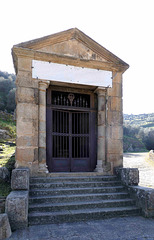
The small temple next to the bridge is one of only two fully preserved Roman temples on the Iberian Peninsula. It contains the tomb of the bridge's builder, Caius Iulius Lacer, probably a Roman military engineer. The Romans already recognized Lacer's genius. Inside there is a stone tablet with the inscription:
"Pontem perpetui mansurum in saecula mundi fecit divina nobilis arte Lacer"
The bridge to stay forever in the centuries of the eternal course of the world, the praiseworthy Lacer created with divine art...
Alcántara - Puente de Alcántara
| 15 Jan 2024 |
|
|
The "Puente de Alcántara" is considered the most important surviving Roman bridge structure.
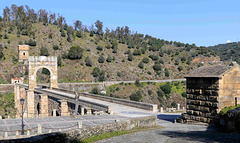
The bridge stretches 194 meters in length with six arches of different widths. Its 8-meter-wide roadway is approximately 50 meters above the Tajo River, and the total height of the structure is 71 meters. Towards the middle of the bridge, there is a 14-meter-high honorary arch dedicated to Emperor Trajan.
The road bridge, which is still in use today, was built in about five years during the time of Emperor Trajan. It was probably completed in 105 or 106 AD.
The Arabs valued the bridge's structural and strategic importance so highly that they named the nearby settlement al-Qantara, meaning "the bridge." The geographer al-Idrisi described the bridge as one of the wonders of the world in his description of Spain in the 12th century.
To the right is a small temple that contains the tomb of the bridge's builder, Caius Iulius Lacer, presumably a Roman military engineer. Along with the Temple of Vic, it is one of only two completely preserved Roman temples on the Iberian Peninsula.
Alcántara - Puente de Alcántara
| 15 Jan 2024 |
|
|
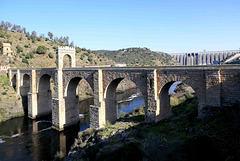
The "Puente de Alcántara" is considered the most important surviving Roman bridge structure.
The bridge stretches 194 meters in length with six arches of different widths. Its 8-meter-wide roadway is approximately 50 meters above the Tajo River, and the total height of the structure is 71 meters. Towards the middle of the bridge, there is a 14-meter-high honorary arch dedicated to Emperor Trajan.
The road bridge, which is still in use today, was built in about five years during the time of Emperor Trajan. It was probably completed in 105 or 106 AD.
The Arabs valued the bridge's structural and strategic importance so highly that they named the nearby settlement al-Qantara, meaning "the bridge." The geographer al-Idrisi described the bridge as one of the wonders of the world in his description of Spain in the 12th century.
Jump to top
RSS feed- Martin M. Miles' latest photos with "Trajan" - Photos
- ipernity © 2007-2026
- Help & Contact
|
Club news
|
About ipernity
|
History |
ipernity Club & Prices |
Guide of good conduct
Donate | Group guidelines | Privacy policy | Terms of use | Statutes | In memoria -
Facebook
X
