

Martin M. Miles' photos with the keyword: Rodez Cathedral

Rodez - Cathédrale Notre-Dame
| 20 Nov 2025 |
|
|
With about 25,000 inhabitants, Rodez is today the economic and cultural center of the Aveyron department.
The city has a history spanning over 2,000 years and was known as Segodunum under the Romans. After the Romans, Rodez was occupied by the Visigoths, the Franks, the armies of the Dukes of Aquitaine and the Counts of Toulouse, and by the Moors, who besieged the city in 725 and destroyed the old church. Several centuries later, the English besieged the city during the Hundred Years' War.
Today there two universities here, whose more than 3000 students bring life to the city.
The area was Christianized in the 4th/5th century by Saints Martial and Amantius: There is no mention of a bishop's church until the 6th century; however, it was enlarged and rebuilt several times over the following centuries. After the collapse of the bell tower of the previous building in 1276, the decision was made to completely rebuild it, which, like the old cathedral, was located outside the existing city walls. Construction work dragged on until 1531 due to the Hundred Years' War and several plague epidemics. The building was thus completed shortly before the outbreak of the Huguenot Wars (1562–1598).
These murals date back to the 15th century and were rediscovered during restoration work in 1974. They adorn the back wall of an altarpiece.
The depictions include the Annunciation, the Birth of Christ, and the Adoration of the Magi.

Rodez - Cathédrale Notre-Dame
| 20 Nov 2025 |
|
|
With about 25,000 inhabitants, Rodez is today the economic and cultural center of the Aveyron department.
The city has a history spanning over 2,000 years and was known as Segodunum under the Romans. After the Romans, Rodez was occupied by the Visigoths, the Franks, the armies of the Dukes of Aquitaine and the Counts of Toulouse, and by the Moors, who besieged the city in 725 and destroyed the old church. Several centuries later, the English besieged the city during the Hundred Years' War.
Today there two universities here, whose more than 3000 students bring life to the city.
The area was Christianized in the 4th/5th century by Saints Martial and Amantius: There is no mention of a bishop's church until the 6th century; however, it was enlarged and rebuilt several times over the following centuries. After the collapse of the bell tower of the previous building in 1276, the decision was made to completely rebuild it, which, like the old cathedral, was located outside the existing city walls. Construction work dragged on until 1531 due to the Hundred Years' War and several plague epidemics. The building was thus completed shortly before the outbreak of the Huguenot Wars (1562–1598).
Nave and choir of the church are 101.57 meters long.
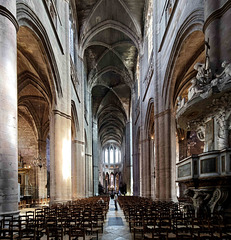
Rodez - Cathédrale Notre-Dame
| 19 Nov 2025 |
|
|
|
With about 25,000 inhabitants, Rodez is today the economic and cultural center of the Aveyron department.
The city has a history spanning over 2,000 years and was known as Segodunum under the Romans. After the Romans, Rodez was occupied by the Visigoths, the Franks, the armies of the Dukes of Aquitaine and the Counts of Toulouse, and by the Moors, who besieged the city in 725 and destroyed the old church. Several centuries later, the English besieged the city during the Hundred Years' War.
Today there two universities here, whose more than 3000 students bring life to the city.
The area was Christianized in the 4th/5th century by Saints Martial and Amantius: There is no mention of a bishop's church until the 6th century; however, it was enlarged and rebuilt several times over the following centuries. After the collapse of the bell tower of the previous building in 1276, the decision was made to completely rebuild it, which, like the old cathedral, was located outside the existing city walls. Construction work dragged on until 1531 due to the Hundred Years' War and several plague epidemics. The building was thus completed shortly before the outbreak of the Huguenot Wars (1562–1598).
Nave and choir of the church are 101.57 meters long.

Rodez - Cathédrale Notre-Dame
| 19 Nov 2025 |
|
|
With about 25,000 inhabitants, Rodez is today the economic and cultural center of the Aveyron department.
The city has a history spanning over 2,000 years and was known as Segodunum under the Romans. After the Romans, Rodez was occupied by the Visigoths, the Franks, the armies of the Dukes of Aquitaine and the Counts of Toulouse, and by the Moors, who besieged the city in 725 and destroyed the old church. Several centuries later, the English besieged the city during the Hundred Years' War.
Today there two universities here, whose more than 3000 students bring life to the city.
The area was Christianized in the 4th/5th century by Saints Martial and Amantius: There is no mention of a bishop's church until the 6th century; however, it was enlarged and rebuilt several times over the following centuries. After the collapse of the bell tower of the previous building in 1276, the decision was made to completely rebuild it, which, like the old cathedral, was located outside the existing city walls. Construction work dragged on until 1531 due to the Hundred Years' War and several plague epidemics. The building was thus completed shortly before the outbreak of the Huguenot Wars (1562–1598).
The west facade, completely devoid of ornamentation gives the impression of a castle rather than a church. This impression is further reinforced by the flat sections of wall, the octagonal stair towers, and the arrow-slit-like windows of the central section.

Rodez - Cathédrale Notre-Dame
| 19 Nov 2025 |
|
|
With about 25,000 inhabitants, Rodez is today the economic and cultural center of the Aveyron department.
The city has a history spanning over 2,000 years and was known as Segodunum under the Romans. After the Romans, Rodez was occupied by the Visigoths, the Franks, the armies of the Dukes of Aquitaine and the Counts of Toulouse, and by the Moors, who besieged the city in 725 and destroyed the old church. Several centuries later, the English besieged the city during the Hundred Years' War.
Today there two universities here, whose more than 3000 students bring life to the city.
The area was Christianized in the 4th/5th century by Saints Martial and Amantius: There is no mention of a bishop's church until the 6th century; however, it was enlarged and rebuilt several times over the following centuries. After the collapse of the bell tower of the previous building in 1276, the decision was made to completely rebuild it, which, like the old cathedral, was located outside the existing city walls. Construction work dragged on until 1531 due to the Hundred Years' War and several plague epidemics. The building was thus completed shortly before the outbreak of the Huguenot Wars (1562–1598).
The upper sections of the north tower were destroyed by fire on in 1510; only the completely unadorned lower section survived. The architect Antoine Salvanh was commissioned to rebuild it. While the lower windows are still set into the smooth masonry of the old tower, the window arches are already adorned with various decorative elements. Even at this level, the transition from a square tower plan to an octagonal plan—accompanied by small corner turrets—is already evident, becoming particularly clear in the upper level. While the middle level gains considerable plasticity through the covering of all structural elements with blind tracery, coats of arms, and inset figures, in the upper story of the tower, architectural elements appear to detach from the underlying structure. The tower is 87 meters high
Jump to top
RSS feed- Martin M. Miles' latest photos with "Rodez Cathedral" - Photos
- ipernity © 2007-2026
- Help & Contact
|
Club news
|
About ipernity
|
History |
ipernity Club & Prices |
Guide of good conduct
Donate | Group guidelines | Privacy policy | Terms of use | Statutes | In memoria -
Facebook
X
