

Martin M. Miles' photos with the keyword: Lanfranc
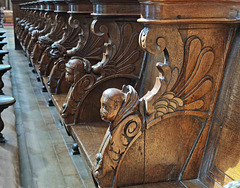
Caen - Saint-Étienne
| 29 Sep 2025 |
|
Caen experienced rapid urban development in the 11th century. It was the center of a ducal domain and possessed markets and a port. It initially flourished as an important city in the Duchy of Normandy under William the Conqueror. He had a strong fortress built in Caen, as well as an abbey for women (Abbaye aux dames) and one for men (Abbaye aux hommes) around 1059, in which he was also buried. He had the monasteries built to atone for his marriage to his cousin Matilda, which was disapproved by the Pope. Both monasteries are among the most important architectural monuments in Normandy and are now used as parish churches.
Saint-Étienne is the former monastery church of the Benedictine "Abbaye aux hommes". Construction of the church began in 1065/66 at the eastern end. It was consecrated in 1077 under the first abbot, Lanfranc of Bec of Pavia, who was appointed Bishop of Canterbury in 1070. The facade towers were completed in the last decade of the 11th century. From 1120/25, the former wooden ceiling in the nave was replaced by a six-part cross-ribbed vault. Around 1200, the conversion of the original stepped choir into a Gothic ambulatory began. Also in the 13th century, the Gothic pointed spires were added to the Romanesque west towers.
Stalls

Caen - Saint-Étienne
| 28 Sep 2025 |
|
|
Caen experienced rapid urban development in the 11th century. It was the center of a ducal domain and possessed markets and a port. It initially flourished as an important city in the Duchy of Normandy under William the Conqueror. He had a strong fortress built in Caen, as well as an abbey for women (Abbaye aux dames) and one for men (Abbaye aux hommes) around 1059, in which he was also buried. He had the monasteries built to atone for his marriage to his cousin Matilda, which was disapproved by the Pope. Both monasteries are among the most important architectural monuments in Normandy and are now used as parish churches.
Saint-Étienne is the former monastery church of the Benedictine "Abbaye aux hommes". Construction of the church began in 1065/66 at the eastern end. It was consecrated in 1077 under the first abbot, Lanfranc of Bec of Pavia, who was appointed Bishop of Canterbury in 1070. The facade towers were completed in the last decade of the 11th century. From 1120/25, the former wooden ceiling in the nave was replaced by a six-part cross-ribbed vault. Around 1200, the conversion of the original stepped choir into a Gothic ambulatory began. Also in the 13th century, the Gothic pointed spires were added to the Romanesque west towers.
Clock

Caen - Saint-Étienne
| 28 Sep 2025 |
|
|
Caen experienced rapid urban development in the 11th century. It was the center of a ducal domain and possessed markets and a port. It initially flourished as an important city in the Duchy of Normandy under William the Conqueror. He had a strong fortress built in Caen, as well as an abbey for women (Abbaye aux dames) and one for men (Abbaye aux hommes) around 1059, in which he was also buried. He had the monasteries built to atone for his marriage to his cousin Matilda, which was disapproved by the Pope. Both monasteries are among the most important architectural monuments in Normandy and are now used as parish churches.
Saint-Étienne is the former monastery church of the Benedictine "Abbaye aux hommes". Construction of the church began in 1065/66 at the eastern end. It was consecrated in 1077 under the first abbot, Lanfranc of Bec of Pavia, who was appointed Bishop of Canterbury in 1070. The facade towers were completed in the last decade of the 11th century. From 1120/25, the former wooden ceiling in the nave was replaced by a six-part cross-ribbed vault. Around 1200, the conversion of the original stepped choir into a Gothic ambulatory began. Also in the 13th century, the Gothic pointed spires were added to the Romanesque west towers.
William the Conqueror was buried in Saint-Étienne. As a memorial, his son William II placed a marble tombstone with a gisant of William in the center of the choir. In 1562/63, Calvinists destroyed the tombstone. The remains were discarded, but a monk salvaged the leg bones. Destroyed again during the French Revolution, the tomb was restored in 1802 and provided with a simple tombstone.
The tombstone bears a Latin inscription that reads: "Here lies the invincible William the Conqueror, Duke of Normandy and King of England, founder of the house, who died in the year 1087."

Caen - Saint-Étienne
| 28 Sep 2025 |
|
Caen experienced rapid urban development in the 11th century. It was the center of a ducal domain and possessed markets and a port. It initially flourished as an important city in the Duchy of Normandy under William the Conqueror. He had a strong fortress built in Caen, as well as an abbey for women (Abbaye aux dames) and one for men (Abbaye aux hommes) around 1059, in which he was also buried. He had the monasteries built to atone for his marriage to his cousin Matilda, which was disapproved by the Pope. Both monasteries are among the most important architectural monuments in Normandy and are now used as parish churches.
Saint-Étienne is the former monastery church of the Benedictine "Abbaye aux hommes". Construction of the church began in 1065/66 at the eastern end. It was consecrated in 1077 under the first abbot, Lanfranc of Bec of Pavia, who was appointed Bishop of Canterbury in 1070. The facade towers were completed in the last decade of the 11th century. From 1120/25, the former wooden ceiling in the nave was replaced by a six-part cross-ribbed vault. Around 1200, the conversion of the original stepped choir into a Gothic ambulatory began. Also in the 13th century, the Gothic pointed spires were added to the Romanesque west towers.
As a result of the monastery's neglect during the Wars of Religion, the crossing tower collapsed in 1566.
From 1599 to 1604, the church was rebuilt while preserving its medieval structure. Further restorations took place in the 19th century.
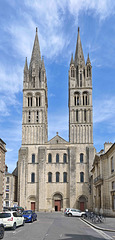
Caen - Saint-Étienne
| 28 Sep 2025 |
|
|
|
Caen experienced rapid urban development in the 11th century. It was the center of a ducal domain and possessed markets and a port. It initially flourished as an important city in the Duchy of Normandy under William the Conqueror. He had a strong fortress built in Caen, as well as an abbey for women (Abbaye aux dames) and one for men (Abbaye aux hommes) around 1059, in which he was also buried. He had the monasteries built to atone for his marriage to his cousin Matilda, which was disapproved by the Pope. Both monasteries are among the most important architectural monuments in Normandy and are now used as parish churches.
Saint-Étienne is the former monastery church of the Benedictine "Abbaye aux hommes". Construction of the church began in 1065/66 at the eastern end. It was consecrated in 1077 under the first abbot, Lanfranc of Bec of Pavia, who was appointed Bishop of Canterbury in 1070. The facade towers were completed in the last decade of the 11th century. From 1120/25, the former wooden ceiling in the nave was replaced by a six-part cross-ribbed vault. Around 1200, the conversion of the original stepped choir into a Gothic ambulatory began. Also in the 13th century, the Gothic pointed spires were added to the Romanesque west towers.
As a result of the monastery's neglect during the Wars of Religion, the crossing tower collapsed in 1566.
From 1599 to 1604, the church was rebuilt while preserving its medieval structure. Further restorations took place in the 19th century.
Jump to top
RSS feed- Martin M. Miles' latest photos with "Lanfranc" - Photos
- ipernity © 2007-2026
- Help & Contact
|
Club news
|
About ipernity
|
History |
ipernity Club & Prices |
Guide of good conduct
Donate | Group guidelines | Privacy policy | Terms of use | Statutes | In memoria -
Facebook
X
