
Martin M. Miles' photos with the keyword: Aquamanile

Münster - LWL Museum für Kunst und Kultur
| 26 Feb 2026 |
|
|
|
Muenster, the cultural centre of Westphalia, is a city with a population of more than 250.000 of which nearly 50.000 are students at the University of Muenster. This surely helped Muenster to gain the status of the "bicycle capital of Germany".
The "Westphalian State Museum of Art and Cultural History" dates back to the 19th century and owes its existence largely to the contributions of local art associations. The Westphalian Art Association, founded in 1831, played a crucial role in collecting and preserving regional art. The museum has undergone several renovations, including the construction of a new building, which opened in September 2014. The museum displays artworks from the early Middle Ages to the present day. Its collection comprises more than 300,000 exhibits.
Aquamanile (Löwin?) / Aquamanile (lioness) /
bronze / 13th c.

Münster - LWL Museum für Kunst und Kultur
| 26 Feb 2026 |
|
|
Muenster, the cultural centre of Westphalia, is a city with a population of more than 250.000 of which nearly 50.000 are students at the University of Muenster. This surely helped Muenster to gain the status of the "bicycle capital of Germany".
The "Westphalian State Museum of Art and Cultural History" dates back to the 19th century and owes its existence largely to the contributions of local art associations. The Westphalian Art Association, founded in 1831, played a crucial role in collecting and preserving regional art. The museum has undergone several renovations, including the construction of a new building, which opened in September 2014. The museum displays artworks from the early Middle Ages to the present day. Its collection comprises more than 300,000 exhibits.
Löwen Aquamanile / Lion aquamanile /
bronze / 13th c.

Paris - Musée de Cluny
| 11 Jan 2026 |
|
|
The Hôtel de Cluny was built in the late 15th century on the site of an older building constructed after the Abbey of Cluny acquired the ancient Roman baths in 1340.
The manor house was rebuilt under Jacques d’Amboise, Abbot Commander of Cluny (1485–1510). In the 18th century, the tower of the Hôtel de Cluny served as an observatory for the astronomers Joseph-Nicolas Delisle, Jérôme Lalande, and Charles Messier. During the French Revolution in 1789, the manor house was confiscated.
In 1832, the archaeologist and art collector Alexandre Du Sommerard acquired the Hôtel de Cluny and used it to display his extensive collection of medieval artifacts. After his death, the collection became the property of the French state. The building opened as a museum in 1843.
The museum underwent a complete renovation over three years and reopened in 2022.
Aquamanile
Equine
Brass, Lower Saxony, 14. century

Paris - Musée de Cluny
| 11 Jan 2026 |
|
|
The Hôtel de Cluny was built in the late 15th century on the site of an older building constructed after the Abbey of Cluny acquired the ancient Roman baths in 1340.
The manor house was rebuilt under Jacques d’Amboise, Abbot Commander of Cluny (1485–1510). In the 18th century, the tower of the Hôtel de Cluny served as an observatory for the astronomers Joseph-Nicolas Delisle, Jérôme Lalande, and Charles Messier. During the French Revolution in 1789, the manor house was confiscated.
In 1832, the archaeologist and art collector Alexandre Du Sommerard acquired the Hôtel de Cluny and used it to display his extensive collection of medieval artifacts. After his death, the collection became the property of the French state. The building opened as a museum in 1843.
The museum underwent a complete renovation over three years and reopened in 2022.
Aquamanile
Unicorn
Brass, Nuremberg, about 1400

Paris - Musée de Cluny
| 11 Jan 2026 |
|
|
The Hôtel de Cluny was built in the late 15th century on the site of an older building constructed after the Abbey of Cluny acquired the ancient Roman baths in 1340.
The manor house was rebuilt under Jacques d’Amboise, Abbot Commander of Cluny (1485–1510). In the 18th century, the tower of the Hôtel de Cluny served as an observatory for the astronomers Joseph-Nicolas Delisle, Jérôme Lalande, and Charles Messier. During the French Revolution in 1789, the manor house was confiscated.
In 1832, the archaeologist and art collector Alexandre Du Sommerard acquired the Hôtel de Cluny and used it to display his extensive collection of medieval artifacts. After his death, the collection became the property of the French state. The building opened as a museum in 1843.
The museum underwent a complete renovation over three years and reopened in 2022.
Aquamanile
Bust of a young man
Brass, Lower Saxony, 1300 - 1325

Lille - Palais des Beaux-Arts
| 10 Sep 2025 |
|
|
The museum opened in 1809 in connection with the French Revolution, following the confiscation of works of art from noblemen and church property. A central warehouse for the Lille area was established in a former monastery building. The space was soon too small. When, after a move the space in the new town hall became insufficient, it was decided to build a new building in 1882. This building opened in 1892, but was closed in 1895 due to structural defects and reopened in 1998 with a renewed heating and ventilation system. During the First World War, the museum suffered significant damage. After the capture of Lille by German troops, certain works of art were stolen. In 1917 and 1918, parts of the collection were transported to Brussels. The museum was not reopened to the public until 1924, after extensive renovations. In 1991, the museum had to be closed due to urgent renovation work. In 1997, the museum reopened to the public. It now has 22,000 m² of space, of which 12,000 m² are available for exhibitions.
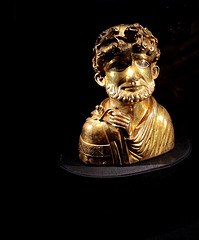
Aachen - Cathedral Treasury
| 07 Aug 2025 |
|
|
The Aachen Cathedral Treasury ("Aachener Domschatz") is one of the largest and most important treasuries of medieval Christian artworks in Europe. The treasury has over a hundred works that are exhibited in a museum adjacent to the Aachen Cathedral – the monumental church of Charlemagne, which together with the treasury was added to the first UNESCO World Cultural Heritage list in 1978.
Aquamanile / Pouring Vessel
in shape of a bust, cast bronze, gilded
Aachen, 1170/80

Aachen - Cathedral Treasury
| 07 Aug 2025 |
|
The Aachen Cathedral Treasury ("Aachener Domschatz") is one of the largest and most important treasuries of medieval Christian artworks in Europe. The treasury has over a hundred works that are exhibited in a museum adjacent to the Aachen Cathedral – the monumental church of Charlemagne, which together with the treasury was added to the first UNESCO World Cultural Heritage list in 1978.
Aquamanile / Pouring Vessel
in shape of a lion, cast bronze
Rhine.Meuse region, 1170/80

Dortmund - Museum für Kunst und Kulturgeschichte
| 14 Jul 2025 |
|
The Museum für Kunst und Kulturgeschichte (Museum of Art and Cultural History) is currently located in an Art Deco building which was formerly the Dortmund Savings Bank, erected in 1924.
The collection ranges from prehistoric and early history to the 20th century.
Aquamanile, Bronze, Magdeburg (?), um 1250
Jump to top
RSS feed- Martin M. Miles' latest photos with "Aquamanile" - Photos
- ipernity © 2007-2026
- Help & Contact
|
Club news
|
About ipernity
|
History |
ipernity Club & Prices |
Guide of good conduct
Donate | Group guidelines | Privacy policy | Terms of use | Statutes | In memoria -
Facebook
X
