

Martin M. Miles' photos with the keyword: Battle of Flodden
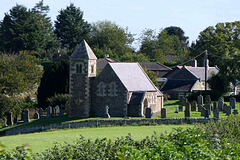
Branxton - St Paul's
| 01 Mar 2025 |
|
|
Local tradition has it that the church’s dedication should be to St Paulinus, who spread the Christian faith in the Glendale area in the 7th century, rather than St Paul. Towards the end of the 12th century the church was given to the monks of Durham in a grant confirmed by the king in 1195. It is likely that the church would have suffered in the long running border wars between the Scots and the English that culminated with the tragic battle of Flodden, that was fought right next to the church. After the battle the bodies of the slain James IV and many nobles were brought to the church
Most of the present building dates from 1849 when the church was rebuilt in the neo-Norman style. The oldest parts of the church are the 12th century chancel arch (rebuilt in the 13th century in the pointed form) and some areas of walling at a low level.
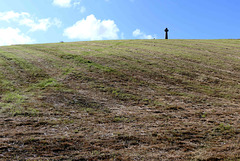
Flodden Field
| 01 Mar 2025 |
|
The Battle of Flodden took place here on September 9, 1513. The battle ended with a crushing defeat for the Scots and the death of the Scottish king James IV.
England was involved in a major conflict and fought on the side of the Holy Roman Emperor Maximilian I and Pope Julius II against France.
James IV took advantage of Henry VIII's absence and declared war on England. James marched into England with an army. When he reached the battlefield, the strength of his troops totalled around 30,000 men. The Scots faced an English army of roughly equal strength.
The much better trained English artillery drove the Scottish artillerymen from the field. The English cannons and archers then concentrated their fire on the Scottish pikemen. The heavy losses tempted the Scots to charge down the hill to get the English within range. In the bloody battle, the Scots were finally surrounded and routed. James IV, many high-ranking nobles and over 10,000 soldiers were killed. The English losses are estimated at between 1000 and 1500 men.
Edinburgh - St Giles’ Cathedral
| 26 Feb 2025 |
|
Edinburgh has been the capital of Scotland since the 15th century. With a population of around 525,000, it is the second largest city in Scotland after Glasgow.
The city is a cultural centre, and is the home of institutions including the National Museum of Scotland, the National Library of Scotland and the Scottish National Gallery. Edinburgh's Old Town and New Town together are listed as a UNESCO World Heritage Site.
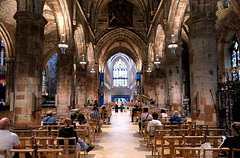
The first documented mention of a church on this site dates back to 854. The construction of the current building started in 1120. After a devasting fire in 1385, the church was rebuilt in the Gothic style. The tower was not completed until 1495.
St Giles is the main church in the city, although it was never a cathedral in its time as a Catholic church, as Edinburgh was part of the Diocese of St Andrews. St Giles' was central to Scotland's response to national disaster of the Battle of Flodden in 1513. As Edinburgh's men were ordered by the town council to defend the city, its women were ordered to gather in St Giles' to pray for James IV and his army. Requiem Mass for the King and the memorial mass for the dead of the battle were held in St Giles'. In the summer of 1544 during the war known as the Rough Wooing (aka Eight Years´ War), after an English army had burnt Edinburgh, Regent Arran maintained a garrison of gunners in the tower of the church.
In 1559, the church became Protestant with John Knox, the foremost figure of the Scottish Reformation, as its minister.
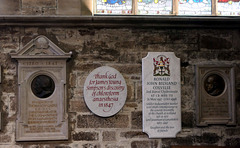
Many memorial slabs are around the walls.
One is for Sir James Young Simpson (1811 - 1870) a Scottish physician and the founder of chloroform anaesthesia in 1847.
Edinburgh - St Giles’ Cathedral
| 26 Feb 2025 |
|
|
Edinburgh has been the capital of Scotland since the 15th century. With a population of around 525,000, it is the second largest city in Scotland after Glasgow.
The city is a cultural centre, and is the home of institutions including the National Museum of Scotland, the National Library of Scotland and the Scottish National Gallery. Edinburgh's Old Town and New Town together are listed as a UNESCO World Heritage Site.
The first documented mention of a church on this site dates back to 854. The construction of the current building started in 1120. After a devasting fire in 1385, the church was rebuilt in the Gothic style. The tower was not completed until 1495.
St Giles is the main church in the city, although it was never a cathedral in its time as a Catholic church, as Edinburgh was part of the Diocese of St Andrews. St Giles' was central to Scotland's response to national disaster of the Battle of Flodden in 1513. As Edinburgh's men were ordered by the town council to defend the city, its women were ordered to gather in St Giles' to pray for James IV and his army. Requiem Mass for the King and the memorial mass for the dead of the battle were held in St Giles'. In the summer of 1544 during the war known as the Rough Wooing (aka Eight Years´ War), after an English army had burnt Edinburgh, Regent Arran maintained a garrison of gunners in the tower of the church.
In 1559, the church became Protestant with John Knox, the foremost figure of the Scottish Reformation, as its minister.
Today it is a parish church of the Church of Scotland.
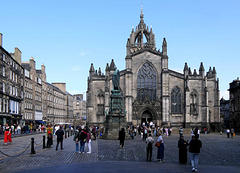
Edinburgh - St Giles’ Cathedral
| 26 Feb 2025 |
|
|
Edinburgh has been the capital of Scotland since the 15th century. With a population of around 525,000, it is the second largest city in Scotland after Glasgow.
The city is a cultural centre, and is the home of institutions including the National Museum of Scotland, the National Library of Scotland and the Scottish National Gallery. Edinburgh's Old Town and New Town together are listed as a UNESCO World Heritage Site.
The first documented mention of a church on this site dates back to 854. The construction of the current building started in 1120. After a devasting fire in 1385, the church was rebuilt in the Gothic style. The tower was not completed until 1495.
St Giles is the main church in the city, although it was never a cathedral in its time as a Catholic church, as Edinburgh was part of the Diocese of St Andrews. St Giles' was central to Scotland's response to national disaster of the Battle of Flodden in 1513. As Edinburgh's men were ordered by the town council to defend the city, its women were ordered to gather in St Giles' to pray for James IV and his army. Requiem Mass for the King and the memorial mass for the dead of the battle were held in St Giles'. In the summer of 1544 during the war known as the Rough Wooing (aka Eight Years´ War), after an English army had burnt Edinburgh, Regent Arran maintained a garrison of gunners in the tower of the church.
In 1559, the church became Protestant with John Knox, the foremost figure of the Scottish Reformation, as its minister.
Today it is a parish church of the Church of Scotland.
Jump to top
RSS feed- Martin M. Miles' latest photos with "Battle of Flodden" - Photos
- ipernity © 2007-2026
- Help & Contact
|
Club news
|
About ipernity
|
History |
ipernity Club & Prices |
Guide of good conduct
Donate | Group guidelines | Privacy policy | Terms of use | Statutes | In memoria -
Facebook
X
