

Martin M. Miles' photos with the keyword: Stavelot

Liège - Cathédrale Saint-Paul
| 18 Aug 2025 |
|
Liège is the center of the largest Walloon agglomeration, and the cultural center of the Walloon region of Belgium. The city, with a population of about 200.000, is located at the confluence of the Ourthe and Meuse rivers.
Around 705, Saint Lambert of Maastricht is credited with completing the Christianization of the region, but conversion may still not have been quite universal, since Lambert was murdered in Liège. To enshrine his relics, the successor, Hubertus (later St. Hubert), built a basilica which became the nucleus of the city.
In 1468, following an uprising of the inhabitants against Burgundian rule, xof Burgundy had the city plundered and systematically destroyed. The few survivors who had fled into the forests—Charles the Bold allegedly had more than 5,000 inhabitants murdered—were only able to return to the city for reconstruction after seven years.
In 1789, partly in connection with the French Revolution, the Liège Revolution occurred. It was directed against the absolutist rule of the Prince-Bishop and was crushed in early 1791 by troops commissioned by the Holy Roman Empire. In 1795, Liège was occupied by French troops and became part of the First French Republic. The Congress of Vienna annexed it to the Kingdom of the Netherlands, which in 1830 became the Kingdom of Belgium, to which Liège has belonged ever since.
Bishop Ebrachar founded a collegiate here in 966 on what was then an island between two branches of the Meuse.
Construction of the present church began in 1240. The first phase included the choir, the transept, and the two bays of the eastern nave. The church was consecrated in1289. The second, High Gothic construction phase began after 1333 and included the four western bays of the nave, the side portal, the chapels of the side aisles, the polygonal apse, and finally the tower. At the beginning of the 16th century, the west portal was added next to the tower.
In 1794, during the French Revolution, the demolition of the huge St. Lambert's Cathedral began. Under the supervision of a "Commission destructive de la cathédrale". In 1803, the two towers on the facade were destroyed. By 1827, almost the entire complex had been leveled.
After the revolution subsided, the population sought a replacement and chose the Collegiate Church as the church closest to the city center. After the church was elevated to cathedral status in 1804, the tower was raised by a bell tower and a spire; The western towers of the destroyed St. Lambert's Cathedral served as a model. A comprehensive restoration in the Neo-Gothic style took place between 1850 and 1875. The choir received two additional side aisles, and the entire exterior façade was decorated with statues and ornamental elements.
The cathedral has an extensive collection in the treasury
Cross
Erlebald of Stavelot (+ 1093)
Embossed silver on wooden core
Stavelot - Blancs Moussi
| 11 Jun 2018 |
|
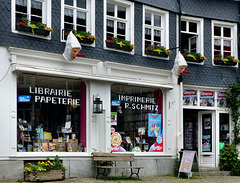
The town of Stavalot grown around the "Abbey of Stavelot", founded in 648 by St. Remaclus, is known for its carneval tradition "Laetare de Stavelot".
When Stavelot was the capital of the "Principality of Stavelot-Malmedy", ruled by a prince-abbot, it was forbidden for the monks to take part in the popular festivities. According to legend, the inhabitants of Stavelot decided to make fun of this prohibition by dressing up as monks to celebrate carnival. In 1502 they created a white costume with a hood referring to the monastic habit. The Stavelotains added to the costume a strange mask with a very long, red and pointed nose.
The "Blancs Moussis" (= white clad) exist since more than 5 centuries. After WWII the "confrérie des blancs moussis" was founded to keep the custom alive.
Here are two large Blancs Moussi-heads hanging over the "Imprimerie R. Schmitz".
www.blanc-moussi.com/
Stavelot - Dumoulin
| 11 Jun 2018 |
|
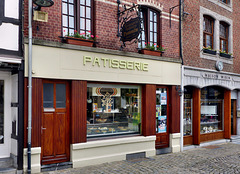
The town of Stavalot grew around the "Abbey of Stavelot", founded in 648 by St. Remaclus, the abbot of the Abbey of Solignac (near Limoge) on behalf of the Merovingian king Sigebert III (aka "Saint Sigebert of Austrasia").
The boulangerie and patisserie Dumoulin exists here since 1785.
Stavelot - Saint Sébastien
| 11 Jun 2018 |
|
|
The town of Stavalot grew around the "Abbey of Stavelot", founded in 648 by St. Remaclus, the abbot of the Abbey of Solignac (near Limoge) on behalf of the Merovingian king Sigebert III (aka "Saint Sigebert of Austrasia").
After the abbey had been raided twice by the Normans, it was a center of the Cluniac Reforms around 1000. The abbey existed upto the French Revolution, when the monks were expelled, the was pillaged by the revolutionaries and then sold and demolished.
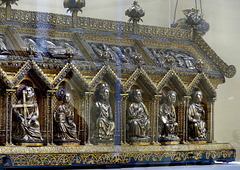
The "Shrine of St. Remaclus" ("La châsse de saint Remacle") from 1268 is a masterpiece. It is kept in the parish church Saint-Sébastien, but unfortunately it was hidden behind a screen.
Stavelot - Saint Sébastien
| 11 Jun 2018 |
|
|
The town of Stavalot grew around the "Abbey of Stavelot", founded in 648 by St. Remaclus, the abbot of the Abbey of Solignac (near Limoge) on behalf of the Merovingian king Sigebert III (aka "Saint Sigebert of Austrasia").
After the abbey had been raided twice by the Normans, it was a center of the Cluniac Reforms around 1000. The abbey existed upto the French Revolution, when the monks were expelled, the was pillaged by the revolutionaries and then sold and demolished.
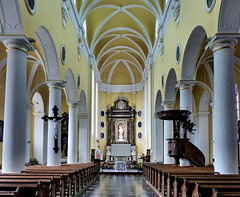
The nave of Stavelot´s parish church "Saint Sébastien". Hidden behind the strange screen in the center is the "Shrine of St. Remaclus" ("La châsse de saint Remacle") from 1268.
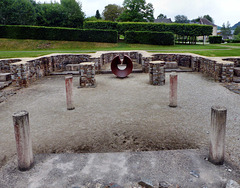
Stavelot - Abbaye de Stavelot
| 11 Jun 2018 |
|
The town of Stavalot grew around the "Abbey of Stavelot", founded in 648 by St. Remaclus, the abbot of the Abbey of Solignac (near Limoge) on behalf of the Merovingian king Sigebert III (aka "Saint Sigebert of Austrasia").
After the abbey had been raided twice by the Normans, it was a center of the Cluniac Reforms around 1000. The abbey existed upto the French Revolution, when the monks were expelled, the was pillaged by the revolutionaries and then sold and demolished.
The abbey´s treasures by now are squattered over the globe. The "Stavelot Bible", an illuminated manuscript from the 10th century, is in London, other masterpieces are in museums of New York, Berlin, Frankfurt and Paris.
Seen here are the foundations of the medieval abbey church.
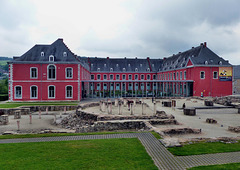
Stavelot - Abbaye de Stavelot
| 11 Jun 2018 |
|
The town of Stavalot grew around the "Abbey of Stavelot", founded in 648 by St. Remaclus, the abbot of the Abbey of Solignac (near Limoge) on behalf of the Merovingian king Sigebert III (aka "Saint Sigebert of Austrasia").
After the abbey had been raided twice by the Normans, it was a center of the Cluniac Reforms around 1000. The abbey existed upto the French Revolution, when the monks were expelled, the was pillaged by the revolutionaries and then sold and demolished.
The abbey´s treasures by now are squattered over the globe. The "Stavelot Bible", an illuminated manuscript from the 10th century, is in London, other masterpieces are in museums of New York, Berlin, Frankfurt and Paris.
Seen here are the foundations of the medieval abbey church. The former abbey buildings behind now host a museum.
Jump to top
RSS feed- Martin M. Miles' latest photos with "Stavelot" - Photos
- ipernity © 2007-2026
- Help & Contact
|
Club news
|
About ipernity
|
History |
ipernity Club & Prices |
Guide of good conduct
Donate | Group guidelines | Privacy policy | Terms of use | Statutes | In memoria -
Facebook
X
