

Martin M. Miles' photos with the keyword: apparation

Agioi Deka - Agia Limni
| 28 Apr 2025 |
|
Agioi Deka was once part of ancient Gortyn. The Roman cemetery may have been located here. The village's name dates back to 250 AD, when Saint Theodoulos and his nine companions were martyred here. The village was given the name "Ten Saints" in honor of these Christian martyrs.
Saint Theodoulos and his nine companions were deacons and priests who were captured during the persecution of Christians under Emperor Decius. They were tortured for 30 days, sentenced to death, and beheaded in the amphitheater of Gortyna—according to another tradition, at the site of the church of Agioi Deka.
On the outskirts of the village, there was a small pond where, in 1927, a woman dressed in black appeared to a child and told him about ten martyrs who had been beheaded on that spot. The apparitions repeated themselves until his parents visited the Metropolitan of Gortyna. That summer, when the pond was almost dry, he commissioned excavations. The workers found the bones of ten people. Subsequently, the chapel was built for them. Six of the tombs can be seen there, and four are built into the foundation walls.

Agioi Deka - Agia Limni
| 28 Apr 2025 |
|
Agioi Deka was once part of ancient Gortyn. The Roman cemetery may have been located here. The village's name dates back to 250 AD, when Saint Theodoulos and his nine companions were martyred here. The village was given the name "Ten Saints" in honor of these Christian martyrs.
Saint Theodoulos and his nine companions were deacons and priests who were captured during the persecution of Christians under Emperor Decius. They were tortured for 30 days, sentenced to death, and beheaded in the amphitheater of Gortyna—according to another tradition, at the site of the church of Agioi Deka.
On the outskirts of the village, there was a small pond where, in 1927, a woman dressed in black appeared to a child and told him about ten martyrs who had been beheaded on that spot. The apparitions repeated themselves until his parents visited the Metropolitan of Gortyna. That summer, when the pond was almost dry, he commissioned excavations. The workers found the bones of ten people. Subsequently, the chapel was built for them. Six of the tombs can be seen there, and four are built into the foundation walls.
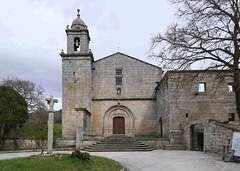
Trandeiras - Mosteiro do Bon Xesús
| 17 Sep 2024 |
|
|
|
The monastery was founded in 1520 and was inhabited by Franciscans. It was destroyed in 1809 by the French, and with the exclaustration it was definitively abandoned. The church is still in good condition and is still used for worship, but the rest of the building is in a total state of abandonment.
The origins of th foundation are wrapped in the legend of the apparation of the Virgin
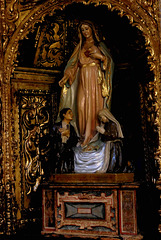
Ourense - Santa Eufemia
| 13 Mar 2024 |
|
|
The Romans were already here and utilised the hot springs. They built a bridge over the river, the Ponte romana, creating an important communication route, which was of course secured by fortifications.
In the 5th century, Ourense became the seat of a bishopric. As the capital of the kingdom of the Suebi, Ourense flourished in the 5th and 6th centuries. The Suebi king Teodomiro († 570) built the first cathedral in Ourense after converting from Arianism to Catholicism.
Constant raids by the Moorish conquerors and the Normans devastated the city to such an extent that it remained almost uninhabited for several centuries. It was rebuilt in 1071 under King Sancho II of Castile. In the following centuries, the city gained importance as a bishop's see, but also as a trading centre. In the 13th century, Ourense was an important trading centre in Galicia due to its geographical location and its large Jewish community. The economic decline began after the expulsion of Ourense's Jews in 1492 by the Catholic Monarchs. In the centuries that followed, Ourense's importance steadily declined.
The Church of Santa Eufemia is a Baroque church just a few metres from the Cathedral of Ourense
St Euphemia is a saint who was martyred at the time of Emperor Hadrian. In 1060, a shepherdess in Campelo discovered a grave from which a hand with a golden ring on one finger protruded. The woman took it and lost her speech. She was only able to regain it after returning the ring to the hand that had it. According to legend, a voice was then heard saying that the tomb of St Eufemia was there.
The mortal remains were buried under the altar of a hermitage between Braga and Orense. In 1159, the bishop of Orense tried to transfer the saint's body to the city cathedral but this was rejected by the parishioners of Braga, which led to a dispute. It was decided to place the body of the saint in a cart pulled by oxen and to bury her remains in the place where the animals went.
The church of Santa Eufemia was built in 1653 as part of a Jesuit college thanks to the Order of the Society of Jesus and was converted into a parish church of the diocese of Ourense in 1767.
An apparition of the Virgin Mary
Jump to top
RSS feed- Martin M. Miles' latest photos with "apparation" - Photos
- ipernity © 2007-2026
- Help & Contact
|
Club news
|
About ipernity
|
History |
ipernity Club & Prices |
Guide of good conduct
Donate | Group guidelines | Privacy policy | Terms of use | Statutes | In memoria -
Facebook
X
