

Martin M. Miles' photos with the keyword: “Plaza Grande”
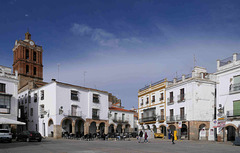
Zafra - Santa María de la Candelaria
| 04 Jan 2024 |
|
|
In ancient times, Zafra was located on the Via de la Plata, a road fortified by the Romans between Hispalis (Seville) and Asturica Augusta (Astorga). There are ruins of several Roman estates in the area. In the early 8th century the region was taken by the Moors, whose rule under the Umayyads, Almoravids, and Almohads lasted until the 13th century.
During the Reconquista, Zafra was captured twice, first in 1229 by Alfonso IX, and then in 1241 definitively by Ferdinand III. The area was then repopulated ("repoblación") by settlers from the north of the peninsula. In 1394, Henry III handed over the towns of Feria and Zafra to Gómez Suárez de Figueroa, the Grand Master of the Order of Santiago.
The tower of Santa María de la Candelaria, seen from the Plaza Grande.
Until the mid-16th century, the original church of Santa María de la Candelaria, along with its attached cemetery, stood in the current Plaza Grande. Count Gomes II Suárez de Figueroa then asked Pope Alexander VI. for a bull to convert the old synagogue, which had already been converted into a church, into a parish seat, a bull which he received in 1500.
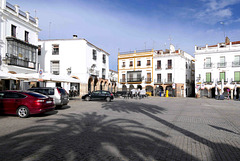
Zafra - Plaza Grande
| 04 Jan 2024 |
|
|
In ancient times, Zafra was located on the Via de la Plata, a road fortified by the Romans between Hispalis (Seville) and Asturica Augusta (Astorga). There are ruins of several Roman estates in the area. In the early 8th century the region was taken by the Moors, whose rule under the Umayyads, Almoravids, and Almohads lasted until the 13th century.
During the Reconquista, Zafra was captured twice, first in 1229 by Alfonso IX, and then in 1241 definitively by Ferdinand III. The area was then repopulated ("repoblación") by settlers from the north of the peninsula. In 1394, Henry III handed over the towns of Feria and Zafra to Gómez Suárez de Figueroa, the Grand Master of the Order of Santiago.
The “Plaza Grande” is the largest square in Zafra. It was created in the 16th century when the medieval church on this site was demolished and the cemetery there was abandoned.
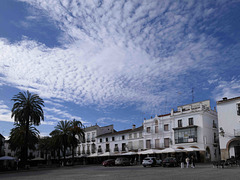
Zafra - Plaza Grande
| 04 Jan 2024 |
|
|
In ancient times, Zafra was located on the Via de la Plata, a road fortified by the Romans between Hispalis (Seville) and Asturica Augusta (Astorga). There are ruins of several Roman estates in the area. In the early 8th century the region was taken by the Moors, whose rule under the Umayyads, Almoravids, and Almohads lasted until the 13th century.
During the Reconquista, Zafra was captured twice, first in 1229 by Alfonso IX, and then in 1241 definitively by Ferdinand III. The area was then repopulated ("repoblación") by settlers from the north of the peninsula. In 1394, Henry III handed over the towns of Feria and Zafra to Gómez Suárez de Figueroa, the Grand Master of the Order of Santiago.
The “Plaza Grande” is the largest square in Zafra. It was created in the 16th century when the medieval church on this site was demolished and the cemetery there was abandoned.
Jump to top
RSS feed- Martin M. Miles' latest photos with "“Plaza Grande”" - Photos
- ipernity © 2007-2026
- Help & Contact
|
Club news
|
About ipernity
|
History |
ipernity Club & Prices |
Guide of good conduct
Donate | Group guidelines | Privacy policy | Terms of use | Statutes | In memoria -
Facebook
X
