

Martin M. Miles' photos with the keyword: Dommuseum

Mainz - Bischöfliches Dom- und Diözesanmuseum
| 01 Feb 2026 |
|
|
Mainz was founded around 20 BC by the Romans under the name “Mogontiacum” as a military camp. Today's capital of the state of Rhineland-Palatinate forms a metropolitan area with Wiesbaden, the neighboring capital of Hesse, with a combined population of around 500,000.
The "Republic of Mainz", a product of the French Revolution, was the first democratic state on German territory. The state was represented in Paris by the naturalist Georg Forster, who had been in the Pacific with Captain Cook as a boy. The Mainz Republic ended after only five months in July 1793 following the conquest of the city by Prussian and Austrian troops. Georg Forster died in Paris in 1794.
Founded in 1925, the Cathedral Museum houses in its historic rooms – the Staufer vaulted halls, the two-story late Gothic cloister and the former chapter houses – works of art from two millennia that once belonged to the furnishings of Mainz Cathedral or the churches of the diocese.
Crucifix
Willigiskreuz
probably once part of a book cover
Mainz, ca 1000

Mainz - Bischöfliches Dom- und Diözesanmuseum
| 01 Feb 2026 |
|
|
Mainz was founded around 20 BC by the Romans under the name “Mogontiacum” as a military camp. Today's capital of the state of Rhineland-Palatinate forms a metropolitan area with Wiesbaden, the neighboring capital of Hesse, with a combined population of around 500,000.
The "Republic of Mainz", a product of the French Revolution, was the first democratic state on German territory. The state was represented in Paris by the naturalist Georg Forster, who had been in the Pacific with Captain Cook as a boy. The Mainz Republic ended after only five months in July 1793 following the conquest of the city by Prussian and Austrian troops. Georg Forster died in Paris in 1794.
Founded in 1925, the Cathedral Museum houses in its historic rooms – the Staufer vaulted halls, the two-story late Gothic cloister and the former chapter houses – works of art from two millennia that once belonged to the furnishings of Mainz Cathedral or the churches of the diocese.
Candlestick
Limoges, ca 1200

Mainz - Bischöfliches Dom- und Diözesanmuseum
| 01 Feb 2026 |
|
|
Mainz was founded around 20 BC by the Romans under the name “Mogontiacum” as a military camp. Today's capital of the state of Rhineland-Palatinate forms a metropolitan area with Wiesbaden, the neighboring capital of Hesse, with a combined population of around 500,000.
The "Republic of Mainz", a product of the French Revolution, was the first democratic state on German territory. The state was represented in Paris by the naturalist Georg Forster, who had been in the Pacific with Captain Cook as a boy. The Mainz Republic ended after only five months in July 1793 following the conquest of the city by Prussian and Austrian troops. Georg Forster died in Paris in 1794.
Founded in 1925, the Cathedral Museum houses in its historic rooms – the Staufer vaulted halls, the two-story late Gothic cloister and the former chapter houses – works of art from two millennia that once belonged to the furnishings of Mainz Cathedral or the churches of the diocese.
Book Cover
Crucifixion
Mainz, 1300/1330

Mainz - Bischöfliches Dom- und Diözesanmuseum
| 01 Feb 2026 |
|
|
Mainz was founded around 20 BC by the Romans under the name “Mogontiacum” as a military camp. Today's capital of the state of Rhineland-Palatinate forms a metropolitan area with Wiesbaden, the neighboring capital of Hesse, with a combined population of around 500,000.
The "Republic of Mainz", a product of the French Revolution, was the first democratic state on German territory. The state was represented in Paris by the naturalist Georg Forster, who had been in the Pacific with Captain Cook as a boy. The Mainz Republic ended after only five months in July 1793 following the conquest of the city by Prussian and Austrian troops. Georg Forster died in Paris in 1794.
Founded in 1925, the Cathedral Museum houses in its historic rooms – the Staufer vaulted halls, the two-story late Gothic cloister and the former chapter houses – works of art from two millennia that once belonged to the furnishings of Mainz Cathedral or the churches of the diocese.
Book Cover
Crucifixion
Mainz, 1300/1330

Mainz - Bischöfliches Dom- und Diözesanmuseum
| 01 Feb 2026 |
|
|
Mainz was founded around 20 BC by the Romans under the name “Mogontiacum” as a military camp. Today's capital of the state of Rhineland-Palatinate forms a metropolitan area with Wiesbaden, the neighboring capital of Hesse, with a combined population of around 500,000.
The "Republic of Mainz", a product of the French Revolution, was the first democratic state on German territory. The state was represented in Paris by the naturalist Georg Forster, who had been in the Pacific with Captain Cook as a boy. The Mainz Republic ended after only five months in July 1793 following the conquest of the city by Prussian and Austrian troops. Georg Forster died in Paris in 1794.
Founded in 1925, the Cathedral Museum houses in its historic rooms – the Staufer vaulted halls, the two-story late Gothic cloister and the former chapter houses – works of art from two millennia that once belonged to the furnishings of Mainz Cathedral or the churches of the diocese.
Book Cover
Madonna and Angels
Mainz, 1300/1330

Mainz - Bischöfliches Dom- und Diözesanmuseum
| 01 Feb 2026 |
|
|
Mainz was founded around 20 BC by the Romans under the name “Mogontiacum” as a military camp. Today's capital of the state of Rhineland-Palatinate forms a metropolitan area with Wiesbaden, the neighboring capital of Hesse, with a combined population of around 500,000.
The "Republic of Mainz", a product of the French Revolution, was the first democratic state on German territory. The state was represented in Paris by the naturalist Georg Forster, who had been in the Pacific with Captain Cook as a boy. The Mainz Republic ended after only five months in July 1793 following the conquest of the city by Prussian and Austrian troops. Georg Forster died in Paris in 1794.
Founded in 1925, the Cathedral Museum houses in its historic rooms – the Staufer vaulted halls, the two-story late Gothic cloister and the former chapter houses – works of art from two millennia that once belonged to the furnishings of Mainz Cathedral or the churches of the diocese.
Book Cover
The Stoning of St. Stephen
Mainz, 1300/1330

Mainz - Bischöfliches Dom- und Diözesanmuseum
| 01 Feb 2026 |
|
|
Mainz was founded around 20 BC by the Romans under the name “Mogontiacum” as a military camp. Today's capital of the state of Rhineland-Palatinate forms a metropolitan area with Wiesbaden, the neighboring capital of Hesse, with a combined population of around 500,000.
The "Republic of Mainz", a product of the French Revolution, was the first democratic state on German territory. The state was represented in Paris by the naturalist Georg Forster, who had been in the Pacific with Captain Cook as a boy. The Mainz Republic ended after only five months in July 1793 following the conquest of the city by Prussian and Austrian troops. Georg Forster died in Paris in 1794.
Founded in 1925, the Cathedral Museum houses in its historic rooms – the Staufer vaulted halls, the two-story late Gothic cloister and the former chapter houses – works of art from two millennia that once belonged to the furnishings of Mainz Cathedral or the churches of the diocese.
Altar Cross / Processional Cross
known as "Theoderichkreuz"
1100 - 1050

Mainz - Bischöfliches Dom- und Diözesanmuseum
| 01 Feb 2026 |
|
|
Mainz was founded around 20 BC by the Romans under the name “Mogontiacum” as a military camp. Today's capital of the state of Rhineland-Palatinate forms a metropolitan area with Wiesbaden, the neighboring capital of Hesse, with a combined population of around 500,000.
The "Republic of Mainz", a product of the French Revolution, was the first democratic state on German territory. The state was represented in Paris by the naturalist Georg Forster, who had been in the Pacific with Captain Cook as a boy. The Mainz Republic ended after only five months in July 1793 following the conquest of the city by Prussian and Austrian troops. Georg Forster died in Paris in 1794.
Founded in 1925, the Cathedral Museum houses in its historic rooms – the Staufer vaulted halls, the two-story late Gothic cloister and the former chapter houses – works of art from two millennia that once belonged to the furnishings of Mainz Cathedral or the churches of the diocese.
Anna Selbdritt
ca 1500
This is a classic motif in Christian art. It depicts Saint Anne together with her daughter Mary and her grandson Jesus.

Mainz - Bischöfliches Dom- und Diözesanmuseum
| 01 Feb 2026 |
|
|
Mainz was founded around 20 BC by the Romans under the name “Mogontiacum” as a military camp. Today's capital of the state of Rhineland-Palatinate forms a metropolitan area with Wiesbaden, the neighboring capital of Hesse, with a combined population of around 500,000.
The "Republic of Mainz", a product of the French Revolution, was the first democratic state on German territory. The state was represented in Paris by the naturalist Georg Forster, who had been in the Pacific with Captain Cook as a boy. The Mainz Republic ended after only five months in July 1793 following the conquest of the city by Prussian and Austrian troops. Georg Forster died in Paris in 1794.
Founded in 1925, the Cathedral Museum houses in its historic rooms – the Staufer vaulted halls, the two-story late Gothic cloister and the former chapter houses – works of art from two millennia that once belonged to the furnishings of Mainz Cathedral or the churches of the diocese.
Grave goods
from the sarcophagus of Archbishop Siegfried III of Eppstein, discovered in 1804.
Siegfried III of Eppstein ( 1194 - 1249 ) acted as regent for Conrad IV of Germany, while Emperor Frederick II was campaigning in Italy,.

Mainz - Bischöfliches Dom- und Diözesanmuseum
| 01 Feb 2026 |
|
|
Mainz was founded around 20 BC by the Romans under the name “Mogontiacum” as a military camp. Today's capital of the state of Rhineland-Palatinate forms a metropolitan area with Wiesbaden, the neighboring capital of Hesse, with a combined population of around 500,000.
The "Republic of Mainz", a product of the French Revolution, was the first democratic state on German territory. The state was represented in Paris by the naturalist Georg Forster, who had been in the Pacific with Captain Cook as a boy. The Mainz Republic ended after only five months in July 1793 following the conquest of the city by Prussian and Austrian troops. Georg Forster died in Paris in 1794.
Founded in 1925, the Cathedral Museum houses in its historic rooms – the Staufer vaulted halls, the two-story late Gothic cloister and the former chapter houses – works of art from two millennia that once belonged to the furnishings of Mainz Cathedral or the churches of the diocese.
The Stoning of St. Stephen
1270

Mainz - Bischöfliches Dom- und Diözesanmuseum
| 01 Feb 2026 |
|
|
Mainz was founded around 20 BC by the Romans under the name “Mogontiacum” as a military camp. Today's capital of the state of Rhineland-Palatinate forms a metropolitan area with Wiesbaden, the neighboring capital of Hesse, with a combined population of around 500,000.
The "Republic of Mainz", a product of the French Revolution, was the first democratic state on German territory. The state was represented in Paris by the naturalist Georg Forster, who had been in the Pacific with Captain Cook as a boy. The Mainz Republic ended after only five months in July 1793 following the conquest of the city by Prussian and Austrian troops. Georg Forster died in Paris in 1794.
Founded in 1925, the Cathedral Museum houses in its historic rooms – the Staufer vaulted halls, the two-story late Gothic cloister and the former chapter houses – works of art from two millennia that once belonged to the furnishings of Mainz Cathedral or the churches of the diocese.
The sculpture of John the Baptist, along with the figures of the apostles, belonged to the so-called "Großes Mainzer Weltgericht" (Great Mainz Last Judgment), which was part of the western rood screen of the Cathedral. Only fragments of the original screen survive today. The screen was created around 1240 by the so-called Naumburg Master, who had acquired his skills on the construction sites of the great French cathedrals in Noyen, Metz, and especially Reims.

Mainz - Bischöfliches Dom- und Diözesanmuseum
| 31 Jan 2026 |
|
|
|
Mainz was founded around 20 BC by the Romans under the name “Mogontiacum” as a military camp. Today's capital of the state of Rhineland-Palatinate forms a metropolitan area with Wiesbaden, the neighboring capital of Hesse, with a combined population of around 500,000.
The "Republic of Mainz", a product of the French Revolution, was the first democratic state on German territory. The state was represented in Paris by the naturalist Georg Forster, who had been in the Pacific with Captain Cook as a boy. The Mainz Republic ended after only five months in July 1793 following the conquest of the city by Prussian and Austrian troops. Georg Forster died in Paris in 1794.
Founded in 1925, the Cathedral Museum houses in its historic rooms – the Staufer vaulted halls, the two-story late Gothic cloister and the former chapter houses – works of art from two millennia that once belonged to the furnishings of Mainz Cathedral or the churches of the diocese.
Archbishop Aribo´s Ring
Aribo was Archbishop of Mainz (1021-1031). He died on a pilgrimage to Rome in northern Italy. His body was brought back to Mainz and buried in the cathedral. When the sarcophagus was found and opened in 1925, Aribo was still wearing the ring with the inscription "ARIBO ARCHi(episcopu)S".
Hildesheim - Dommuseum
| 08 Aug 2022 |
|
|
Louis the Pious founded the bishopric of Hildesheim in 815. The settlement developed into a town and was granted market rights by King Otto III in 983. Craftsmen and merchants were attracted and the city developed into an important community. By 1167, Hildesheim was an almost completely walled market settlement.
At the beginning of the 13th century, Hildesheim had about 5,000 inhabitants, and when Hildesheim received its city charter in 1249, it was one of the largest cities in northern Germany. The clergy ruled Hildesheim for four centuries before a town hall was built and the citizens gained influence and independence. In 1367, Hildesheim became a member of the Hanseatic League. But what is now called Hildesheim was various small "suburbs". After centuries of (sometimes armed) disputes, it was not until the end of the 16th century that a union was created and subsequently at least the inner wall was taken down Old and New Town.
During the Thirty Years' War, Hildesheim was besieged and occupied several times. In 1813, after the Napoleonic Wars, the town became part of the Kingdom of Hanover, which was annexed by the Kingdom of Prussia as a province after the Austro-Prussian War in 1866.
The air raids on Hildesheim in 1944/45 destroyed large parts of the city. Of the 1500 half-timbered houses, only 200 remained. 90 percent of the historic old town was destroyed in the firestorm.
-
Bishop Gunthar, who was in office in Hildesheim from 815 to 834 had a small basilica built. This served as the original cathedral. The next cathedral was built by Bishop Altfried in 872 as a cruciform three-aisled basilica with a two-story westwork. The building suffered severe fire damage in 1046. Bishop Hezilo built then incorporated the surviving walls into the new building using the foundation of the former basilica. Until the 14th century, further profound changes took place, but without deviating from the ground plan of the basilica. The side chapels date from the Gothic period. From 1840 to 1850, the original west building, which had fallen into disrepair, was replaced by a neo-Romanesque double tower front, which remained in place until 1945.
During the air raids on Hildesheim in WWII, the cathedral was completely destroyed except for the west building, the southern nave arcades, and the outer walls. Only the crypt and the Laurentius Chapel from the 11th century were preserved.
The cathedral was rebuilt in a simplified form between 1950 and 1960. The baroque elements were abandoned in favor of a form that took its cue from the early Romanesque style.
-
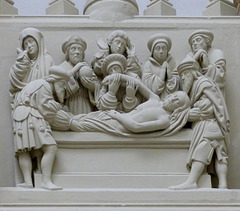
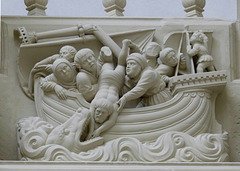
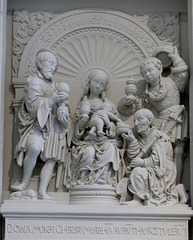
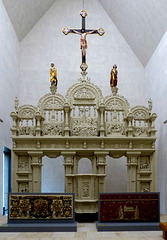
The "Dommuseum" is the "Schatzkammer" (treasury) of the cathedral. It is located in historic rooms off the southern transept of the Cathedral, the church of St Antonius and part of the cathedral cloisters.
The former rood screen of the Cathedral is an extraordinary work of art of the 16th century. It was erected as a donation of the canon Arnold Freitag around 1546, at a time when the Reformation had already taken hold in Hildesheim.
It was commissioned to the then leading Münster workshop of the brothers Johann and Franz Brabender, who specialized in complex stonework and were able to use the Baumberg sandstone quarried not far from Münster for this purpose. It is the only almost completely preserved rood screen from the Brabender workshop.
A detail - The "Entombment of Christ" / "Mise au Tombeau"
Hildesheim - Dommuseum
| 08 Aug 2022 |
|
|
Louis the Pious founded the bishopric of Hildesheim in 815. The settlement developed into a town and was granted market rights by King Otto III in 983. Craftsmen and merchants were attracted and the city developed into an important community. By 1167, Hildesheim was an almost completely walled market settlement.
At the beginning of the 13th century, Hildesheim had about 5,000 inhabitants, and when Hildesheim received its city charter in 1249, it was one of the largest cities in northern Germany. The clergy ruled Hildesheim for four centuries before a town hall was built and the citizens gained influence and independence. In 1367, Hildesheim became a member of the Hanseatic League. But what is now called Hildesheim was various small "suburbs". After centuries of (sometimes armed) disputes, it was not until the end of the 16th century that a union was created and subsequently at least the inner wall was taken down Old and New Town.
During the Thirty Years' War, Hildesheim was besieged and occupied several times. In 1813, after the Napoleonic Wars, the town became part of the Kingdom of Hanover, which was annexed by the Kingdom of Prussia as a province after the Austro-Prussian War in 1866.
The air raids on Hildesheim in 1944/45 destroyed large parts of the city. Of the 1500 half-timbered houses, only 200 remained. 90 percent of the historic old town was destroyed in the firestorm.
-
Bishop Gunthar, who was in office in Hildesheim from 815 to 834 had a small basilica built. This served as the original cathedral. The next cathedral was built by Bishop Altfried in 872 as a cruciform three-aisled basilica with a two-story westwork. The building suffered severe fire damage in 1046. Bishop Hezilo built then incorporated the surviving walls into the new building using the foundation of the former basilica. Until the 14th century, further profound changes took place, but without deviating from the ground plan of the basilica. The side chapels date from the Gothic period. From 1840 to 1850, the original west building, which had fallen into disrepair, was replaced by a neo-Romanesque double tower front, which remained in place until 1945.
During the air raids on Hildesheim in WWII, the cathedral was completely destroyed except for the west building, the southern nave arcades, and the outer walls. Only the crypt and the Laurentius Chapel from the 11th century were preserved.
The cathedral was rebuilt in a simplified form between 1950 and 1960. The baroque elements were abandoned in favor of a form that took its cue from the early Romanesque style.
-
The "Dommuseum" is the "Schatzkammer" (treasury) of the cathedral. It is located in historic rooms off the southern transept of the Cathedral, the church of St Antonius and part of the cathedral cloisters.
The former rood screen of the Cathedral is an extraordinary work of art of the 16th century. It was erected as a donation of the canon Arnold Freitag around 1546, at a time when the Reformation had already taken hold in Hildesheim.
It was commissioned to the then leading Münster workshop of the brothers Johann and Franz Brabender, who specialized in complex stonework and were able to use the Baumberg sandstone quarried not far from Münster for this purpose. It is the only almost completely preserved rood screen from the Brabender workshop.
A detail - Jonah is thrown from the ship and swallowed by the whale.
Hildesheim - Dommuseum
| 08 Aug 2022 |
|
|
Louis the Pious founded the bishopric of Hildesheim in 815. The settlement developed into a town and was granted market rights by King Otto III in 983. Craftsmen and merchants were attracted and the city developed into an important community. By 1167, Hildesheim was an almost completely walled market settlement.
At the beginning of the 13th century, Hildesheim had about 5,000 inhabitants, and when Hildesheim received its city charter in 1249, it was one of the largest cities in northern Germany. The clergy ruled Hildesheim for four centuries before a town hall was built and the citizens gained influence and independence. In 1367, Hildesheim became a member of the Hanseatic League. But what is now called Hildesheim was various small "suburbs". After centuries of (sometimes armed) disputes, it was not until the end of the 16th century that a union was created and subsequently at least the inner wall was taken down Old and New Town.
During the Thirty Years' War, Hildesheim was besieged and occupied several times. In 1813, after the Napoleonic Wars, the town became part of the Kingdom of Hanover, which was annexed by the Kingdom of Prussia as a province after the Austro-Prussian War in 1866.
The air raids on Hildesheim in 1944/45 destroyed large parts of the city. Of the 1500 half-timbered houses, only 200 remained. 90 percent of the historic old town was destroyed in the firestorm.
-
Bishop Gunthar, who was in office in Hildesheim from 815 to 834 had a small basilica built. This served as the original cathedral. The next cathedral was built by Bishop Altfried in 872 as a cruciform three-aisled basilica with a two-story westwork. The building suffered severe fire damage in 1046. Bishop Hezilo built then incorporated the surviving walls into the new building using the foundation of the former basilica. Until the 14th century, further profound changes took place, but without deviating from the ground plan of the basilica. The side chapels date from the Gothic period. From 1840 to 1850, the original west building, which had fallen into disrepair, was replaced by a neo-Romanesque double tower front, which remained in place until 1945.
During the air raids on Hildesheim in WWII, the cathedral was completely destroyed except for the west building, the southern nave arcades, and the outer walls. Only the crypt and the Laurentius Chapel from the 11th century were preserved.
The cathedral was rebuilt in a simplified form between 1950 and 1960. The baroque elements were abandoned in favor of a form that took its cue from the early Romanesque style.
-
The "Dommuseum" is the "Schatzkammer" (treasury) of the cathedral. It is located in historic rooms off the southern transept of the Cathedral, the church of St Antonius and part of the cathedral cloisters.
The former rood screen of the Cathedral is an extraordinary work of art of the 16th century. It was erected as a donation of the canon Arnold Freitag around 1546, at a time when the Reformation had already taken hold in Hildesheim.
It was commissioned to the then leading Münster workshop of the brothers Johann and Franz Brabender, who specialized in complex stonework and were able to use the Baumberg sandstone quarried not far from Münster for this purpose. It is the only almost completely preserved rood screen from the Brabender workshop.
A detail - The Adoration of the Magi
Hildesheim - Dommuseum
| 08 Aug 2022 |
|
|
Louis the Pious founded the bishopric of Hildesheim in 815. The settlement developed into a town and was granted market rights by King Otto III in 983. Craftsmen and merchants were attracted and the city developed into an important community. By 1167, Hildesheim was an almost completely walled market settlement.
At the beginning of the 13th century, Hildesheim had about 5,000 inhabitants, and when Hildesheim received its city charter in 1249, it was one of the largest cities in northern Germany. The clergy ruled Hildesheim for four centuries before a town hall was built and the citizens gained influence and independence. In 1367, Hildesheim became a member of the Hanseatic League. But what is now called Hildesheim was various small "suburbs". After centuries of (sometimes armed) disputes, it was not until the end of the 16th century that a union was created and subsequently at least the inner wall was taken down Old and New Town.
During the Thirty Years' War, Hildesheim was besieged and occupied several times. In 1813, after the Napoleonic Wars, the town became part of the Kingdom of Hanover, which was annexed by the Kingdom of Prussia as a province after the Austro-Prussian War in 1866.
The air raids on Hildesheim in 1944/45 destroyed large parts of the city. Of the 1500 half-timbered houses, only 200 remained. 90 percent of the historic old town was destroyed in the firestorm.
-
Bishop Gunthar, who was in office in Hildesheim from 815 to 834 had a small basilica built. This served as the original cathedral. The next cathedral was built by Bishop Altfried in 872 as a cruciform three-aisled basilica with a two-story westwork. The building suffered severe fire damage in 1046. Bishop Hezilo built then incorporated the surviving walls into the new building using the foundation of the former basilica. Until the 14th century, further profound changes took place, but without deviating from the ground plan of the basilica. The side chapels date from the Gothic period. From 1840 to 1850, the original west building, which had fallen into disrepair, was replaced by a neo-Romanesque double tower front, which remained in place until 1945.
During the air raids on Hildesheim in WWII, the cathedral was completely destroyed except for the west building, the southern nave arcades, and the outer walls. Only the crypt and the Laurentius Chapel from the 11th century were preserved.
The cathedral was rebuilt in a simplified form between 1950 and 1960. The baroque elements were abandoned in favor of a form that took its cue from the early Romanesque style.
-
The "Dommuseum" is the "Schatzkammer" (treasury) of the cathedral. It is located in historic rooms off the southern transept of the Cathedral, the church of St Antonius and part of the cathedral cloisters.
The former rood screen of the Cathedral is an extraordinary work of art of the 16th century. It was erected as a donation of the canon Arnold Freitag around 1546, at a time when the Reformation had already taken hold in Hildesheim.
It was commissioned to the then leading Münster workshop of the brothers Johann and Franz Brabender, who specialized in complex stonework and were able to use the Baumberg sandstone quarried not far from Münster for this purpose. It is the only almost completely preserved rood screen from the Brabender workshop.
Hildesheim - Dommuseum
| 08 Aug 2022 |
|
|
Louis the Pious founded the bishopric of Hildesheim in 815. The settlement developed into a town and was granted market rights by King Otto III in 983. Craftsmen and merchants were attracted and the city developed into an important community. By 1167, Hildesheim was an almost completely walled market settlement.
At the beginning of the 13th century, Hildesheim had about 5,000 inhabitants, and when Hildesheim received its city charter in 1249, it was one of the largest cities in northern Germany. The clergy ruled Hildesheim for four centuries before a town hall was built and the citizens gained influence and independence. In 1367, Hildesheim became a member of the Hanseatic League. But what is now called Hildesheim was various small "suburbs". After centuries of (sometimes armed) disputes, it was not until the end of the 16th century that a union was created and subsequently at least the inner wall was taken down Old and New Town.
During the Thirty Years' War, Hildesheim was besieged and occupied several times. In 1813, after the Napoleonic Wars, the town became part of the Kingdom of Hanover, which was annexed by the Kingdom of Prussia as a province after the Austro-Prussian War in 1866.
The air raids on Hildesheim in 1944/45 destroyed large parts of the city. Of the 1500 half-timbered houses, only 200 remained. 90 percent of the historic old town was destroyed in the firestorm.
-
Bishop Gunthar, who was in office in Hildesheim from 815 to 834 had a small basilica built. This served as the original cathedral. The next cathedral was built by Bishop Altfried in 872 as a cruciform three-aisled basilica with a two-story westwork. The building suffered severe fire damage in 1046. Bishop Hezilo built then incorporated the surviving walls into the new building using the foundation of the former basilica. Until the 14th century, further profound changes took place, but without deviating from the ground plan of the basilica. The side chapels date from the Gothic period. From 1840 to 1850, the original west building, which had fallen into disrepair, was replaced by a neo-Romanesque double tower front, which remained in place until 1945.
During the air raids on Hildesheim in WWII, the cathedral was completely destroyed except for the west building, the southern nave arcades, and the outer walls. Only the crypt and the Laurentius Chapel from the 11th century were preserved.
The cathedral was rebuilt in a simplified form between 1950 and 1960. The baroque elements were abandoned in favor of a form that took its cue from the early Romanesque style.
-
The "Dommuseum" is the "Schatzkammer" (treasury) of the cathedral. It is located in historic rooms off the southern transept of the Cathedral, the church of St Antonius and part of the cathedral cloisters.
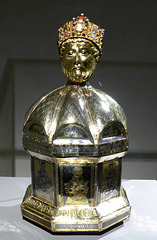
Head reliquary of St.Oswald, ca 1185

Hildesheim - Dommuseum
| 08 Aug 2022 |
|
|
Louis the Pious founded the bishopric of Hildesheim in 815. The settlement developed into a town and was granted market rights by King Otto III in 983. Craftsmen and merchants were attracted and the city developed into an important community. By 1167, Hildesheim was an almost completely walled market settlement.
At the beginning of the 13th century, Hildesheim had about 5,000 inhabitants, and when Hildesheim received its city charter in 1249, it was one of the largest cities in northern Germany. The clergy ruled Hildesheim for four centuries before a town hall was built and the citizens gained influence and independence. In 1367, Hildesheim became a member of the Hanseatic League. But what is now called Hildesheim was various small "suburbs". After centuries of (sometimes armed) disputes, it was not until the end of the 16th century that a union was created and subsequently at least the inner wall was taken down Old and New Town.
During the Thirty Years' War, Hildesheim was besieged and occupied several times. In 1813, after the Napoleonic Wars, the town became part of the Kingdom of Hanover, which was annexed by the Kingdom of Prussia as a province after the Austro-Prussian War in 1866.
The air raids on Hildesheim in 1944/45 destroyed large parts of the city. Of the 1500 half-timbered houses, only 200 remained. 90 percent of the historic old town was destroyed in the firestorm.
-
Bishop Gunthar, who was in office in Hildesheim from 815 to 834 had a small basilica built. This served as the original cathedral. The next cathedral was built by Bishop Altfried in 872 as a cruciform three-aisled basilica with a two-story westwork. The building suffered severe fire damage in 1046. Bishop Hezilo built then incorporated the surviving walls into the new building using the foundation of the former basilica. Until the 14th century, further profound changes took place, but without deviating from the ground plan of the basilica. The side chapels date from the Gothic period. From 1840 to 1850, the original west building, which had fallen into disrepair, was replaced by a neo-Romanesque double tower front, which remained in place until 1945.
During the air raids on Hildesheim in WWII, the cathedral was completely destroyed except for the west building, the southern nave arcades, and the outer walls. Only the crypt and the Laurentius Chapel from the 11th century were preserved.
The cathedral was rebuilt in a simplified form between 1950 and 1960. The baroque elements were abandoned in favor of a form that took its cue from the early Romanesque style.
-
The "Dommuseum" is the "Schatzkammer" (treasury) of the cathedral. It is located in historic rooms off the southern transept of the Cathedral, the church of St Antonius and part of the cathedral cloisters.
Deposition from the Cross, 12th century, Northern Italy
Jump to top
RSS feed- Martin M. Miles' latest photos with "Dommuseum" - Photos
- ipernity © 2007-2026
- Help & Contact
|
Club news
|
About ipernity
|
History |
ipernity Club & Prices |
Guide of good conduct
Donate | Group guidelines | Privacy policy | Terms of use | Statutes | In memoria -
Facebook
X
