

Martin M. Miles' photos with the keyword: Ludwig I of Bavaria

Nafplio - Bavarian Lion
| 30 Jun 2026 |
|
|
Otto I of Greece was born in Salzburg in 1815 as Otto von Wittelsbach. He was the second son of King Ludwig I of Bavaria.
As Greece was seeking a foreign monarch following its War of Independence against the Ottoman Empire, the 16-year-old Bavarian Prince Otto was selected during the London Conference. Otto ascended the newly created Greek throne in 1832, though the affairs of state were initially managed by a three-member regency council composed of Bavarian court officials. Upon coming of age, Otto dismissed the regents.
Despite various uprisings, he remained in power for three decades. In October 1862, he was deposed during a popular revolt. Otto and his wife Amalia left Greece and went into exile in Bavaria. Nevertheless, the king refused to abdicate and did not regard his departure as final.
This monument was commissioned by King Ludwig I of Bavaria, the father of Otto I. It commemorates the soldiers of the Royal Bavarian Brigade who died here during a typhus epidemic between 1833 and 1834.

Athens - Temple of Hephaestus
| 23 May 2025 |
|
Athens, the southernmost capital on the European mainland, is one of the world's oldest cities, with its recorded history spanning over 3,400 years. According to Greek mythology the city was named after Athena, the ancient Greek goddess of wisdom. Classical Athens was one of the most powerful city-states in ancient Greece. It was a centre for democracy, the arts, education and philosophy, and was highly influential throughout the European continent, particularly in Ancient Rome. For this reason it is often regarded as the cradle of Western civilisation and the birthplace of democracy.
The Temple of Hephaestus is a well-preserved Greek temple dedicated to Hephaestus, the patron god of metal working, craftsmanship, and fire.
Construction of the temple began around 449 BC. By 430 BC, the temple was largely complete; only the roof and the cult image group were still missing. The temple was probably consecrated in 415 BC. It was located on what was then the western city limits of Athens and later became "Agora of Athens".
The temple is built of marble, excepting the bottom step of the krepis or platform. The dimensions of the temple are 13.71 m north to south and 31.78 m east to west, with six columns on the short east and west sides and thirteen columns along the longer north and south sides.
Unlike the Parthenon, the Hephaesteion still has all its columns, and even the roof is largely intact. However, the friezes and other decorations have been severely damaged by iconoclasts, art lovers, and looters over the centuries.
From the 7th century until 1834, it served as the Greek Orthodox church of Saint George Akamates. The building's condition has been maintained due to its history of varied use.
During the Ottoman rule in Greece, the temple remained a Greek Orthodox church. When the first king of independent Greece, King Otto of Greece, son of King Ludwig I of Bavaria, entered Athens in 1834, the welcoming mass was held here.
A frieze runs all around the temple

Athens - Temple of Hephaestus
| 23 May 2025 |
|
Athens, the southernmost capital on the European mainland, is one of the world's oldest cities, with its recorded history spanning over 3,400 years. According to Greek mythology the city was named after Athena, the ancient Greek goddess of wisdom. Classical Athens was one of the most powerful city-states in ancient Greece. It was a centre for democracy, the arts, education and philosophy, and was highly influential throughout the European continent, particularly in Ancient Rome. For this reason it is often regarded as the cradle of Western civilisation and the birthplace of democracy.
The Temple of Hephaestus is a well-preserved Greek temple dedicated to Hephaestus, the patron god of metal working, craftsmanship, and fire.
Construction of the temple began around 449 BC. By 430 BC, the temple was largely complete; only the roof and the cult image group were still missing. The temple was probably consecrated in 415 BC. It was located on what was then the western city limits of Athens and later became "Agora of Athens".
The temple is built of marble, excepting the bottom step of the krepis or platform. The dimensions of the temple are 13.71 m north to south and 31.78 m east to west, with six columns on the short east and west sides and thirteen columns along the longer north and south sides.
Unlike the Parthenon, the Hephaesteion still has all its columns, and even the roof is largely intact. However, the friezes and other decorations have been severely damaged by iconoclasts, art lovers, and looters over the centuries.
From the 7th century until 1834, it served as the Greek Orthodox church of Saint George Akamates. The building's condition has been maintained due to its history of varied use.
During the Ottoman rule in Greece, the temple remained a Greek Orthodox church. When the first king of independent Greece, King Otto of Greece, son of King Ludwig I of Bavaria, entered Athens in 1834, the welcoming mass was held here.
A frieze runs all around the temple

Athens - Temple of Hephaestus
| 23 May 2025 |
|
Athens, the southernmost capital on the European mainland, is one of the world's oldest cities, with its recorded history spanning over 3,400 years. According to Greek mythology the city was named after Athena, the ancient Greek goddess of wisdom. Classical Athens was one of the most powerful city-states in ancient Greece. It was a centre for democracy, the arts, education and philosophy, and was highly influential throughout the European continent, particularly in Ancient Rome. For this reason it is often regarded as the cradle of Western civilisation and the birthplace of democracy.
The Temple of Hephaestus is a well-preserved Greek temple dedicated to Hephaestus, the patron god of metal working, craftsmanship, and fire.
Construction of the temple began around 449 BC. By 430 BC, the temple was largely complete; only the roof and the cult image group were still missing. The temple was probably consecrated in 415 BC. It was located on what was then the western city limits of Athens and later became "Agora of Athens".
The temple is built of marble, excepting the bottom step of the krepis or platform. The dimensions of the temple are 13.71 m north to south and 31.78 m east to west, with six columns on the short east and west sides and thirteen columns along the longer north and south sides.
Unlike the Parthenon, the Hephaesteion still has all its columns, and even the roof is largely intact. However, the friezes and other decorations have been severely damaged by iconoclasts, art lovers, and looters over the centuries.
From the 7th century until 1834, it served as the Greek Orthodox church of Saint George Akamates. The building's condition has been maintained due to its history of varied use.
During the Ottoman rule in Greece, the temple remained a Greek Orthodox church. When the first king of independent Greece, King Otto of Greece, son of King Ludwig I of Bavaria, entered Athens in 1834, the welcoming mass was held here.

Athens - Temple of Hephaestus
| 22 May 2025 |
|
|
|
Athens, the southernmost capital on the European mainland, is one of the world's oldest cities, with its recorded history spanning over 3,400 years. According to Greek mythology the city was named after Athena, the ancient Greek goddess of wisdom. Classical Athens was one of the most powerful city-states in ancient Greece. It was a centre for democracy, the arts, education and philosophy, and was highly influential throughout the European continent, particularly in Ancient Rome. For this reason it is often regarded as the cradle of Western civilisation and the birthplace of democracy.
The Temple of Hephaestus is a well-preserved Greek temple dedicated to Hephaestus, the patron god of metal working, craftsmanship, and fire.
Construction of the temple began around 449 BC. By 430 BC, the temple was largely complete; only the roof and the cult image group were still missing. The temple was probably consecrated in 415 BC. It was located on what was then the western city limits of Athens and later became "Agora of Athens".
The temple is built of marble, excepting the bottom step of the krepis or platform. The dimensions of the temple are 13.71 m north to south and 31.78 m east to west, with six columns on the short east and west sides and thirteen columns along the longer north and south sides.
Unlike the Parthenon, the Hephaesteion still has all its columns, and even the roof is largely intact. However, the friezes and other decorations have been severely damaged by iconoclasts, art lovers, and looters over the centuries.
From the 7th century until 1834, it served as the Greek Orthodox church of Saint George Akamates. The building's condition has been maintained due to its history of varied use.
During the Ottoman rule in Greece, the temple remained a Greek Orthodox church. When the first king of independent Greece, King Otto of Greece, son of King Ludwig I of Bavaria, entered Athens in 1834, the welcoming mass was held here.

Athens - Temple of Hephaestus
| 22 May 2025 |
|
|
Athens, the southernmost capital on the European mainland, is one of the world's oldest cities, with its recorded history spanning over 3,400 years. According to Greek mythology the city was named after Athena, the ancient Greek goddess of wisdom. Classical Athens was one of the most powerful city-states in ancient Greece. It was a centre for democracy, the arts, education and philosophy, and was highly influential throughout the European continent, particularly in Ancient Rome. For this reason it is often regarded as the cradle of Western civilisation and the birthplace of democracy.
The Temple of Hephaestus is a well-preserved Greek temple dedicated to Hephaestus, the patron god of metal working, craftsmanship, and fire.
Construction of the temple began around 449 BC. By 430 BC, the temple was largely complete; only the roof and the cult image group were still missing. The temple was probably consecrated in 415 BC. It was located on what was then the western city limits of Athens and later became "Agora of Athens".
The temple is built of marble, excepting the bottom step of the krepis or platform. The dimensions of the temple are 13.71 m north to south and 31.78 m east to west, with six columns on the short east and west sides and thirteen columns along the longer north and south sides.
Unlike the Parthenon, the Hephaesteion still has all its columns, and even the roof is largely intact. However, the friezes and other decorations have been severely damaged by iconoclasts, art lovers, and looters over the centuries.
From the 7th century until 1834, it served as the Greek Orthodox church of Saint George Akamates. The building's condition has been maintained due to its history of varied use.
During the Ottoman rule in Greece, the temple remained a Greek Orthodox church. When the first king of independent Greece, King Otto of Greece, son of King Ludwig I of Bavaria, entered Athens in 1834, the welcoming mass was held here.
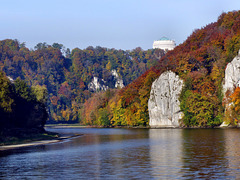
Kelheim - Befreiungshalle
| 06 Feb 2021 |
|
|
The "Befreiungshalle" ("Hall of Liberation") seen from the riverboat on the Danube.
The neoclassical monument above the town of Kelheim was built on the order of King Ludwig I of Bavaria to commemorate the victories against Napoleon during the Wars of Liberation that lasted from 1813 to 1815.
The ceremonial opening took place on 18 October 1863 – the 50th anniversary of the Völkerschlacht (Battle of Nations) near Leipzig.
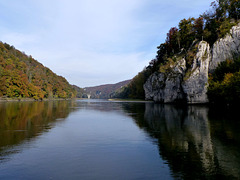
Weltenburger Enge
| 06 Feb 2021 |
|
|
"Weltenburger Enge" (aka "Donaudurchbruch bei Weltenburg" is the "Danube Gorge" near the Weltenburg Monastery. The gorge is enclosed on either side by rock faces up to 80 metres high. The Danube narrows by up to 110 metres and attains a depth of 20 metres.
The area was designated as a natural monument under King Ludwig I of Bavaria as early as 1840.
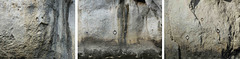
Weltenburger Enge
| 06 Feb 2021 |
|
"Weltenburger Enge" (aka "Donaudurchbruch bei Weltenburg" is the "Danube Gorge" near the Weltenburg Monastery. The gorge is enclosed on either side by rock faces up to 80 metres high. The Danube narrows by up to 110 metres and attains a depth of 20 metres.
The area was designated as a natural monument under King Ludwig I of Bavaria as early as 1840.
All along rivers existed towpaths, as up to the 19th century towing was the only way to move boats upstream. As towing was impossible within the "Weltenburger Narrowness" people used long spearlike rods with hooks and these iron rings to pull the boat upstream.
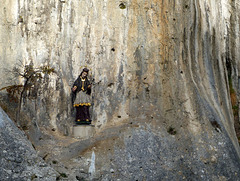
Weltenburger Enge
| 05 Feb 2021 |
|
|
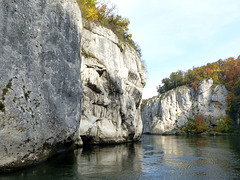
"Weltenburger Eng"e (aka "Donaudurchbruch bei Weltenburg" is the "Danube Gorge" near the Weltenburg Monastery. The gorge is enclosed on either side by rock faces up to 80 metres high. The Danube narrows by up to 110 metres and attains a depth of 20 metres.
The area was designated as a natural monument under King Ludwig I of Bavaria as early as 1840.
The sculpture of the patron saint "St. Nepomuk" is located in a niche of the cliff named "Lange Wand" (= long wall).
Weltenburger Enge
| 05 Feb 2021 |
|
|
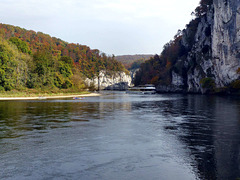
"Weltenburger Eng"e (aka "Donaudurchbruch bei Weltenburg" is the "Danube Gorge" near the Weltenburg Monastery. The gorge is enclosed on either side by rock faces up to 80 metres high. The Danube narrows by up to 110 metres and attains a depth of 20 metres.
The area was designated as a natural monument under King Ludwig I of Bavaria as early as 1840.
The "MS Gisela" offers a breathtaking trip through the gorge.
Weltenburger Enge
| 05 Feb 2021 |
|
|
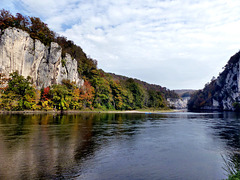
"Weltenburger Eng"e (aka "Donaudurchbruch bei Weltenburg" is the "Danube Gorge" near the Weltenburg Monastery. The gorge is enclosed on either side by rock faces up to 80 metres high. The Danube narrows by up to 110 metres and attains a depth of 20 metres.
The area was designated as a natural monument under King Ludwig I of Bavaria as early as 1840.
"MS Gisela" is approaching. The boat offers a breathtaking trip through the gorge.
Weltenburger Enge
| 05 Feb 2021 |
|
|
|
"Weltenburger Enge" (aka "Donaudurchbruch bei Weltenburg" is the "Danube Gorge" near the Weltenburg Monastery. The gorge is enclosed on either side by rock faces up to 80 metres high. The Danube narrows by up to 110 metres and attains a depth of 20 metres.
The area was designated as a natural monument under King Ludwig I of Bavaria as early as 1840. .
Straubing
| 08 Jan 2013 |
|
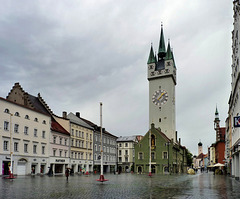
Pouring rain.in Straubing. Only very few people can be seen on the central square of the town, that is dominated by the Stadtturm (city-tower), the 68 meters high landmark of Straubing.
The central square in Straubing is 600 meters long. In 1812 young Prince Ludwig (later King Ludwig I of Bavaria) and his wife visited Straubing. Since then one side of the place is named "Ludwigsplatz", while the opposite side is "Theresienplatz".
Over centuries a watchman lived up on the tower. The last of the watchmen left the tower in 1930.
Jump to top
RSS feed- Martin M. Miles' latest photos with "Ludwig I of Bavaria" - Photos
- ipernity © 2007-2026
- Help & Contact
|
Club news
|
About ipernity
|
History |
ipernity Club & Prices |
Guide of good conduct
Donate | Group guidelines | Privacy policy | Terms of use | Statutes | In memoria -
Facebook
X
