
Martin M. Miles' photos with the keyword: Sanseverino
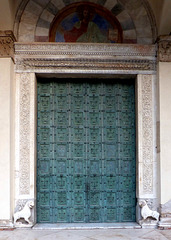
Salerno - Cattedrale di Salerno
| 25 Nov 2022 |
|
Salerno (pop. ~ 130.000) is located on the Gulf of Salerno on the Tyrrhenian Sea. The site has been one of the most important and strategic ports on the Mediterranean sea, yielding a rich Greco-Roman heritage. It was an independent Lombard principality in the early Middle Ages. The Normans in 1077 made Salerno the capital of their rule in all of southern Italy. In the 16th century, under the Sanseverino family, among the most powerful feudal lords in southern Italy, the city became a center of learning, culture, and the arts.
Salerno has been the seat of an archbishop since 983 and the city's medical school is famous for being the first college or "university" of medieval Europe.
The construction of the Cathedral was begun by Robert Guiscard in 1076. This was just three years after the Normans took over the city, which had previously been under Lombard rule for more than 400 years. The church, built on an early Christian church, that was built on the ruins of a Roman temple, was consecrated in 1084 and completed in 1085.
Due to the short construction time, cracks formed repeatedly in the building over the centuries. After severe damage from an earthquake in 1688, the cathedral was restored with baroque alterations. In the 20th century, attempts were made to reconstruct the original facade.
The bronze Door of the church was cast in Constantinople in 1099. It is made up of 54 panels mostly depicting Byzantine crosses. There is also the icon of two griffins drinking from a baptismal font. Although today the door has a greenish color typical of ancient bronze, it was once covered in gold and silver. Flanking the bronze door are prayers to St. Matthew in Armenian and Greek characters, and only recently deciphered.
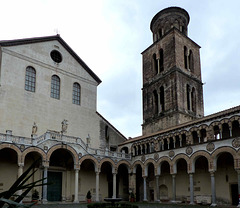
Salerno - Cattedrale di Salerno
| 25 Nov 2022 |
|
|
Salerno (pop. ~ 130.000) is located on the Gulf of Salerno on the Tyrrhenian Sea. The site has been one of the most important and strategic ports on the Mediterranean sea, yielding a rich Greco-Roman heritage. It was an independent Lombard principality in the early Middle Ages. The Normans in 1077 made Salerno the capital of their rule in all of southern Italy. In the 16th century, under the Sanseverino family, among the most powerful feudal lords in southern Italy, the city became a center of learning, culture, and the arts.
Salerno has been the seat of an archbishop since 983 and the city's medical school is famous for being the first college or "university" of medieval Europe.
The construction of the Cathedral was begun by Robert Guiscard in 1076. This was just three years after the Normans took over the city, which had previously been under Lombard rule for more than 400 years. The church, built on an early Christian church, that was built on the ruins of a Roman temple, was consecrated in 1084 and completed in 1085.
Due to the short construction time, cracks formed repeatedly in the building over the centuries. After severe damage from an earthquake in 1688, the cathedral was restored with baroque alterations. In the 20th century, attempts were made to reconstruct the original facade.
The monumental Arabo-Norman bell tower rises almost 52 meters in height. On a plaque is written that the builder was Guglielmo da Ravenna, Archbishop of Salerno from 1137 to 1152.
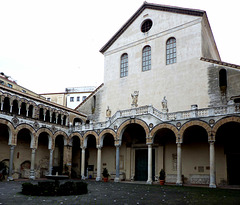
Salerno - Cattedrale di Salerno
| 25 Nov 2022 |
|
|
Salerno (pop. ~ 130.000) is located on the Gulf of Salerno on the Tyrrhenian Sea. The site has been one of the most important and strategic ports on the Mediterranean sea, yielding a rich Greco-Roman heritage. It was an independent Lombard principality in the early Middle Ages. The Normans in 1077 made Salerno the capital of their rule in all of southern Italy. In the 16th century, under the Sanseverino family, among the most powerful feudal lords in southern Italy, the city became a center of learning, culture, and the arts.
Salerno has been the seat of an archbishop since 983 and the city's medical school is famous for being the first college or "university" of medieval Europe.
The construction of the Cathedral was begun by Robert Guiscard in 1076. This was just three years after the Normans took over the city, which had previously been under Lombard rule for more than 400 years. The church, built on an early Christian church, that was built on the ruins of a Roman temple, was consecrated in 1084 and completed in 1085.
Due to the short construction time, cracks formed repeatedly in the building over the centuries. After severe damage from an earthquake in 1688, the cathedral was restored with baroque alterations. In the 20th century, attempts were made to reconstruct the original facade.
Salerno
| 25 Nov 2022 |
|
|
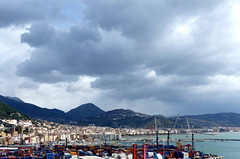
Salerno (pop. ~ 130.000) is located on the Gulf of Salerno on the Tyrrhenian Sea. The site has been one of the most important and strategic ports on the Mediterranean sea, yielding a rich Greco-Roman heritage. It was an independent Lombard principality in the early Middle Ages. The Normans in 1077 made Salerno the capital of their rule in all of southern Italy. In the 16th century, under the Sanseverino family, among the most powerful feudal lords in southern Italy, the city became a center of learning, culture, and the arts.
Even in ancient times, the port of Salerno was an important trading center. In the Middle Ages, there were trade relations with Sicily and North Africa; Salerno has been the seat of an archbishop since 983 and the city's medical school is famous for being the first college or "university" of medieval Europe. In modern times, the onset of industrialization brought about an upswing. The port's global container throughput continues to be significant.
Napoli - Gesù Nuovo
| 19 Nov 2020 |
|
Napoli is the regional capital of Campania and the third-largest city of Italy. Its metropolitan area has a population of more than 3 million.
Founded by Greek settlers before 900 BC, Napoli was an important part of Magna Graecia and played a major role in the merging of Greek and Roman society.
Following the decline of the Western Roman Empire Napoli was shortly ruled by the Ostrogoths. Byzantine troops captured the city in 536m but after the Byzantine exarchate Ravenna fell a Duchy of Naples was created. Over centuries the Duchy´s relations to Rome or Byzanz were hard-fought. In 836 Napoli could repel a siege of Lombard troops with the help of the Saracens, what did not prevent Muhammad I Abu 'l-Abbas in the 850s loot Napoli. In the 11th century, the Duchy hired Norman mercenaries and about 1140 it came under Norman control under Roger II, then King of Sicily.
In 1228 Emperor Frederick II founded the first university in Europe here, making Napoli the intellectual centre of the kingdom. The conflict between the House of Hohenstaufen and the Papacy led in 1266 to Pope Innocent IV crowning the Angevin duke Charles I King of Sicily. Charles officially moved the capital from Palermo to Napoli.
In 1282 after the "Sicilian Vespers", a successful rebellion on the island of Sicily against the rule of King Charles I, the Kingdom of Sicily was divided into two. The Angevin Kingdom of Naples included the southern part of the Italian peninsula, while the island of Sicily became the Aragonese Kingdom of Sicily.
By the 17th century, Naples had become Europe's second-largest city – second only to Paris – with around 250000 inhabitants.
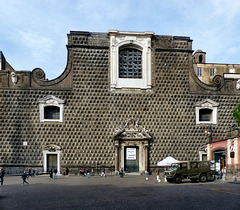
The Church of Gesù Nuovo was originally a palace built in 1470 for Roberto Sanseverino, Prince of Salerno. After the inquisition got introduced to Napoli political intrigues caused the property to be confiscated and eventually sold in the 1580s to the Jesuits to construct a church, that was constructed from 1584 to 1601. The new church retained the unusual facade, originally built for the palace, faced with rustic ashlar diamonds.
When in 1767 the Jesuits were expelled from Naples, the church passed to the Franciscan order.
There is an enigma around marks carved into the diamonds. These may be stonemasons marks, but it was and is also believed that there may be an alchemical or hermetic meaning behind the signs. After the large dome of the church collapsed completely twice, a popular superstition was that the palace or church was "cursed". Recently art historians published a thesis, that the signs on the facade are Aramaic letters.
Maybe Dan Brown can construct a conspiracy theory connecting it to the Holy Grail or suchlike.
Vence - Sanseverino
| 07 Jan 2020 |
|
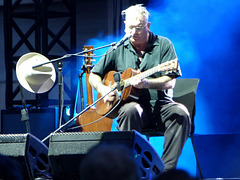
Since more than 20 years Vence hosts the festival "Nuits du Sud". Vence is a wonderful village in the hills between Nice and Antibes. The summernights there are warm and with the music they are really magic.
Sanseverino is a French singer-songwriter and as well a clown, who can really interact with the audience. His music, influenced by Django Reinhardt, is kind of "manouche", between Chanson and Jazz. The lyrics are hard to understand (for a tourist), but the French do and have fun. As he "significantly contributed to the enrichment of the French cultural inheritance" he was awarded the "Ordre des Arts et des Lettres".
Here is the sound:
www.youtube.com/watch?v=tVWl-9vl25Q
and here is the "manouch" side
www.youtube.com/watch?v=Wkkf-y9yYLA
Vence - Sanseverino
| 07 Jan 2020 |
|
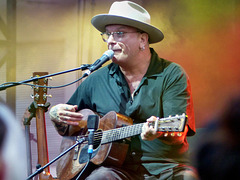
Since more than 20 years Vence hosts the festival "Nuits du Sud". Vence is a wonderful village in the hills between Nice and Antibes. The summernights there are warm and with the music they are really magic.
Sanseverino is a French singer-songwriter and as well a clown, who can really interact with the audience. His music, influenced by Django Reinhardt, is kind of "manouche", between Chanson and Jazz. The lyrics are hard to understand (for a tourist), but the French do and have fun. As he "significantly contributed to the enrichment of the French cultural inheritance" he was awarded the "Ordre des Arts et des Lettres".
Here is the sound:
www.youtube.com/watch?v=tVWl-9vl25Q
Jump to top
RSS feed- Martin M. Miles' latest photos with "Sanseverino" - Photos
- ipernity © 2007-2026
- Help & Contact
|
Club news
|
About ipernity
|
History |
ipernity Club & Prices |
Guide of good conduct
Donate | Group guidelines | Privacy policy | Terms of use | Statutes | In memoria -
Facebook
X
