

Martin M. Miles' photos with the keyword: walrus ivory

Paris - Musée de Cluny
| 08 Jan 2026 |
|
|
The Hôtel de Cluny was built in the late 15th century on the site of an older building constructed after the Abbey of Cluny acquired the ancient Roman baths in 1340.
The manor house was rebuilt under Jacques d’Amboise, Abbot Commander of Cluny (1485–1510). In the 18th century, the tower of the Hôtel de Cluny served as an observatory for the astronomers Joseph-Nicolas Delisle, Jérôme Lalande, and Charles Messier. During the French Revolution in 1789, the manor house was confiscated.
In 1832, the archaeologist and art collector Alexandre Du Sommerard acquired the Hôtel de Cluny and used it to display his extensive collection of medieval artifacts. After his death, the collection became the property of the French state. The building opened as a museum in 1843.
The museum underwent a complete renovation over three years and reopened in 2022.
Crozier
Walrus ivory, England (?), 1120-1130

Lille - Palais des Beaux-Arts
| 10 Sep 2025 |
|
|
The museum opened in 1809 in connection with the French Revolution, following the confiscation of works of art from noblemen and church property. A central warehouse for the Lille area was established in a former monastery building. The space was soon too small. When, after a move the space in the new town hall became insufficient, it was decided to build a new building in 1882. This building opened in 1892, but was closed in 1895 due to structural defects and reopened in 1998 with a renewed heating and ventilation system. During the First World War, the museum suffered significant damage. After the capture of Lille by German troops, certain works of art were stolen. In 1917 and 1918, parts of the collection were transported to Brussels. The museum was not reopened to the public until 1924, after extensive renovations. In 1991, the museum had to be closed due to urgent renovation work. In 1997, the museum reopened to the public. It now has 22,000 m² of space, of which 12,000 m² are available for exhibitions.
One of the
24 Elders of the Apocalypse
carved from walrus ivory.
Three other similar statues are preserved in Saint Omer, London and New York. They may have once adorned a reliquary in the Abby of St.Bertin.
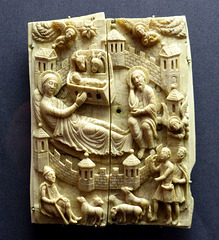
Cologne - Schnütgen Museum
| 30 May 2018 |
|
Cologne is the fourth-largest city in Germany - and one of the oldest. A Germanic tribe, the Ubii, had a settlement here, this was named by the Romans "Oppidum Ubiorum". In 50 AD, the Romans founded "Colonia Claudia Ara Agrippinensium", the city then became the provincial capital of "Germania Inferior".
A city with such a history has -of course- many museums. One is the "Museum Schnütgen", devoted to medieval art. In 1906, the collection of Alexander Schnütgen, a theologian and passionate art collector, was donated to the city.
Since 1956, the museum has occupied the Romanesque church of St. Cäcilien (1130-1160), that was once part of a monastery founded in 881. An annex was added in the 1950s, but even now only about 10% of all artefacts can be displayed as of course the collection has expanded since Schnütgen´s donation.
www.museum-schnuetgen.de/Info
The Nativity of Christ.
Carved from walfus ivory 1150/1160 in Cologne.
Jump to top
RSS feed- Martin M. Miles' latest photos with "walrus ivory" - Photos
- ipernity © 2007-2026
- Help & Contact
|
Club news
|
About ipernity
|
History |
ipernity Club & Prices |
Guide of good conduct
Donate | Group guidelines | Privacy policy | Terms of use | Statutes | In memoria -
Facebook
X
